High Horology on the Red Carpet and Beyond as Matt Damon Debuts the Rolex Land-Dweller Alongside Major Pieces from Jay-Z and David Beckham

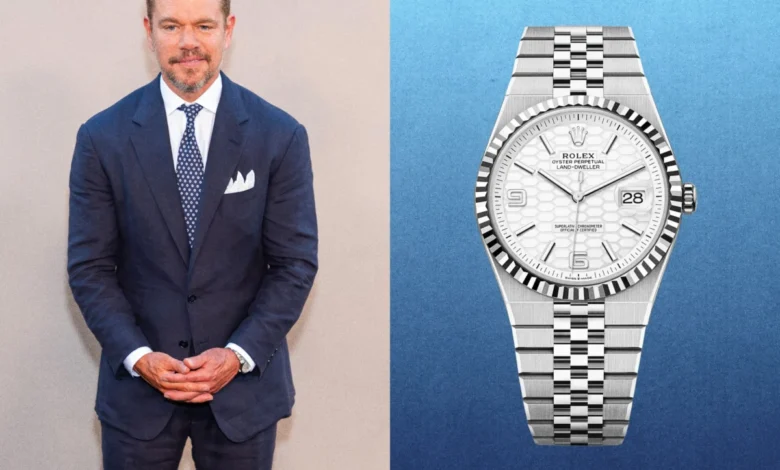
The intersection of high-profile cinema and luxury horology reached a new peak this week at the New York City premiere of Christopher Nolan’s latest epic, The Odyssey. While the film’s narrative follows the grueling decade-long journey of the Greek hero Odysseus across the Mediterranean, the red carpet focused on a different kind of endurance: the lasting appeal of the Rolex Land-Dweller. Leading man Matt Damon, who portrays the titular wanderer, appeared at the event wearing the Rolex Land-Dweller reference 127334. The choice was not merely a stylistic one; it signaled the continued dominance of a model that has redefined Rolex’s position in the luxury-sports watch market since its debut at Watches and Wonders 2025.
The Land-Dweller represents a significant pivot for the Geneva-based manufacture. While the brand has long been defined by its professional "tool" watches—the Submariner for divers, the GMT-Master for pilots, and the Daytona for racers—the Land-Dweller occupies a space that bridges the gap between rugged utility and high-fashion integrated design. Damon’s reference 127334, crafted from Oystersteel and white gold, features a 40mm case that balances modern presence with classical proportions. The watch’s design DNA is a sophisticated homage to the reference 5100 "Texano," a quartz-powered anomaly from 1970 that preceded the integrated bracelet craze later popularized by the Audemars Piguet Royal Oak and Patek Philippe Nautilus.
Technical Innovation and Design Heritage
The Land-Dweller’s emergence in the mid-2020s was initially met with intense speculation regarding its movement. Rolex utilized this collection to introduce a fresh architectural approach to its calibers, blending the traditional lever escapement with high-efficiency direct-impulse designs. This movement technology ensures a power reserve and precision that exceed the already stringent Superlative Chronometer standards. The aesthetic elements of the watch—specifically the honeycomb dial and the flat Jubilee bracelet—serve as a curated retrospective of Rolex’s most celebrated design cues from the 1970s and 80s.

Industry analysts have noted that the Land-Dweller’s price point of $16,450 for the steel and white gold variant positions it aggressively against competitors. In a market where time-only luxury sports watches from rival houses often command prices exceeding $30,000, the Land-Dweller offers a combination of heritage and technical prowess that is difficult to overlook. The "Rolesor" construction—Rolex’s term for the combination of gold and steel—adds a layer of formality to the piece, making it a fitting choice for Damon’s appearance at a high-stakes film premiere.
The irony of Damon wearing a "Land-Dweller" to promote a film about a man lost at sea for ten years was not lost on horological enthusiasts. While a Sea-Dweller or a Submariner might have offered a more literal connection to the plot of The Odyssey, the Land-Dweller serves as a symbolic nod to the character’s ultimate goal: the return to the solid ground of Ithaca. It is a watch that celebrates the homecoming, a central theme in Nolan’s adaptation of the Homeric epic.
Will Ferrell and the Return to Vintage Hand-Wound Classics
While Matt Damon showcased the cutting edge of modern Rolex production, actor Will Ferrell opted for a more understated, vintage approach at the premiere of his new series, The Hawk. Ferrell was spotted wearing a Rolex Oysterdate Precision, likely a reference 6694. This choice is notable for its departure from current trends favoring oversized, automatic timepieces. The Oysterdate Precision is powered by a manual-wind caliber, a feature that requires the wearer to engage with the mechanical heart of the watch daily—a ritual that many modern collectors find increasingly appealing.
The reference 6694 was a staple of the Rolex catalog for nearly three decades, characterized by its 34mm case size and Oyster bracelet. In an era where 40mm to 44mm cases have become the standard, Ferrell’s choice of a 34mm watch highlights a growing movement toward "neo-vintage" pieces that favor discretion over bravado. The manual-wind movement, while anachronistic in a world of smartwatches and high-frequency automatics, represents a link to a period of horology where reliability was measured by the simplicity of the engineering. Ferrell’s piece, featuring a clean dial and the iconic cyclops lens over the date, proves that vintage Rolex remains a versatile and sophisticated option for the modern red carpet.

David Beckham and Tudor’s Centennial Flagship
The horological spotlight also fell on Dallas Stadium this week, where David Beckham attended the high-stakes semi-final match between France and Spain. As a longtime ambassador for Tudor, Beckham’s wristwear is always a subject of scrutiny, but his choice for the match was particularly significant. He wore the Tudor Monarch, the brand’s latest flagship model released to commemorate Tudor’s 100th anniversary.
The Monarch is a radical departure from the vintage-inspired Black Bay and Pelagos lines that have defined Tudor for the last decade. Housed in a 39mm faceted stainless steel case, the watch introduces a new design language for the brand. The standout feature is the "California" dial—a layout that utilizes a mix of Roman and Arabic numerals. Historically, this configuration was designed to provide maximum legibility and prevent the wearer from misreading the orientation of the watch in low-light or high-stress environments.
Technically, the Monarch is a powerhouse. It is powered by the METAS-certified Manufacture Calibre MT5662-2U. The METAS certification is one of the most rigorous in the industry, requiring the watch to maintain precision under magnetic fields of 15,000 gauss and ensuring water resistance and power reserve meet exacting standards. By choosing the Monarch, Beckham highlighted Tudor’s evolution from "Rolex’s younger brother" to a manufacture capable of producing world-class, original designs that stand on their own merit.
The Platinum Standard: Tom Holland’s Cosmograph Daytona
In New York City, Tom Holland continued his streak of high-end horological choices, appearing with his preferred Rolex Cosmograph Daytona reference 126506-0002. This specific reference is the pinnacle of the Daytona line, crafted entirely from 950 platinum. It is distinguished by its ice-blue dial—a color Rolex reserves exclusively for its platinum models—and 11 diamond-set indices.

The platinum Daytona is a study in "stealth wealth." To the untrained eye, it might resemble a standard stainless steel watch, but the weight of the platinum and the unique hue of the dial signal its status to those in the know. The reference 126506 also features a ceramic Cerachrom bezel and, notably for Rolex, a transparent sapphire caseback that allows a view of the meticulously finished caliber 4131. Holland’s frequent choice of this piece suggests a preference for watches that combine iconic sports watch history with the absolute highest level of material luxury.
Jay-Z and the $5 Million Sultan Qaboos Daytona
Perhaps the most extraordinary horological sighting of the month occurred at Yankee Stadium during the 30th-anniversary celebration of Jay-Z’s seminal album, Reasonable Doubt. The rap mogul and renowned watch collector wore a Rolex Cosmograph Daytona reference 6270, a watch of such rarity that it exists in only eight known examples.
The reference 6270 was originally commissioned in the 1980s for Sultan Qaboos bin Said of Oman. It is a masterpiece of gem-setting, featuring a yellow gold case, a bezel set with 28 baguette-cut diamonds, and a "snow-set" pavé dial. The indices are crafted from sapphires, and the sub-dials (totalizers) are finished in a contrasting deep blue. This specific model gained international headlines recently when a similar example sold at auction for approximately $5.2 million.
Jay-Z’s choice of the 6270 for the Reasonable Doubt anniversary is a powerful statement of his cultural and financial stature. The album, which laid the foundation for his career in 1996, was celebrated with a watch that represents the absolute zenith of vintage collecting. The presence of the "Omani Khanjar" or the specific Sultanate provenance often associated with these pieces makes them some of the most sought-after objects in the world of high-stakes auctions.

Market Implications and the Future of Integrated Design
The diverse array of watches seen on celebrities this week reflects a broader trend in the global watch market. The success of the Rolex Land-Dweller suggests that the appetite for integrated-bracelet sports watches remains insatiable, even as brands look back to their archives for inspiration. The move by Rolex to revisit the "Texano" aesthetic indicates a willingness to experiment with shapes and textures—such as the honeycomb dial—that were once considered too avant-garde for the brand’s conservative reputation.
Furthermore, the contrast between Holland’s modern platinum Daytona and Ferrell’s vintage Oysterdate shows a bifurcated market. On one hand, there is a push toward ultra-luxury materials and "hyper-watches"; on the other, there is a renewed appreciation for the mechanical simplicity and smaller proportions of the mid-20th century.
The Tudor Monarch’s debut also suggests that the industry is moving toward higher standards of certification. As METAS becomes more prevalent, consumers are beginning to expect a level of transparency regarding a watch’s performance that was previously reserved for a small niche of enthusiasts.
As the summer of 2026 progresses, the influence of these high-profile appearances will likely be felt at authorized dealers and auction houses worldwide. Whether it is the technical innovation of Matt Damon’s Land-Dweller or the historical weight of Jay-Z’s Sultan Qaboos Daytona, the message is clear: the wristwatch remains the ultimate vessel for storytelling, personal expression, and the celebration of enduring legacy.