Canada and France Forge Strategic Alliance to Counter Economic Volatility and Enhance Global Security

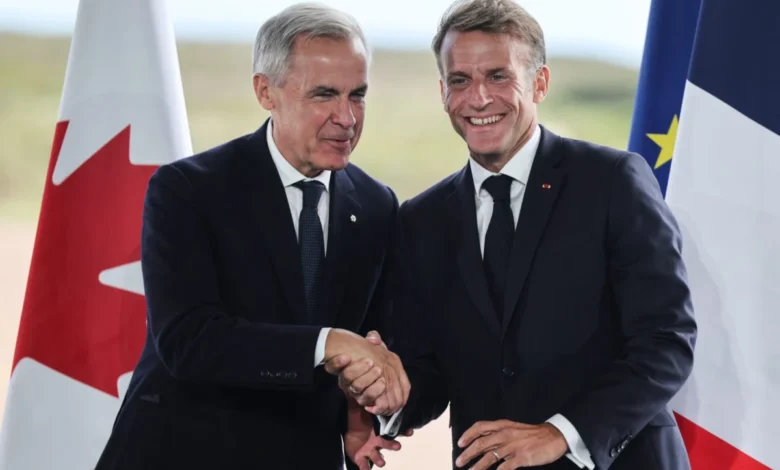
In a significant realignment of North Atlantic geopolitical priorities, Canadian Prime Minister Mark Carney and French President Emmanuel Macron met on Sunday in the French territory of Saint-Pierre-et-Miquelon to finalize a comprehensive partnership. This agreement signals a deliberate shift in Canadian foreign policy, moving away from a long-standing, singular dependence on the United States toward a more diversified network of European economic and security ties. As global markets react to the ongoing volatility in the Middle East—specifically the conflict involving Iran—and the unpredictable nature of U.S. trade policy, the meeting between Carney and Macron serves as a structural hedge against future instability.
The bilateral discussions, held against the backdrop of the North Atlantic, focused on integrating capabilities in aerospace, defense infrastructure, energy security, and advanced technology. By pooling resources, the two nations aim to create a "resilience corridor" that spans the Atlantic, insulating their respective domestic economies from the shocks of protectionist trade agendas and regional conflicts.
A Diplomatic Pivot: From North American Integration to Atlantic Cooperation
The meeting in Saint-Pierre-et-Miquelon represents the culmination of a weeks-long strategy articulated by Prime Minister Carney. Following recent tensions with the Washington administration—characterized by the implementation of aggressive tariffs and rhetoric regarding the annexation or integration of Canadian territory—Ottawa has sought a proactive "Plan B."
Carney’s recent public overtures regarding the possibility of Canada seeking associate membership within the European Union have sent ripples through international diplomatic circles. By positioning Canada as a bridge between the North American continent and the European Union, Carney argues that Canada can reclaim its sovereignty in the face of what he describes as "economic coercion."
"Canada and Europe will build an alliance for the future that will strengthen our collective resilience so we can live our lives as we choose based on the values that we share," Carney stated during the joint press conference. This rhetoric marks a departure from traditional Canadian foreign policy, which has historically prioritized the maintenance of a seamless economic relationship with its southern neighbor above all else.
Chronology of Escalating Tensions
The necessity for this new alliance is rooted in a series of events that have strained the Canada-U.S. relationship over the past year:
- Q1-Q2: The U.S. administration introduces a new round of sweeping tariffs on Canadian steel, aluminum, and softwood lumber, citing national security concerns.
- Q3: Washington begins to articulate, both formally and through media surrogates, the concept of "administrative integration," leading to widespread public alarm in Canada.
- Late Q3: Prime Minister Carney delivers a keynote address to the Canadian Parliament, publicly embracing the prospect of EU associate membership as a vital safeguard.
- Early Q4: Following reports of the Iranian conflict disrupting energy supply chains, President Macron initiates urgent consultations with G7 partners, leading to the Saint-Pierre-et-Miquelon summit.
Strategic Synergy: Space, Defense, and Energy
The core of the Sunday agreement rests on the practical integration of infrastructure. Carney and Macron have directed their respective defense ministries and national space agencies to develop a shared framework for launch systems and ground-based satellite reception facilities.
Aerospace and Defense
The move toward shared space infrastructure is designed to reduce reliance on third-party providers, ensuring that both nations maintain secure communications and surveillance capabilities. For Canada, this means leveraging France’s advanced aerospace footprint to bolster its own Arctic monitoring—a region that has become a flashpoint for international competition.
Energy Security and Critical Minerals
France, currently facing an acute need to replace energy imports disrupted by the war in Iran, views Canada as a primary alternative supplier. Macron’s interest is clear: Canada possesses the largest reserves of uranium and significant deposits of rare earth elements, both of which are essential for France’s nuclear energy sector and its defense manufacturing capabilities.
"Canada is a country with significant resources of critical minerals and rare earths. It is also a major oil and natural gas producer," Macron noted. "What we want to do is conclude agreements to secure more liquefied natural gas (LNG) that can be shipped to Europe’s Atlantic coast."
Economic Implications and Global Context
The partnership is not merely a military or diplomatic gesture; it is an economic necessity. By aligning its regulatory frameworks more closely with the EU, Canada hopes to lower barriers for its technology firms in sectors such as quantum computing and supercomputing.
Analysts suggest that this move is a strategic response to the "Greenland Deal"—a recent agreement between the U.S. and Denmark that allows for an increased U.S. military presence on the island. While Macron publicly welcomed the deal as a success for international law and Danish sovereignty, behind the scenes, European leaders remain wary of the U.S. expanding its footprint in the North Atlantic without deeper consultation with its NATO allies.
Broader Impact and Future Outlook
The implications of the Carney-Macron summit extend far beyond the immediate exchange of technology and energy. By fostering this closer link, Canada is effectively attempting to redefine its role in the global order. For decades, Canada was viewed primarily through the lens of its relationship with the U.S. If this new trajectory holds, Canada will increasingly be seen as an independent power center, acting in concert with the European bloc.
However, the path forward is not without challenges. Integrating defense and economic infrastructure between two nations separated by an ocean requires significant capital investment and political stamina. Furthermore, it remains to be seen how the U.S. government will respond to what is essentially a move toward Canadian "strategic autonomy."
Economists point out that the success of this initiative will depend on the speed of implementation. The energy sector, in particular, requires large-scale LNG infrastructure—terminals that are currently in short supply on the Canadian Atlantic coast. If the joint effort can streamline the regulatory and engineering processes for these facilities, it could provide a stable, long-term supply chain for Europe by 2026.
Conclusion: A New Atlanticism
As the global geopolitical environment continues to fracture, the meeting in Saint-Pierre-et-Miquelon marks a definitive end to the post-Cold War consensus. Canada’s pivot toward France—and by extension, the EU—reflects a world where traditional alliances are no longer viewed as permanent, and where national resilience is increasingly defined by the ability to diversify one’s economic and security partners.
The coming months will likely see further bilateral meetings, with technical working groups expected to meet in Ottawa and Paris to flesh out the details of the space and energy sharing agreements. For both Carney and Macron, the objective is clear: to ensure that regardless of the political winds in Washington, their nations remain secure, prosperous, and tethered to a stable, rules-based international system.
The cooperation agreed upon this weekend may well serve as a blueprint for other nations seeking to navigate the increasingly complex intersection of trade, security, and global energy dependencies. Whether this "Atlantic Alliance" can withstand the pressures of shifting international loyalties remains the central question for the decade to come.
Related posts: