The Inevitable Intersection of Aging and Athletics: How Weekend Warriors Can Outsmart the Clock

As the global population of active adults continues to age, a pervasive physiological reality is coming to light for millions of recreational athletes worldwide: the abrupt transition from invulnerability to vulnerability in sports performance. For decades, active individuals can subject their bodies to rigorous physical challenges—ranging from competitive soccer matches and marathons to obstacle course races and high-intensity functional fitness—with minimal consequence. However, clinical data and sports medicine specialists indicate that a critical inflection point typically occurs between the ages of 35 and 40. During this window, cumulative physiological changes, combined with modern sedentary work habits, significantly alter the body’s capacity to withstand high-impact physical stress.
This growing phenomenon highlights a broader public health and sports science challenge. While participation in adult recreational sports leagues and endurance events is at an all-time high, the medical infrastructure supporting these athletes often lags behind. Understanding the underlying mechanisms of age-related sports injuries, recognizing the critical risk factors, and implementing evidence-based prevention strategies have become essential for anyone looking to maintain a lifelong commitment to physical fitness.
The Physiology of Aging Connective Tissue
To comprehend why sports injuries surge during a person’s late thirties and forties, one must examine the fundamental biological shifts occurring within aging musculoskeletal systems. Dr. Brian Forsythe, a prominent sports medicine surgeon and associate professor at Rush University Medical Center, as well as the head orthopedic officer for Major League Soccer’s Chicago Fire FC, notes that soft-tissue injuries become markedly more frequent with age.
As individuals progress past their mid-thirties, skeletal muscle naturally begins to lose both overall mass and elasticity—a process medically recognized as sarcopenia, though its early stages often manifest as subtle losses in power and recovery efficiency. Tendons and ligaments concurrently experience a reduction in collagen turnover and blood supply, rendering them less resilient to sudden tensile forces, rapid decelerations, and multi-planar movements.
Compounding these intrinsic biological changes are lifestyle factors unique to modern adulthood. The vast majority of recreational athletes spend forty or more hours per week in sedentary desk jobs. This chronic lack of movement induces muscular imbalances, postural deviations, and neural deconditioning. When these individuals attempt to transition immediately from a week of minimal physical activity to high-intensity weekend sports—such as competitive soccer, basketball, or long-distance running—the musculoskeletal system experiences severe mechanical shock. Sports medicine physicians frequently categorize this exact dynamic as the primary catalyst for the cascading injuries that routinely sideline thirty- and forty-something athletes.
A Chronology of Cumulative Vulnerability
The typical trajectory of adult athletic decline often follows a distinct chronological pattern, frequently described by healthcare professionals as a cascade of overlapping overuse and acute trauma injuries.
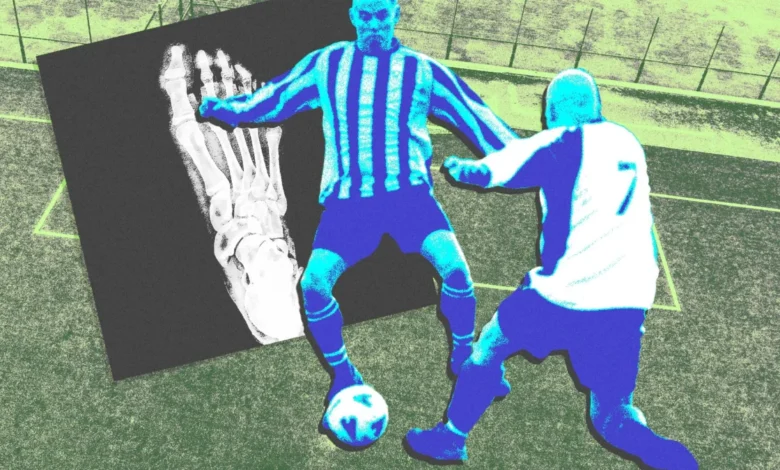
In the initial phase, typically between ages 35 and 38, subtle warning signs emerge. Athletes who previously recovered from intense sessions overnight begin to experience persistent morning stiffness or lingering joint discomfort. Because these early signals are frequently ignored, they often progress into stress fractures—such as metatarsal stress fractures in the foot—brought on by cumulative bone fatigue and inadequate remodeling cycles.
As the athlete returns to activity following periods of immobilization (such as wearing a medical boot for months), compensatory movement patterns develop. These secondary imbalances frequently precipitate acute muscle strains or tears during routine athletic maneuvers, such as sprinting, pivoting, or jumping. Hamstring strains, calf tears, and debilitating cases of shin splints commonly occur in rapid succession during this second phase.
Without targeted intervention, this sequence can trap an athlete in a frustrating cycle of reinjury. Dr. James B. Chen, an orthopedic surgeon at the DISC Sports and Spine Center, emphasizes that returning to sport prematurely is one of the most common pitfalls observed in clinical practice. When an athlete attempts to bypass the necessary biological tissue-healing phases following a minor strain, the weakened structure is highly susceptible to severe tearing, effectively extending recovery timelines from weeks to many months.
Quantitative Risk Factors: Weight, Mechanics, and Recovery
Clinical research underscores several quantifiable factors that dictate an aging athlete’s vulnerability to injury. Foremost among these is body mass index (BMI) and its direct relationship with joint load.
According to orthopedic biomechanics data referenced by clinical specialists, the physical forces exerted across major joints—particularly the knees and hips—are magnified exponentially by even modest increases in body weight. During dynamic activities like running or cutting, the force experienced across the patellofemoral joint can reach up to six times an individual’s total body weight. Consequently, when an adult carries excess weight accumulated through professional lifestyle shifts, the repetitive mechanical stress placed on articular cartilage and connective tissues increases dramatically, accelerating degenerative wear and tear.
Furthermore, systemic recovery metrics decline steadily with age. Protein synthesis rates slow down, and the physiological clearance of metabolic waste products from muscle tissue becomes less efficient. External lifestyle variables, including alcohol consumption and fragmented sleep patterns, further impair the body’s endogenous repair mechanisms. Clinical data shows that insufficient sleep drastically reduces growth hormone release during deep sleep cycles, directly inhibiting the cellular repair required to maintain robust tendons and ligaments.
Expert-Backed Strategies for Injury Prevention
Medical professionals and sports scientists agree that while the biological aging process cannot be halted, its adverse effects on athletic performance can be aggressively mitigated. To safely prolong an athletic career into one’s forties, fifties, and beyond, experts recommend a structured framework centered on five foundational pillars.
-
Mitigate Sedentary Behavior During the Week
To bridge the gap between weekday inactivity and weekend athletic intensity, individuals must introduce regular, low-intensity movement throughout the work week. Maintaining baseline cardiovascular conditioning and daily mobility work prevents the nervous system and supporting musculature from experiencing sudden shock during high-intensity weekend games. -
Optimize Body Composition and Manage Joint Load
Returning to or maintaining a healthy, functional body weight is vital for reducing mechanical torque on joints. Lowering overall body mass directly decreases the exponential forces experienced by weight-bearing joints during impact sports, thereby lowering the incidence of chronic tendinopathies and joint degradation. -
Sport-Specific Neuromuscular Training
General endurance activities, such as steady-state jogging, fail to prepare connective tissues for the multi-directional forces demanded by sports like soccer, tennis, or basketball. Athletes must incorporate sport-specific movement patterns into their training regimens, including structured agility drills, rapid acceleration and deceleration exercises, and multi-planar stability work. -
Implement Standardized Warm-Up Protocols
Pre-activity preparation is non-negotiable for mature athletes. Comprehensive warm-up routines, such as the internationally recognized FIFA 11+ program designed specifically for injury prevention, have been shown in clinical studies to reduce severe soccer injuries by up to one-third when performed consistently multiple times per week. These routines systematically combine running drills with strength, balance, and eccentric hamstring loading exercises. Crucially, static stretching should be reserved for post-activity recovery, as aggressive pre-game stretching can impair muscle tendon function and increase vulnerability to strains. -
Prioritize Structured Recovery and Listen to Physiological Feedback
Mature athletes must redefine their relationship with rest. Recognizing that connective tissue requires significantly more recovery time than the cardiovascular system is essential. Respecting acute fatigue, adhering strictly to graduated return-to-play protocols following minor strains, and utilizing sleep and nutrition as primary recovery tools allow athletes to sustain high performance levels while safeguarding long-term musculoskeletal health.
Broader Implications for Recreational Sports and Public Health
The rising prevalence of sports injuries among adults aged 35 and older carries notable implications for public health systems, sports organizations, and community athletic leagues. As societies place a greater emphasis on active aging and preventative healthcare, maintaining the physical autonomy of adults through sports participation yields substantial psychological and physiological benefits.
However, sports medicine infrastructure must adapt to support this demographic. Community clubs, local fitness facilities, and healthcare providers must shift their educational focus away from youth-centric training paradigms and toward adult-specific injury prevention. By acknowledging that aging athletes require specialized conditioning, appropriate recovery intervals, and structured biomechanical screening, the medical and athletic communities can successfully empower individuals to remain active, competitive, and injury-free well into later life.