From the First Feline Astronaut to the Celestial Cat’s Head Nebula: A Journey Through Space Exploration History

In space, nobody can hear you scream, or meow, for that matter, a reality that spans from the historical milestones of the early space race to the modern, breathtaking observations of the cosmos provided by our most advanced telescopes. While the vast emptiness of the vacuum ensures silence, the visual legacy of feline exploration—both terrestrial and astronomical—remains a compelling chapter in our understanding of the universe. This dual narrative, connecting the singular achievement of Félicette, the world’s first feline astronaut, with the cosmic majesty of the Cat’s Head Nebula, highlights the intersection of biological history and stellar evolution.
The Pioneering Flight of Félicette
The history of animal spaceflight is often dominated by primates and canines, yet the contribution of a small, stray Parisian tuxedo cat named Félicette stands as a unique, often overlooked milestone. In the early 1960s, the French space program, Centre d’Enseignement et de Recherches de Médecine Aéronautique (CERMA), embarked on a project to study the physiological effects of microgravity on feline subjects.
In October 1963, Félicette was launched aboard a Veronique AG1 rocket from the Hammaguir launch site in the Algerian Sahara. The flight reached an altitude of approximately 157 kilometers (97 miles), technically crossing the Kármán line into space. During this suborbital mission, Félicette experienced several minutes of weightlessness. Her brain activity was monitored via implanted electrodes, providing researchers with unprecedented data on how the feline vestibular system adjusted to the rigors of spaceflight.
The mission was a success, with the capsule parachuting safely back to Earth. Félicette was recovered unharmed, providing the scientific community with vital data that would influence future manned space flight safety protocols. Despite her contribution, she remained largely absent from public consciousness for decades, until a crowdfunding campaign led to the installation of a bronze statue in her honor at the International Space University in Strasbourg, France, in 2020. This memorial serves as a permanent testament to her role in the advancement of aerospace medicine.
The Celestial Cat’s Head Nebula
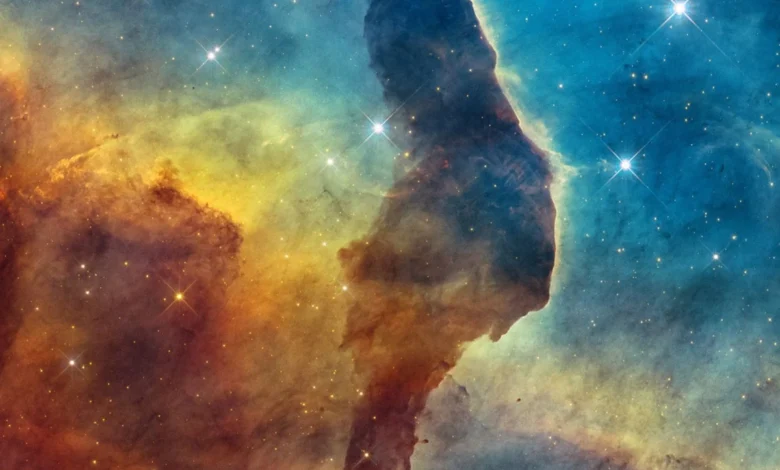
While Félicette represents the history of biological exploration, the Cat’s Head Nebula—officially cataloged as NGC 6334—represents the grand scale of stellar birth. Located approximately 7,500 light-years away in the constellation Scorpius, this region is a massive star-forming complex. The moniker "Cat’s Head" is derived from the distinct, whimsical shape captured in recent composite imaging from the Hubble Space Telescope and the James Webb Space Telescope (JWST).
The nebula is a sprawling cloud of gas and dust that acts as a stellar nursery. Within its structure, the forces of gravity are actively collapsing pockets of molecular hydrogen to ignite the fusion processes that create new stars. The "feline" appearance, characterized by a column of gas that resembles a cat’s ears and a singular glowing "eye," is the result of ionized radiation and stellar winds interacting with the surrounding interstellar medium.
The "eye" of the cat is particularly significant to astrophysicists. It is a massive, young star buried deep within the dust, emitting intense ultraviolet light that sculpts the surrounding nebula. By analyzing this region, researchers can observe the life cycle of stars in real-time, witnessing how these celestial bodies clear away their natal cocoons and alter the chemical composition of their galactic neighborhood.
Comparative Chronology of Space Observation
The journey from the 1963 suborbital flight to the high-resolution imaging of the JWST marks a transformative era in human technology. The following timeline outlines the progression of these efforts:
- 1947: The first animals (fruit flies) are launched into space by the United States to test radiation exposure.
- 1957: The Soviet Union launches Laika the dog, the first living creature to orbit the Earth.
- 1963: Félicette becomes the first and only cat to travel to space, marking a significant success for French aerospace research.
- 1990: The Hubble Space Telescope is deployed, providing humanity with its first clear, consistent look at distant nebulae.
- 2021: The James Webb Space Telescope launches, utilizing infrared technology to peer through the thick dust clouds of regions like the Cat’s Head Nebula, which were previously opaque to visible-light telescopes.
Analytical Implications: From Biology to Physics
The scientific importance of studying these two disparate subjects is profound. Félicette’s flight allowed scientists to understand the neurological and physical stress of space travel on complex mammals. This was a prerequisite for the eventual success of the Apollo missions and the long-term habitation of the International Space Station (ISS). The physiological data gathered from the feline study helped refine life-support systems, ensuring that mammals could survive the transition from gravity to weightlessness.
Conversely, the study of the Cat’s Head Nebula provides data on the "physics of creation." Astronomers are particularly interested in the feedback mechanisms between newborn stars and their parent clouds. When a star like the one forming the "eye" of the Cat’s Head Nebula ignites, it releases powerful stellar winds. These winds can either trigger further star formation in neighboring gas pockets—a process known as stimulated star formation—or disperse the gas, effectively ending the birth of stars in that region. Understanding this balance is key to modeling the evolution of entire galaxies.
Perspectives from the Scientific Community
Space agencies, including the European Space Agency (ESA) and NASA, have frequently highlighted the Cat’s Head Nebula as a prime example of the power of multi-wavelength astronomy. By combining Hubble’s visible-light data with Webb’s infrared capabilities, scientists can "see through" the thick curtains of dust that define the nebula’s shape.
"These images are not merely aesthetic; they are analytical," notes one project researcher familiar with the recent data releases. "By overlaying the data from different spectral ranges, we are able to map the temperature, density, and chemical makeup of the gas clouds. We are seeing the raw materials of planetary systems being forged in a crucible of radiation and gravity."
Regarding the historical aspect, historians of science note that the story of Félicette is indicative of a broader shift in how society views the ethics of animal testing in space. While her flight was deemed a necessity for national security and scientific progress in the 1960s, modern space agencies have largely pivoted toward automated, non-invasive observation and robotic explorers, reducing the need for live animal subjects in high-risk missions.
Broader Impact and Future Exploration
The narrative of the Cat’s Head Nebula and the legacy of Félicette serve as a reminder of the two distinct ways humanity engages with the cosmos: through the direct, albeit limited, physical exploration of space and through the indirect, infinite reach of our telescopic lenses.
As we look toward the future of exploration, the focus remains on pushing these boundaries further. Missions such as the Artemis program aim to return humans to the lunar surface, while the ongoing operation of the JWST continues to peel back the layers of the early universe. The Cat’s Head Nebula, with its vibrant colors and complex structures, serves as a beacon for what lies ahead. It is a reminder that the universe is not just a cold, silent vacuum, but a dynamic, evolving environment filled with the very processes that led to the formation of our own solar system.
In conclusion, while Félicette’s journey was a short, 13-minute excursion that lasted only a moment in the scale of cosmic time, it established a precedent for biological endurance in the void. Meanwhile, the Cat’s Head Nebula stands as a monument to the massive, slow-motion processes that occur over millions of years. Both subjects, despite their vast differences in scale and origin, invite us to look upward with curiosity, bridging the gap between the terrestrial history of our species and the celestial mysteries of the infinite. Whether through the eyes of a pioneer cat or the lens of a billion-dollar telescope, the act of observation remains our most powerful tool for understanding our place within the vast, silent, and awe-inspiring expanse of space.
Related posts: