Virginia Lawmaker Demands Investigation After Deceased Family Pet Receives Official State Voting Rights Restoration Certificate


Virginia State Delegate Tom Garrett has formally requested an independent investigation into the executive branch’s administrative procedures following a bizarre bureaucratic error in which an official state rights-restoration certificate was issued to a deceased beagle-hound mix named Biscuit. The dog, who belonged to a Goochland County resident, died approximately five years ago, yet somehow wound up cleared by the administration of Governor Abigail Spanberger as a former felon eligible to have her voting and jury-service rights reinstated.
The incident has ignited a fierce political firestorm across the Commonwealth, emerging just days before voters head to the polls to decide a high-stakes, constitutional ballot measure that would enshrine automatic voting-rights restoration for released felons into state law. With concerns mounting over data integrity, executive oversite, and government transparency, state officials face intense scrutiny over the robustness of the vetting systems governing the restoration of civic privileges.

Anatomy of an Administrative Blunder
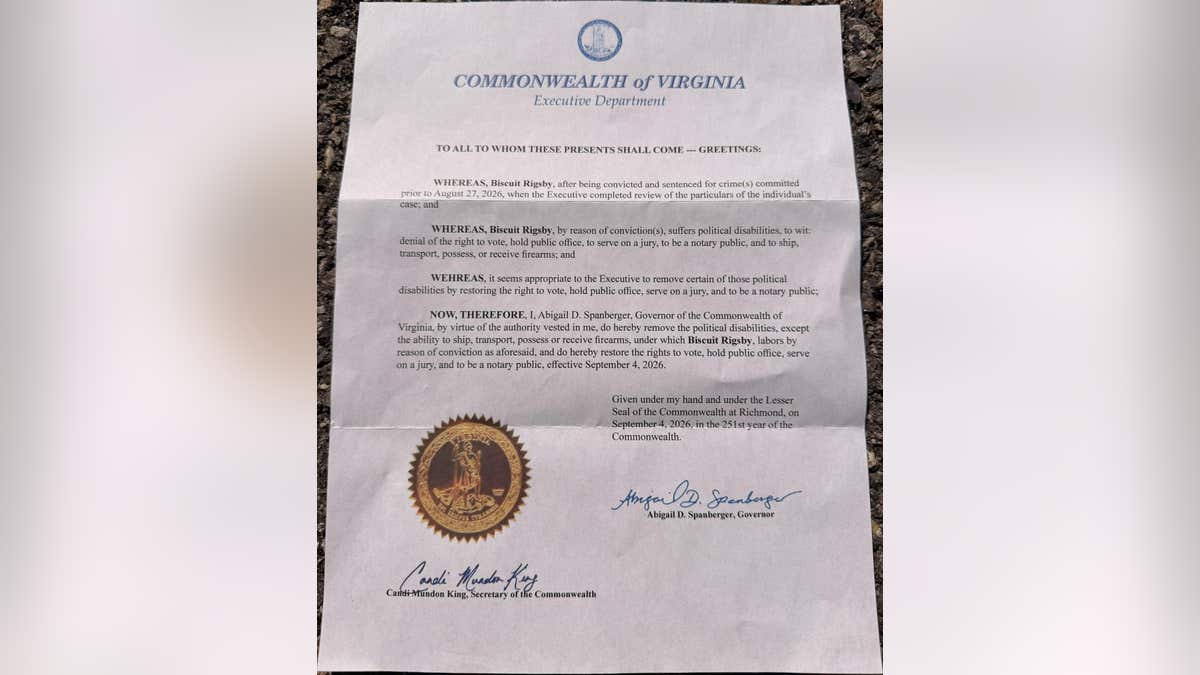
The controversy came to light when a Southside Virginia constituent contacted Delegate Garrett, a Republican representing Buckingham County who also practices law in Fluvanna County, to share the bizarre official document. The certificate, bearing the formal signature of the Governor, explicitly stated that the executive office had carefully reviewed the particulars of "Biscuit Rigsby’s" criminal case and determined that her civil rights should be restored.
Upon receiving the documentation, Garrett verified its authenticity and alerted the public, prompting widespread disbelief and sharp criticism from political observers. The dog’s owner, who has chosen to remain anonymous to protect themselves from potential political retaliation, confirmed the animal’s passing half a decade ago and wryly noted to investigators that the pet was a "good dog and is greatly missed."
"To my knowledge, she was never convicted of a felony, nor did she ever show any interest in voting," the owner remarked. Furthermore, the owner confirmed that Biscuit had never been impounded or subjected to any local government interactions that could have erroneously placed her into a criminal database or administrative pipeline managed by state authorities in Richmond.
While the owner noted that an immediate relative is currently incarcerated, legal experts and state officials agree that this familial connection is entirely irrelevant, given that the administration’s active restoration initiatives target individuals who have completed their sentences rather than incarcerated persons—let alone domesticated animals.
A Growing Pattern of Vetting Discrepancies
The revelation regarding Biscuit the beagle is not an isolated incident; it arrives directly on the heels of another embarrassing administrative blunder in Chesapeake, Virginia. Known locally as the "Betty No Last Name" controversy, that earlier case involved an official state document purporting to restore the civil rights of a convict who seemingly possessed no surname.
Together, these episodes have cast a harsh light on the executive vetting process championed by Governor Spanberger’s administration. Critics argue that the successive disclosures demonstrate systemic flaws within the state agencies responsible for scrubbing and managing civic databases.
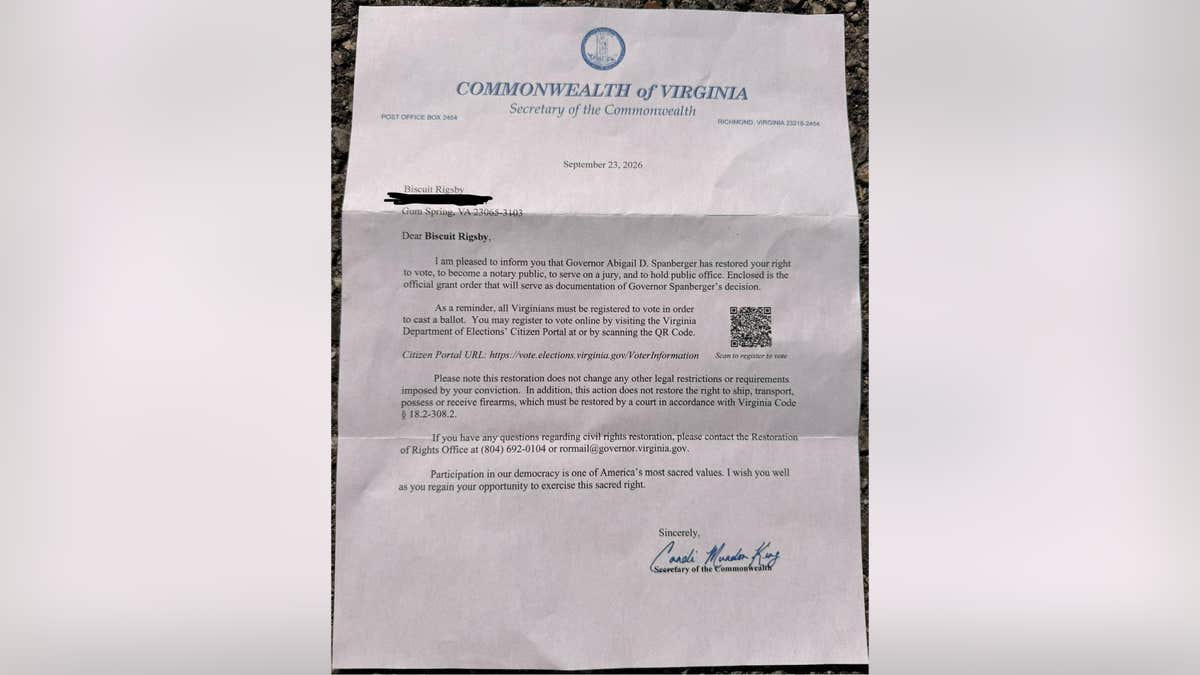
The administration’s proactive push to restore civil rights has moved at a staggering pace. In July, the Spanberger administration announced that Secretary of the Commonwealth Candi Mundon-King would spearhead an aggressive initiative to proactively identify Virginians who had lost their rights, verify their eligibility, and issue restoration certificates. By August, the administration proudly reported that the tally of restored individuals had skyrocketed from an initial benchmark of 66,000 to more than 100,000 citizens since the Governor assumed office in January.
However, the rapid acceleration of this bureaucratic pipeline appears to have compromised quality control. Delegate Garrett and other legislative critics argue that the sheer volume of processed certificates has superseded basic verification protocols.
Calls for an Independent Audit and Official Response
In response to the issuance of Biscuit’s certificate, Delegate Garrett has issued a stern demand for an immediate, independent audit of the executive branch’s rights-restoration procedures. He insists that the administration must transparently disclose the underlying records that led to a deceased pet being flagged as a felon, define what constitutes an adequate "review of the particulars," and explain what technological safeguards—if any—are currently in place.

"This is not a question of whether people who have served their sentences deserve a second chance," Garrett said in a strongly worded public statement. "This is a question of whether the Commonwealth is exercising one of the Governor’s constitutional powers with even the most basic level of review. Biscuit was a dog. Biscuit has been dead for five years. Yet an official document bearing the governor’s signature says the executive reviewed the particulars of Biscuit’s criminal case and determined her rights should be restored. Virginians deserve an explanation for how that is possible."
Garrett’s demands extend beyond a mere apology or administrative fix. He is calling for a comprehensive accounting of how many erroneous certificates have been issued to deceased individuals, nonexistent entities, or duplicate human profiles, alongside a legal mandate to preserve all relevant data logs for upcoming legislative oversight hearings.
As of publication time, Fox News Digital and other media outlets have reached out to Governor Spanberger’s office for an official statement, but a comprehensive response explaining the root cause of the error has not yet been provided.

Broader Implications Ahead of Election Day
The timing of the "Biscuit Rigsby" scandal could not be more precarious for proponents of the upcoming Election Day ballot measure. Virginia voters are currently weighing a monumental constitutional amendment that would permanently codify automatic rights restoration for individuals upon their release from incarceration, a policy vigorously backed by Richmond Democrats and progressive organizations.
Supporters of the ballot initiative argue that streamlining the restoration process removes archaic barriers to civic participation, helping former offenders successfully reintegrate into society. They contend that administrative hiccups should not derail a fundamental policy aimed at fairness and civic rehabilitation.
Conversely, opponents and skeptical lawmakers argue that incidents involving nonexistent citizens like "Betty No Last Name" and household pets like Biscuit validate conservative concerns regarding election integrity and administrative competence. Critics assert that if state databases are so porous that a deceased animal can pass through executive scrutiny as a felon, public trust in voter rolls and automated administrative systems is severely undermined.

Garrett maintains that his pursuit of transparency transcends partisan politics, arguing that even supporters of felon enfranchisement should be deeply troubled by the breakdown in executive oversight. In a video distributed across social media platforms, the Virginia lawmaker pressed the issue further: "At what point does rank incompetence and malfeasance become criminal conduct?"
As Virginia voters cast their ballots, the political fallout from the Goochland County dog’s unexpected civic enfranchisement serves as a cautionary tale about the perils of rapid bureaucratic expansion. Whether the state legislature will successfully launch a bipartisan inquiry into the Secretary of the Commonwealth’s operations remains to be seen, but the image of an official state proclamation addressed to a late canine has undoubtedly left an indelible mark on the Commonwealth’s electoral landscape.
Related posts: