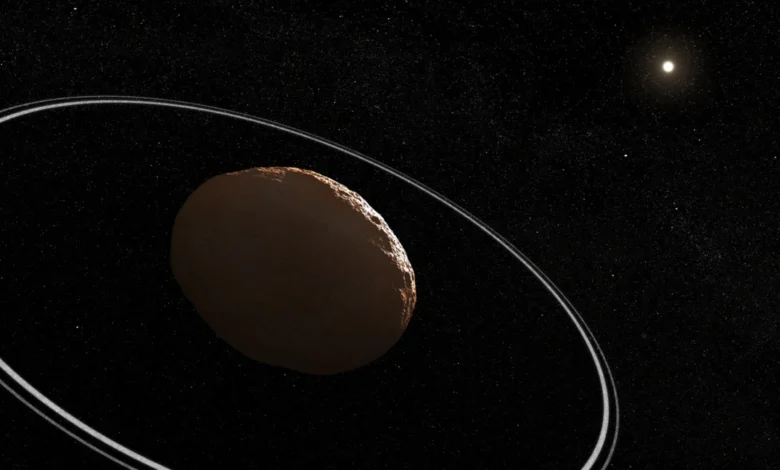
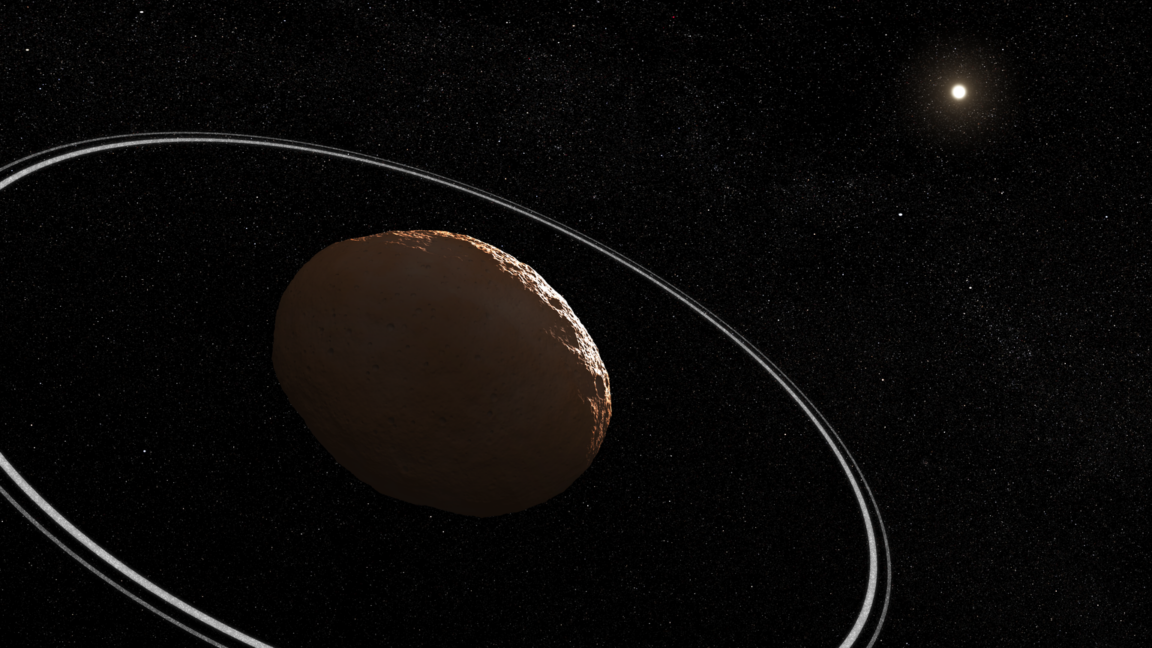
For decades, the scientific consensus regarding planetary rings was neatly confined to the gas giants of our solar system. Saturn, Jupiter, Uranus, and Neptune were viewed as the exclusive owners of these celestial halos, which were perceived as massive, stable structures resulting from the debris of giant moons or captured cosmic material. However, the discovery of a ring system around Chariklo in 2013 fundamentally challenged this perspective, revealing that even minor bodies—objects barely 250 kilometers in diameter—could host complex, multi-ring architectures. New observations from the James Webb Space Telescope (JWST) have now provided further evidence that these rings are not static relics, but dynamic, evolving structures that can shift in density and composition over a mere decade.
Chariklo, an object categorized as a Centaur, orbits the Sun in the volatile region between Saturn and Uranus. Its discovery of rings, initially observed through ground-based occultation events, was a watershed moment in planetary science. An occultation occurs when a minor body passes directly in front of a distant star, temporarily blocking its light. By measuring the duration and profile of this "blink," astronomers can calculate the object’s dimensions and the presence of any surrounding material. In the case of Chariklo, researchers identified two distinct, narrow rings, designated C1R and C2R, located approximately 390 and 405 kilometers from the object’s center.
A Decade of Dynamic Change
The latest investigation, led by Pablo Santos-Sanz of the Instituto de Astrofísica de Andalucía, sought to revisit Chariklo using the unprecedented infrared capabilities of the James Webb Space Telescope. The target was to observe another occultation, a task of immense technical complexity. Unlike ground-based telescopes, the JWST orbits the Sun at the second Lagrange point (L2), necessitating precise navigation and scheduling. Because the telescope’s orbit requires constant station-keeping maneuvers, predicting the exact line of sight for an occultation requires sophisticated orbital modeling.
The team’s efforts culminated on October 18, 2022, when they successfully captured an occultation event. The resulting data revealed a startling transformation. The inner ring, C1R, had become significantly more opaque—a sign of increased density—while the outer ring, C2R, had faded to the point of near-invisibility at certain wavelengths. Comparing the average opacity of C1R from ground-based observations (0.303) to the JWST measurements (0.431) indicated a profound change in the distribution of material within the ring system.
To ensure these findings were not merely the result of the telescope passing through a "lumpy" or non-uniform section of the ring, the team conducted over 10 million simulated occultations. These models demonstrated that the probability of the increased opacity being a simple geometric artifact was statistically negligible, suggesting a genuine physical evolution of the ring system.
The Mechanism of Ring Evolution
The observed changes raise critical questions about the longevity and stability of rings around small bodies. One prevailing theory is the existence of a "shepherd moon"—a small, yet-to-be-detected satellite orbiting within or near the rings. Such a body would act as a gravitational anchor, maintaining the sharp edges of the rings and potentially contributing debris to the inner ring, which would explain its observed thickening.
Radiative transfer models applied to the JWST data further suggest a difference in composition between the two rings. The data indicates that the inner ring is likely composed of larger particles, whereas the outer ring appears to contain a higher proportion of fine, dust-like material. This compositional disparity, combined with the loss of material from the outer ring and the gain in the inner, hints at a process of mass migration or ongoing replenishment that is not yet fully understood.
Santos-Sanz and his colleagues emphasize that this is a work in progress. While the evidence points toward a real, temporal evolution of the rings, determining the exact nature of the material—such as the ratio of water ice to silicates—requires further observation. The team is currently scouting for future occultation events that could be observed in visible light, which would help differentiate between wavelength-dependent scattering effects and actual physical changes in the rings’ density.
Broader Scientific Implications
The realization that Chariklo’s rings are unstable over short astronomical timescales has significant implications for the study of minor bodies across the solar system. Similar ring structures have been identified around other objects, including the Centaur Chiron, the dwarf planet Haumea, and the trans-Neptunian object Quaoar. These findings suggest that the presence of rings might be a common, though transient, phenomenon in the outer solar system.
In the context of planetary science, the evolution of these rings provides a micro-laboratory for studying the same processes that govern the much larger, more complex ring systems of the gas giants. For instance, astronomers have long observed that Saturn’s D-ring is shrinking and that the arcs of Neptune’s rings are rearranging. By studying these shifts in a smaller, more accessible environment like Chariklo, researchers hope to gain a better understanding of the fundamental physics of accretion, orbital dynamics, and debris management.
The JWST data serves as a critical piece of a much larger puzzle. It demonstrates that our solar system remains a place of active change, even among its smallest inhabitants. As we continue to refine our ability to predict and observe these fleeting occultation events, we are likely to uncover more about the mechanisms that form, maintain, and eventually dismantle the delicate structures surrounding minor celestial bodies.

Technical Challenges and Future Prospects
The technical feat of using the JWST to observe an object as small as Chariklo cannot be overstated. The telescope’s 14-day advance planning requirement meant the team had to work with "blind" predictions in the weeks leading up to the October 2022 event. The fact that the telescope’s line of sight ultimately skimmed just 7.4 kilometers above the object’s surface—effectively bypassing the body to focus entirely on the rings—was a remarkable outcome of international coordination and computational precision.
As the scientific community looks forward to future observations, the focus will remain on characterizing the particle sizes and material properties of these rings. If the "ghost moon" hypothesis holds true, the next generation of space-based observatories may be able to resolve the satellite directly, confirming the mechanism that keeps these rings from dispersing into the vacuum of space.
For now, the Chariklo findings serve as a reminder that the solar system is not a static clockwork mechanism. Whether through the seasonal shifts of giant planets or the rapid, mysterious evolution of a minor body’s halo, the celestial environment is in a constant state of flux. The study, published in Science Advances, stands as a landmark in our effort to document these changes, ensuring that as our technology advances, our understanding of the cosmic neighborhood keeps pace.
The implications of this research extend beyond Chariklo itself, providing a framework for future studies of minor bodies. As we move into an era of high-resolution space observation, the "ringed" nature of our solar system is becoming an increasingly crowded and dynamic map. The, at times, contradictory behavior of the inner and outer rings of Chariklo provides the necessary data to challenge existing models and force a re-evaluation of how such structures survive the gravitational tug-of-war of the outer solar system. The mission to understand these systems is only beginning, and the "two rings" around Chariklo remain a testament to the persistent surprises awaiting astronomers in the deep, dark reaches of space.