Astronomers may have discovered a new phenomenon in space-time that explains an impossible black hole merger

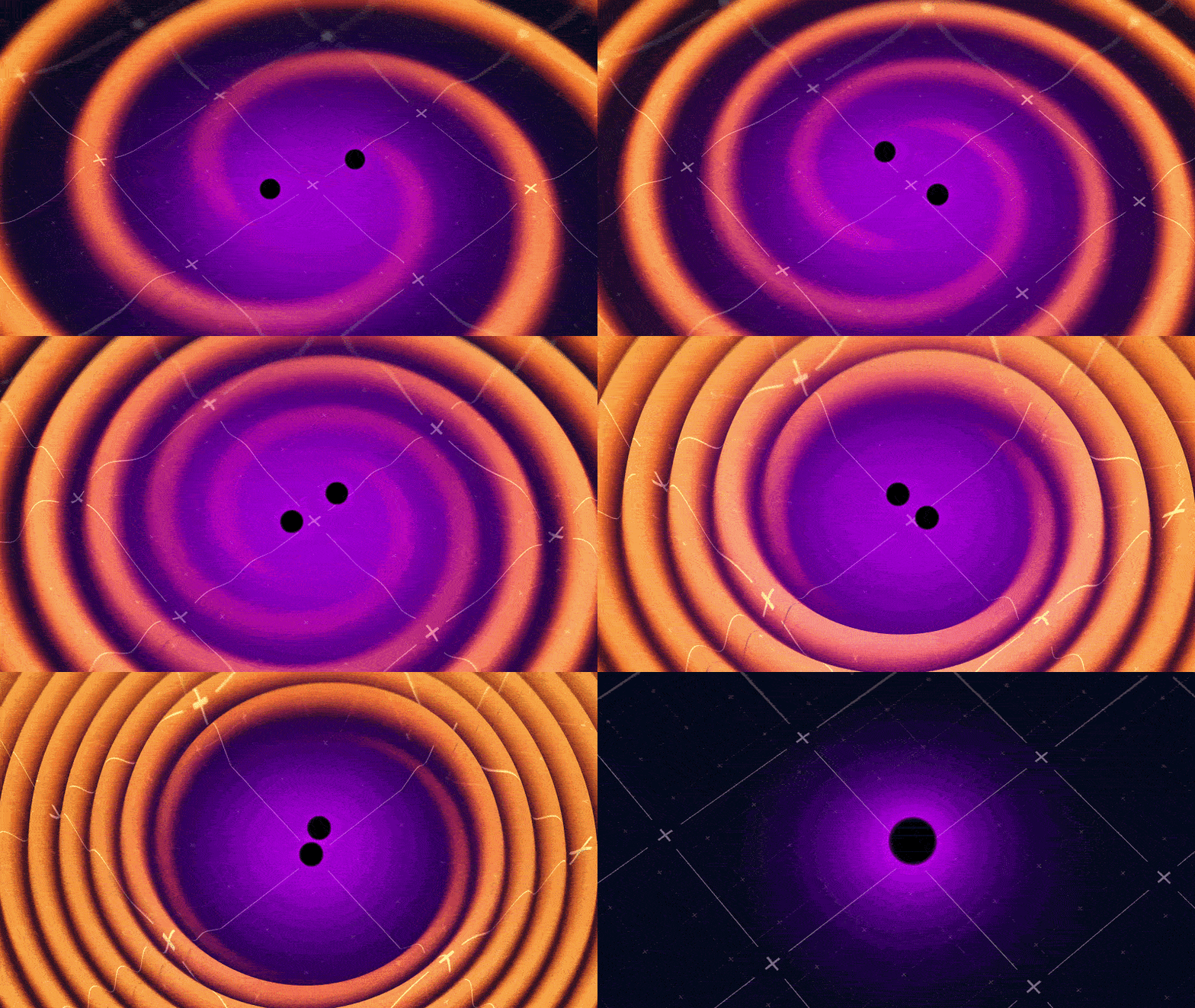
The discovery of the gravitational wave signal designated as GW231123 has sent ripples through the international astrophysics community, challenging existing models of black hole evolution and stellar dynamics. Detected on November 23, 2023, by the dual detectors of the Laser Interferometer Gravitational-Wave Observatory (LIGO), this event represents more than just another data point in the catalog of cosmic collisions. It represents a potential paradigm shift in our understanding of how massive objects behave in the deep reaches of the universe.
The signal originated approximately 2 billion light-years from Earth, a distance that places the event well within the reach of modern sensitive instrumentation but far enough to suggest that such occurrences may be more common than previously theorized. As researchers continue to parse the data, the emerging consensus is that the merger involved characteristics that defy standard astrophysical predictions, leading to the hypothesis that an exotic variation of space-time interaction—previously only theorized—may be at play.
The Anatomy of an Impossible Collision
To understand why GW231123 is considered "impossible" by conventional standards, one must first look at the mechanism of gravitational waves. These ripples in the fabric of space-time are the signatures of cataclysmic events: the death throes of stars, the rapid spinning of neutron stars, and the inevitable spiral of binary systems toward a final, singular union.
Standard gravitational wave detection typically follows a predictable "chirp"—a frequency and amplitude progression that allows scientists to calculate the masses and orbital dynamics of the merging objects. GW231123, however, deviated from these templates. The signal exhibited a signature that suggests the two black holes involved possessed mass ratios or orbital configurations that should not have been stable enough to result in a merger under existing models of general relativity.
Astrophysicists suspect that a "lensing" effect—or perhaps a more complex interaction involving high-density dark matter or a previously unobserved quantum gravity effect—altered the waveform as it traveled through the intervening 2 billion light-years. This has forced experts to reconsider whether their current simulations of binary black hole systems are missing a critical variable.
Chronology of the Detection
The timeline of the discovery underscores the precision required in modern multi-messenger astronomy.
- November 23, 2023: At 04:12 UTC, both the LIGO Hanford Observatory in Washington and the LIGO Livingston Observatory in Louisiana registered a coherent, high-confidence strain in the space-time fabric.
- Late November – December 2023: Initial automated analysis pipelines flagged the event as a significant outlier. Because the signal did not match standard binary black hole templates, it was initially sequestered for deeper human review to ensure it was not instrumental noise or "glitch" interference from terrestrial activity.
- January – March 2024: Collaborative teams from the LIGO-Virgo-KAGRA (LVK) collaboration began a cross-check of data. They looked for electromagnetic counterparts, though none were found, which is consistent with a black hole merger (which generally does not emit light).
- Mid-2024 to Present: Peer-reviewed analysis has shifted toward theoretical modeling. The data has been published in scientific archives, inviting global scrutiny. The consensus that the event is "impossible" refers specifically to the inability of current standard GR (General Relativity) models to fully replicate the signal’s peculiar modulation without invoking new, exotic physical mechanisms.
Supporting Data and Technical Challenges
The data associated with GW231123 presents a significant challenge to the current LIGO-Virgo-KAGRA library. The signal-to-noise ratio (SNR) was exceptionally high, meaning that the unusual features of the wave are almost certainly not artifacts of the detector.
According to preliminary findings, the primary concern lies in the mass distribution of the two black holes. If the objects were indeed black holes of the masses inferred from the signal, their pre-merger orbital decay should have been significantly different. The data suggests an accelerated spiral that cannot be accounted for by the gravitational radiation emission alone. This implies that the black holes were losing orbital energy through an additional, unseen mechanism.
One theory currently gaining traction is that the binary system was interacting with a "background" of high-energy particles or a localized anomaly in the space-time manifold. Another possibility is that the black holes themselves are not the standard "Schwarzschild" or "Kerr" varieties defined by basic relativity, but perhaps possess "hair"—additional physical characteristics such as scalar fields—that influence the way they radiate gravitational energy.
Official Responses and Academic Discourse
While the LVK collaboration maintains a cautious tone, official statements have acknowledged the anomaly. "We are looking at a signal that refuses to conform to our well-established templates," noted a lead researcher involved in the data processing. "In the past, when we have encountered such deviations, they have often pointed toward a gap in our instrumentation or our understanding of noise. However, in the case of GW231123, the coherence across our detectors makes the ‘noise’ explanation increasingly difficult to defend."
The broader academic community has reacted with a mix of skepticism and excitement. Conferences held throughout 2024 have seen intense debate regarding the possibility of "exotic compact objects" (ECOs). If these objects are not standard black holes, then the implications for stellar evolution are profound. It would mean that there are pathways to creating massive, compact entities that do not follow the life cycles of massive stars, potentially requiring a complete rewrite of the stellar graveyard catalog.
Broader Impact and Theoretical Implications
The implications of the GW231123 event extend far beyond the immediate study of binary systems. If the phenomenon responsible for the "impossible" signal is indeed a new variation of space-time physics, it could provide the first observational evidence for physics beyond the Standard Model.
- Testing General Relativity: Einstein’s theory of gravity has passed every test for over a century. However, it is known to be incomplete, particularly at the quantum scale. GW231123 might be a "stress test" of GR, revealing where the theory begins to fail under extreme conditions.
- Dark Matter Interactions: If the orbital decay was influenced by dark matter, this event could provide a rare opportunity to observe the indirect gravitational effects of dark matter on macroscopic, high-density objects.
- Refining Detection Algorithms: The "impossibility" of this signal has forced developers of gravitational wave software to create more flexible, adaptive algorithms. Future detections will benefit from the lessons learned here, as scientists move away from rigid, pre-defined templates toward more machine-learning-driven detection methods that can identify "unexpected" signals.
The Search for the Unknown
As we stand on the precipice of a new era in gravitational wave astronomy, the mystery of GW231123 remains a central focal point. The question is no longer just "what collided," but "what physical laws were at play during the collision?"
The scientific community is now turning its attention to the next generation of detectors, such as the LISA (Laser Interferometer Space Antenna) project, which will observe gravitational waves from space. With a larger baseline and a wider range of frequency detection, these future missions may be able to capture the early stages of such mergers, providing the missing context that GW231123 failed to offer.
Until then, the impossible merger remains a beacon for theoretical physicists. It serves as a reminder that the universe is not obligated to conform to our current models. Every time we look at the heavens with improved clarity, we are reminded that the most significant discoveries are often the ones that break the rules. The path forward will likely involve a combination of rigorous mathematical re-evaluation, the development of new detection technology, and the humility to accept that our current map of the universe is far from complete. The mystery of GW231123 is not a dead end; it is a doorway into a deeper, more complex cosmic reality that we are only just beginning to perceive.