Health Secretary Robert F. Kennedy Jr. Addresses Children’s Health Defense in Pivotal Moment for MAHA Agenda

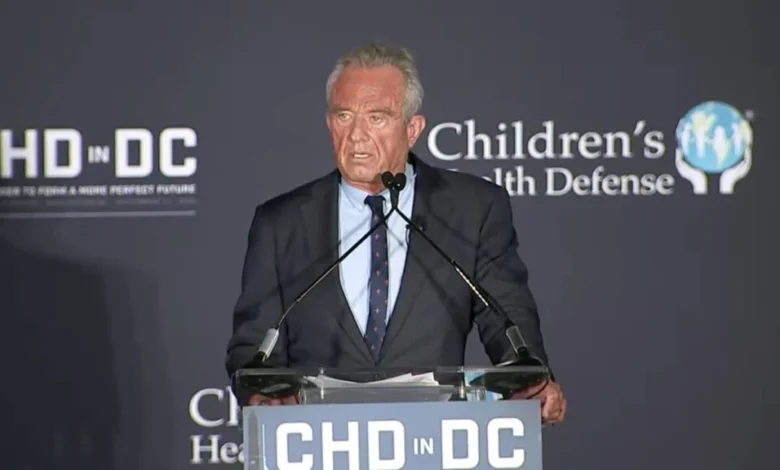
WASHINGTON — Health Secretary Robert F. Kennedy Jr. returned to the ideological bedrock of his political career on Thursday, delivering a keynote address at a conference hosted by Children’s Health Defense (CHD). The appearance served as both a strategic victory lap and a rallying cry for the Make America Healthy Again (MAHA) movement, arriving just weeks before midterm elections that analysts view as a referendum on the administration’s sweeping overhaul of federal health policy.
For Kennedy, the event was a return to familiar territory. CHD, an anti-vaccine nonprofit he helped establish, provided an audience receptive to his skepticism regarding established public health orthodoxy. While Kennedy has spent much of the past year focusing on high-level administrative initiatives—such as restructuring federal food guidance, scrutinizing chemical additives in the food supply, and mandating changes to hospital nutrition standards—his speech served as a deliberate pivot back to the issue that defined his ascent: vaccine safety and the alleged link between childhood immunization and chronic disease.
A Chronology of Policy Shifts
The trajectory of Kennedy’s influence within the Department of Health and Human Services (HHS) has been rapid. Since taking office, the administration has systematically dismantled several long-standing public health pillars.
- September 2025: The federal government formally reversed the longstanding recommendation for universal newborn hepatitis B vaccination, a policy shift that marked a departure from decades of established clinical practice.
- December 2025: The Trump administration officially codified the end of the newborn hepatitis B mandate, citing concerns over early-life immune stimulation.
- January 2026: HHS introduced new recommendations that significantly altered the childhood immunization schedule, sparking widespread alarm within the pediatric medical community.
- April 2026: A federal lawsuit was filed challenging the administrative changes to the Advisory Committee on Immunization Practices (ACIP) policies, a case that remains a flashpoint for legal and medical debate.
- August 2026: President Trump issued an executive order reinforcing his support for Kennedy’s oversight of vaccine safety, effectively aligning the White House with the MAHA agenda.
The Science of Adverse Event Reporting
The crux of Kennedy’s argument during the Thursday address rested on his interpretation of vaccine package inserts. Displaying a slide of a hepatitis B vaccine insert, Kennedy questioned the rigor of the clinical trials that led to the vaccine’s original FDA approval. He highlighted that the initial trials involved 147 participants and were monitored for a short duration without a placebo control group.
“The question is: Should we be looking at the potential that some of these chronic illnesses are associated with vaccines?” Kennedy asked the audience. He argued that no other pharmaceutical product would receive FDA approval under similar conditions.
However, public health experts and federal data suggest a more complex reality. The FDA frequently accepts supplemental data from post-market studies, which are designed to track safety and efficacy across larger, more diverse populations over longer periods. Following the market introduction of the hepatitis B vaccine, thousands of participants were studied, leading to a 99% reduction in chronic hepatitis B infections among children and adolescents, according to data from the Centers for Disease Control and Prevention (CDC).
The medical community emphasizes that the "adverse events" listed on package inserts are reports of conditions that occurred following vaccination, not necessarily conditions caused by the vaccine. The inserts themselves state: “It is not possible to reliably estimate their frequency or establish a causal relationship to a vaccine exposure.”
Institutional Reforms and Data Transparency
Kennedy’s address also outlined a roadmap for the future of the Vaccine Adverse Event Reporting System (VAERS). He described the current reporting infrastructure as outdated and insufficiently user-friendly, arguing that it fails to capture the full scope of potential side effects.
The Secretary announced that HHS is currently reviewing more than 150 serious adverse events reported post-vaccination to determine if a causal link can be established. He noted that the agency is planning to implement a system to compensate healthcare providers for the time spent reporting potential side effects, a move intended to incentivize more comprehensive data collection. Furthermore, he hinted at the automation of VAERS, a project he has championed since his early days in the administration, aimed at increasing the volume and accessibility of safety data.
The Broader Impact and Public Health Tensions
The Secretary’s rhetoric regarding vaccines occurs against the backdrop of a resurgent measles crisis in the United States. While Kennedy focused his address on the potential risks of the childhood vaccine schedule, he made only a single, brief mention of the measles virus, which has recently contributed to at least four fatalities in Pennsylvania.
The medical establishment, including organizations such as the American Academy of Pediatrics and the American Medical Association, has expressed deep concern regarding the administration’s messaging. Critics argue that casting doubt on the safety of vaccines without robust, peer-reviewed evidence risks eroding the herd immunity that has historically prevented the resurgence of vaccine-preventable diseases.
Furthermore, the involvement of Andrew Wakefield—the former physician whose 1998 study linking the MMR vaccine to autism was later retracted by The Lancet and discredited by the medical community—as a featured speaker at the same conference has intensified the divide. For supporters of the MAHA movement, Wakefield represents a martyr for medical transparency; for the global public health community, his inclusion underscores a deep ideological rift between the current HHS leadership and the mainstream scientific consensus.
Implications for the Midterm Elections
The midterm elections are poised to be a pivotal moment for the longevity of the MAHA agenda. Should the current administration maintain its influence in Congress, it is expected that the funding for HHS research into vaccine timing and sequencing will expand. Conversely, a change in legislative control could lead to increased oversight and potential investigations into the administrative changes made to the childhood immunization schedule.
Kennedy’s speech served to solidify his base, positioning himself as a steadfast ally of the President and a defender of parental choice. "Let me be clear: You have a strong and steadfast friend at the White House," he told the crowd.
As the political season intensifies, the debate over the role of federal health agencies—and the balance between traditional public health mandates and the burgeoning movement for reform—remains one of the most volatile issues in American politics. The path forward for HHS remains a landscape defined by significant uncertainty, as the agency continues to navigate the competing demands of scientific evidence, public safety, and a fundamental shift in political philosophy.
Whether these administrative changes will result in long-term health improvements or lead to the further degradation of public trust in immunization remains the central, unresolved question facing the nation’s healthcare system as it approaches the end of the year. The administration’s continued focus on individual choice, coupled with its skepticism of long-standing clinical protocols, suggests that the influence of the MAHA movement will remain a defining feature of the American health policy landscape for the foreseeable future.