How a Downtown NYC Bartender’s Inside-Joke T-Shirt Turned into a Cult Global Brand

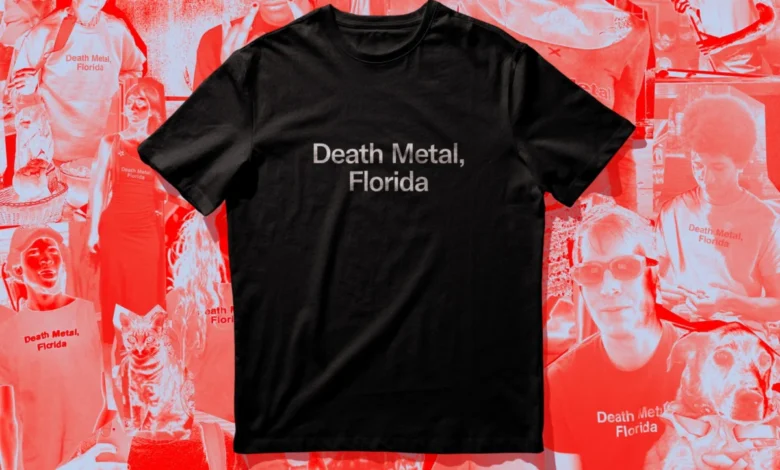
The streets of Lower Manhattan have long served as a fertile testing ground for countercultural aesthetics, where ephemeral trends are born on smoke-filled sidewalks and discarded just as quickly. In recent months, however, a single piece of apparel has broken through the cyclical noise of the downtown scene. Printed in bold Helvetica across discarded or thrifted cotton tees, the phrase Death Metal, Florida has captured the attention of artists, independent magazine editors, and fashion insiders alike. Though the fictional destination conjures images of a sun-bleached, panhandle wasteland populated by metalheads, the garment’s creator insists it is less a geographic tribute and more an exercise in psychological disorientation.
At the helm of this burgeoning phenomenon is 29-year-old Brandon Santana, a neighborhood server whose accidental foray into apparel design has upended his quiet life in Brooklyn. While the shirts have become ubiquitous fixtures in the micro-neighborhood colloquially known as Dimes Square, their creator views the commercial success with a mixture of wry amusement and mounting anxiety. Operating at the intersection of high-concept art, insider humor, and DIY punk ethos, Santana’s project has evolved far beyond a simple batch of novelty garments, stretching into independent music management, avant-garde retail partnerships, and a global digital footprint that reaches far beyond the confines of New York City.
The Genesis of an Inside Joke
The conceptual framework for Death Metal, Florida began to take root in November 2022, fueled by a specific set of auditory and geographical influences. At the time, Santana found himself listening on repeat to foundational extreme metal acts such as Death, Morbid Angel, and Obituary. Mentally cataloging the genre’s history, he fixated on the geographic reality that many of these pioneering death metal bands originated in Northern Florida, a stark contrast to Santana’s own upbringing in the southern region of the state.
The spark for the design format, however, arrived years earlier, inspired by a college acquaintance who had produced a garment featuring an entirely inaccurate map of Mount Vernon, Washington. This specific brand of solipsistic, hyper-localized humor—designed primarily to bewilder casual observers—resonated deeply with Santana. Sitting in his apartment, the cognitive dissonance of the concept coalesced.
"It just all came together one day when I was lying in bed," Santana recalls. "And I was like, I want to put it on a shirt."
Armed with a makeshift setup, Santana began screen-printing the phrase onto used, inside-out Gildan t-shirts inside a friend’s basement studio. Initially, the distribution model was entirely insular. The first wave of garments was gifted exclusively to a tight-knit circle of artists, musicians, and downtown scenesters who populated Santana’s immediate social sphere.

Chronology of a Viral Micro-Trend
The dissemination of Death Metal, Florida followed an organic, highly stratified trajectory typical of Manhattan’s creative underground before catching the attention of broader cultural tastemakers.
- November 2022: The conceptual phase crystallizes during a period of heavy listening to 1980s and 1990s Florida death metal bands, leading to the first round of unauthorized, basement-printed prototypes.
- Late 2022 to Early 2023: The initial run of shirts circulates among Lower Manhattan creatives. Garments are worn during interviews for independent literary magazines, gallery openings in Chinatown, and neighborhood social gatherings, generating organic intrigue.
- Mid 2023: Dimes Deli, a central culinary and social hub in the Dimes Square neighborhood, becomes the primary physical clearinghouse for the shirts, cementing the brand’s local mythology.
- Late 2023: The operational scope expands beyond apparel. Death Metal, Florida officially begins functioning as an independent music label, taking on management duties for the local noise rock outfit German Suplex. Santana also secures a partnership to produce exclusive collections for Retail Pharmacy, an independent boutique in Chinatown.
- 2024: Word-of-mouth momentum crosses international and celebrity boundaries. Unsolicited inquiries and validation arrive from prominent figures in contemporary design and photography, including designer Willy Chavarria, legendary photographer Ryan McGinley, and actress Zoë Kravitz.
Esoteric Influences and Design Methodology
To understand the visual language of Death Metal, Florida is to decode an encyclopedia of hyper-niche cultural references. Santana’s creative process relies heavily on personal ephemera, obscure cinematic history, and the margins of visual art. Rather than adhering to market research or trend forecasting, his designs function as wearable diary entries.
Among the disparate inspirations cited by Santana are the impromptu tattoos observed on unhoused individuals in New York City, specific frames from Nan Goldin’s seminal 1986 photographic work The Ballad of Sexual Dependency, and canonical arthouse cinema from the Criterion Collection. Another recurring design motif stems from a photograph titled "ex-girlfriend doppelgänger," featuring a woman Santana serendipitously scouted and photographed before they entered a romantic relationship—a status that has since oscillated between complex, undefined, and reconciled.
This penchant for autobiographical obfuscation extends to Santana’s experimental production methods. During a recent creative phase, he utilized his bathtub in Bed-Stuy to experiment with layered, all-over print techniques on what he terms "drafts" of unreleased shirts. One such garment was directly inspired by viewing Larisa, a 1980 documentary by Soviet-Russian filmmaker Elem Klimov dedicated to his late wife. While composing a review of the film on the social cataloging platform Letterboxd, Santana encountered a line of dialogue delivered by David Lynch’s character in the fourth season of Twin Peaks: "Fix their hearts or die."
Adapting the sentiment to his own thematic framework, Santana paraphrased the quote to read "Live for your wife or die," screen-printing the phrase alongside a stylized heart inscribed with the name Larisa rendered in Ukrainian Cyrillic script. The garment was never intended for mass consumption, yet it exemplifies the idiosyncratic nature of Santana’s output, where personal grief, prestige television, and Soviet cinema collide on cheap cotton.
Beyond Apparel: Music Management and Retail Expansion
Despite the undeniable traction of the t-shirts, Death Metal, Florida resists categorization as a traditional fashion label. In addition to his ongoing capsule collections with Retail Pharmacy—an independent storefront anchoring a shifting retail landscape in Manhattan’s Chinatown—Santana utilizes the imprint to foster local musical acts.
Chief among these is German Suplex, a band managed under the Death Metal, Florida banner. In a move that highlights the project’s overarching commitment to subverting expectations, the group performs abrasive noise rock rather than the extreme metal subgenre referenced in the label’s moniker. By cross-pollinating visual art, apparel, and independent music production, Santana has constructed a multi-layered brand architecture that mimics corporate enterprise while retaining a fiercely independent, anti-commercial ethos.

This dual identity has not gone unnoticed by the wider fashion and entertainment industries. As the brand’s footprint expands via digital word-of-mouth, Santana frequently receives high-profile validation from figures outside his immediate peer group. Reports of interest from established menswear designer Willy Chavarria and acclaimed photographer Ryan McGinley underscore a growing crossover appeal. Furthermore, secondhand accounts from acquaintances—such as a rumor relayed by an ex-roommate that actress Zoë Kravitz had expressed approval of a shirt—demonstrate how rapidly localized street-level movements can scale in the modern attention economy.
Industry Implications and the Fear of "Blowing Up"
The trajectory of Death Metal, Florida offers a compelling case study in contemporary micro-branding and the economics of scarcity. In an era dominated by algorithmic trend forecasting, direct-to-consumer digital marketing, and manufactured virality, Santana’s approach relies on deliberate opacity. The humor is insular, the distribution channels are physical and analog, and the inventory is frequently described by its maker as accidental or defective.
Strangers regularly approach Santana on the street to purchase the experimental, one-off garments off his back—an interaction he confesses to finding deeply embarrassing, given that he views these shirts as irreparable mistakes that cannot be replicated. This tension between public demand and private intention has introduced a palpable sense of apprehension regarding the brand’s future.
"The reason I chose the tablecloth is because it’s so far from clothing," Santana notes, referencing an upcoming screen-print project featuring an image of his partner sleeping rendered across household linens. "I’m afraid of blowing up."
This anxiety reflects a broader paradox facing independent creators in Lower Manhattan’s cultural ecosystem. The very qualities that render a project authentic—its locality, its insular humor, its resistance to commercial optimization—are precisely what draw the machinery of mass attention toward it. Whether Death Metal, Florida can successfully navigate this inflection point without losing the self-evident punkdom that birthed it remains to be seen. For now, Santana continues to print from his apartment, drink in local parks, and engineer garments designed to confuse as many people as possible.