In the realm of baking and confectionery arts, the intersection of rich, velvety textures and vibrant, fruit-forward acidity has long represented the gold standard of dessert craftsmanship. The culinary world has recently turned its attention toward a refined yet approachable adaptation of a perennial favorite: Raspberry Swirl Cheesecake Bars. Combining the dense, luxurious profile of traditional New York-style cheesecake with the bright, sweet-tart profile of a fresh raspberry puree, this iteration bridges the gap between sophisticated baking and accessible, everyday home preparation.

Developed and refined through rigorous home-kitchen testing, the recipe capitalizes on a format designed specifically for modern entertaining. While individual cheesecakes require delicate water baths and whole-cake formats demand precision slicing, the bar format offers built-in portion control alongside the structural integrity necessary for outdoor gatherings, picnics, and formal catered events.
Culinary Anatomy and Flavor Profile
At its core, the Raspberry Swirl Cheesecake Bar relies on a carefully balanced tripartite structure: a buttery graham cracker crust, a gently lemon-infused cream cheese filling, and a deeply concentrated raspberry coulis.

Culinary analysts note that the inclusion of citrus zest and juice within the dairy layer serves a critical chemical function. The acid cuts through the heavy milk fats of the cream cheese, elevating the flavor profile and preventing palate fatigue—a common critique of overly dense cheesecakes. Meanwhile, the crust provides a necessary textural contrast, utilizing crushed graham crackers bound with unsalted butter and a touch of granulated sugar, baked briefly to set before the liquid batter is introduced.
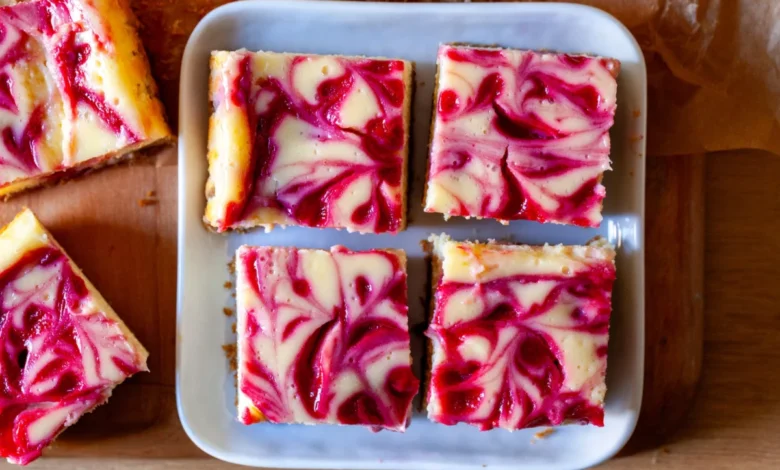
The visual hallmark of the dessert—its distinct marbled surface—is achieved through an unpretentious technique utilizing a standard piping method and a simple wooden skewer. By injecting the raspberry puree both beneath the surface and across the top of the batter before baking, bakers create a dynamic visual reminiscent of natural stone or tie-dye textiles. This aesthetic versatility has made the recipe an immediate favorite for food photography and spring-themed gatherings, frequently styled alongside seasonal florals such as peonies.

Chronology and Development
The evolution of cheesecake bars within contemporary baking archives spans nearly two decades of recipe development. Early iterations focused primarily on dense, single-flavor profiles or heavy chocolate and caramel additions. However, a distinct shift toward fruit-integrated pastries gained momentum in the late 2010s, driven by consumer demand for desserts that balance indulgence with bright, natural acidity.
The recent formulation of these specific raspberry bars underwent a multi-week testing phase designed to optimize structural stability and flavor distribution.

- Week One: Initial testing established the baseline measurements for the graham cracker crust and the standard cream cheese-to-sugar ratio. Early challenges involved the bleeding of the fruit puree into the base during the baking cycle.
- Week Two: Adjustments were made to the density of the raspberry reduction. By passing the blended berries through a fine sieve to remove seeds and excess water, bakers achieved a viscous coulis that maintained its structural definition during the thermal expansion of the bake.
- Week Three: The incorporation technique was refined. Moving away from a purely surface-level drizzle, developers introduced the "underwater blob" method—injecting pockets of puree into the lower half of the batter to ensure that every bite delivers a balanced ratio of tart fruit to sweet cheese.
Nutritional and Practical Implications
From a logistical standpoint, the standardization of the 8-by-8-inch baking pan format yields sixteen uniform squares, maximizing efficiency for commercial and domestic bakers alike. Furthermore, the dessert addresses a common logistical challenge in home kitchens: the utilization of overripe or delicate berries. Soft, highly perishable raspberries, which might otherwise be discarded, are identified as the optimal ingredient for the swirl, as their deeper, inkier pigmentation translates to a more striking visual contrast against the pale cream cheese batter.
Food safety and storage parameters also favor the bar format. Properly sealed and refrigerated, the confections maintain structural integrity and flavor fidelity for five to seven days. This extended shelf life makes the recipe exceptionally well-suited for advance preparation, a key metric for event planners and busy households.

Broader Industry Context
The popularity of hybrid desserts like the Raspberry Swirl Cheesecake Bar reflects broader shifts in consumer preferences toward elevated comfort foods. Culinary economists observe that during periods of economic uncertainty, consumers frequently gravitate toward comfort foods that offer high sensory rewards relative to their cost of production. Cream cheese, graham crackers, and frozen or fresh seasonal berries represent accessible, cost-effective ingredients that can be transformed through precise technique into premium-tier offerings.
As home baking continues to benefit from digital recipe sharing and high-definition visual media, recipes that offer a high "effort-to-reward" ratio—requiring no specialized culinary degree while yielding professional-grade aesthetics—are positioned to dominate culinary trends. Whether served on fine china at a formal reception or portioned onto paper plates at a neighborhood potluck, the raspberry swirl cheesecake bar demonstrates the enduring appeal of balanced contrasts in modern pastry arts.