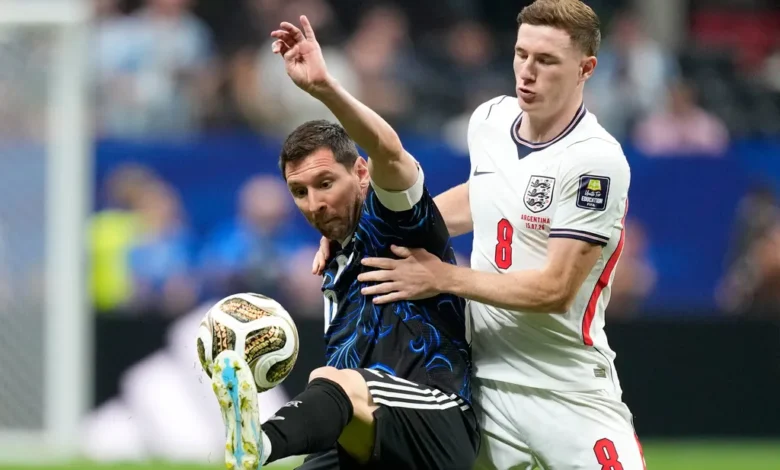
Last year, having taken the oath of allegiance as a new American citizen, a mild effort was made to care less about the failings of the old country, England. However, the oath requires only an absolute and entire renunciation of allegiance and fidelity to any foreign prince, potentate, state, or sovereignty, of whom or which one has heretofore been a subject. It does not demand the sacrifice of the repeatedly forlorn hope that England will again win the FIFA World Cup. That would indeed be a bridge too far for many, including this observer. The last triumph was in 1966, a cherished memory for a 9-year-old and his brothers who gloried in that victory over what was then West Germany. Every four years since, a familiar pattern of disappointment has emerged as England stumbled at various hurdles, never again returning to the sport’s ultimate final.
This year’s failure in the semi-final against reigning champions Argentina, held at the Mercedes-Benz Stadium in Atlanta, Georgia, on Wednesday, July 15, 2026, was particularly agonizing. Like many before it, the defeat felt largely self-inflicted, raising questions about tactical decisions and the national team’s perennial struggles under pressure. The match, highly anticipated due to the deep historical rivalry between the two footballing nations, began with England asserting an early advantage, striking first to take a 1-0 lead early in the second half. The goal, a blistering finish from lightning-fast winger Anthony Gordon, ignited hopes across England and among its diaspora.
A Detailed Look at the Semifinal Clash
The atmosphere in Atlanta was electric, a blend of passionate English and Argentine supporters creating a cacophony that underscored the magnitude of the occasion. England, under the stewardship of head coach Thomas Turchel, had navigated a challenging path to the semifinals, demonstrating moments of brilliance mixed with periods of inconsistency. Argentina, led by their talismanic captain Lionel Messi, had showcased their customary flair and resilience, solidifying their status as tournament favorites.
The first half was a cagey affair, marked by tactical caution from both sides. England, fielding a dynamic 4-3-3 formation, focused on disciplined pressing and quick transitions. Argentina, with their characteristic 4-2-3-1 setup, sought to control possession and probe England’s defensive lines, with Messi often dropping deep to orchestrate play. While Argentina held a slight edge in possession (54% to 46%) in the opening 45 minutes, England’s defensive shape was robust, limiting the South American giants to speculative long-range efforts and half-chances. Key English midfielders, including Jude Bellingham and Declan Rice, worked tirelessly to disrupt Argentina’s rhythm, while defenders Harry Maguire and John Stones marshaled the backline effectively.
The deadlock was broken in the 53rd minute. A swift counter-attack saw England’s right-back, Trent Alexander-Arnold, release Gordon down the left flank. Gordon, exhibiting blistering pace and close control, cut inside past two Argentine defenders before unleashing a powerful, low shot that nestled into the bottom corner of the net, sending the English contingent into raptures. The goal was a testament to England’s strategic intent: absorb pressure and exploit the pace of their attacking players on the break.
Following the goal, England’s tactical approach underwent a significant, and ultimately controversial, shift. Coach Turchel, seemingly intent on preserving the slender 1-0 lead, initiated a series of substitutions that fundamentally altered the team’s dynamic. Anthony Gordon, the goalscorer and England’s most potent attacking threat, was surprisingly withdrawn, as were other fast attacking players like Bukayo Saka. In their place, Turchel introduced defensive midfielders and additional central defenders, effectively transitioning England into a more conservative 5-4-1 formation. The explicit aim appeared to be to create an impenetrable wall at the back, prioritizing defense above all else and abandoning any significant offensive ambition for the remaining 30 to 40 minutes of the match.
This tactical pivot proved to be a critical error. By virtually eliminating the threat of a second goal and sacrificing most of their possession, England ceded the initiative entirely to Argentina. The reigning world champions, no longer needing to fear a counterattack, were allowed to flow forward in waves, relentlessly peppering the English goal. The statistics from the latter part of the second half tell a stark story: Argentina’s possession surged to over 70%, they registered 12 shots on target in the final 30 minutes compared to England’s zero, and their pass completion rate in the attacking third soared.
The pressure eventually told. In the 78th minute, Argentina found their equalizer. A moment of individual brilliance from Lionel Messi saw him weave past two English defenders before delivering a perfectly weighted through ball to Julian Alvarez, who slotted home calmly. The momentum had decisively shifted. Just five minutes later, in the 83rd minute, Argentina capitalized on England’s defensive disarray. A corner kick was headed clear only as far as Enzo Fernandez, whose powerful strike from the edge of the box found the top corner, leaving England’s goalkeeper Aaron Ramsdale with no chance. Argentina had completed a stunning comeback, securing a 2-1 lead that they would not relinquish. The final whistle brought jubilation for Argentina and a familiar, crushing disappointment for England.
The Weight of History: England’s World Cup Journey Since 1966
England’s solitary World Cup triumph in 1966 remains an indelible part of the national psyche, a benchmark against which all subsequent performances are measured. Since that glorious day at Wembley, the nation has endured a litany of "what ifs" and near misses, making the current semi-final defeat feel like another painful chapter in a long, frustrating narrative.
- 1970 Mexico: Expected to defend their title, England exited in the quarterfinals to West Germany, squandering a 2-0 lead.
- 1986 Mexico: The infamous "Hand of God" goal and Maradona’s solo brilliance saw England knocked out by Argentina in the quarterfinals, a match forever etched in the rivalry’s history.
- 1990 Italy: Under Bobby Robson, England reached the semifinals, their best performance since 1966, only to lose a heartbreaking penalty shootout to West Germany. This run ignited renewed hope but ultimately ended in familiar disappointment.
- 1998 France: Another penalty shootout defeat, this time to Argentina in the Round of 16, adding another layer to the Anglo-Argentine rivalry.
- 2002 South Korea/Japan: A strong squad featuring David Beckham and Michael Owen fell to eventual champions Brazil in the quarterfinals, with Ronaldinho’s speculative free-kick proving decisive.
- 2006 Germany: Another quarterfinal exit, this time against Portugal, again on penalties, further cementing England’s reputation for faltering under pressure.
- 2010 South Africa: A dismal performance under Fabio Capello saw England crash out in the Round of 16 to Germany.
- 2014 Brazil: England suffered their worst World Cup performance in decades, failing to progress from the group stage.
- 2018 Russia: Gareth Southgate’s young squad captivated the nation, reaching the semifinals for the first time in 28 years, only to lose to Croatia in extra time, once again snatching defeat from the jaws of victory.
- 2022 Qatar: England put up a strong fight but were eliminated by eventual finalists France in the quarterfinals, despite a strong performance.
Each tournament brings renewed optimism, fueled by a talented generation of players and passionate support. Yet, time and again, England has stumbled, often due to a combination of individual errors, tactical misjudgments, and the immense pressure associated with the national team’s expectations. This 2026 semi-final loss, particularly its tactical nature, feels like a particularly bitter pill.
The Road to Atlanta: Context of the 2026 World Cup
The 2026 FIFA World Cup, jointly hosted by the United States, Canada, and Mexico, marked a new era with an expanded format and an unprecedented number of participating nations. The tournament had been a spectacle of thrilling matches, surprising upsets, and established powerhouses asserting their dominance.
England’s journey to the semi-finals was not without its challenges. They topped their group comfortably, showcasing attacking prowess and defensive solidity. In the Round of 16, they overcame a spirited challenge from Japan, securing a 2-0 victory. The quarter-finals pitted them against a highly-fancied German side, a match England won 1-0 in a tense encounter, a result that further fueled national optimism given the historical rivalry. Key players like Anthony Gordon, Jude Bellingham, and Declan Rice had been instrumental in their progress, delivering consistently high-level performances.
Argentina, as the reigning champions, entered the tournament with immense pressure to defend their title. They navigated their group stage with typical South American flair, showcasing moments of individual brilliance, particularly from Lionel Messi. Their path to the semi-final included a hard-fought victory over the Netherlands in the Round of 16 and a convincing win against Uruguay in the quarter-finals, setting up the much-anticipated clash with England. The rivalry between England and Argentina extends beyond the football pitch, rooted in historical events like the Falklands War and emblematic moments such as Maradona’s "Hand of God" goal in 1986. This added an extra layer of intensity and significance to the semi-final encounter.
Reactions and Repercussions
The immediate aftermath of the match saw a mixture of frustration, anger, and profound sadness from the English camp.
"It’s a devastating result, utterly devastating," Head Coach Thomas Turchel stated in a post-match press conference, his voice heavy with disappointment. "We had a plan, and for a long period, it was working. We were ahead, and we felt we could see the game out. We made tactical changes to solidify our defense, to protect the lead. With hindsight, perhaps it was too cautious. Argentina are world champions for a reason; they punish any lapse, any invitation to attack. I take full responsibility for the decisions made on the touchline."
Captain Harry Kane, reflecting on the defeat, expressed the team’s heartbreak. "To be 1-0 up in a World Cup semi-final and not see it through… it’s just crushing. We fought hard, we believed. But when you give a team of Argentina’s quality that much space and time, they will hurt you. We’ll learn from this, but right now, it’s incredibly tough to process."
Pundits and former players were quick to criticize Turchel’s tactical choices. Gary Lineker, speaking on BBC Sport, lamented, "It’s the ultimate defensive gamble, and it backfired spectacularly. You don’t invite the best attacking team in the world to repeatedly test your defense for 30 minutes without offering any counter-threat. It’s a recipe for disaster, and sadly, England has cooked it up before." Rio Ferdinand echoed these sentiments, suggesting that England "lacked the courage to go for the kill" and that the tactical shift was "a monumental mistake."
Public reaction in England was swift and overwhelmingly negative, particularly towards the coach. Social media platforms were awash with expressions of anger and despair, with many fans calling for Turchel’s immediate dismissal. Newspaper headlines the following day reflected the national mood: "GORDON’S GOLD SQUANDERED BY TURCHEL’S TACTICS" (The Sun), "DEJA VU: ENGLAND’S WORLD CUP DREAM CRUMBLES AGAIN" (The Times), and "COACHING BLUNDER COSTS ENGLAND WORLD CUP FINAL SPOT" (Daily Mail). The sense of a missed opportunity, particularly one perceived to be self-inflicted, permeated the national discourse.
Beyond the Pitch: A Metaphor for National Strategy
The tactical misjudgment witnessed in the semi-final game transcends the confines of the football pitch, serving as a potent metaphor for broader fields of human endeavor, particularly in politics, national security, and economic competition. The principle is fundamental: a purely defensive posture, without the credible threat of retaliation or counterattack, often invites aggression rather than deterring it.
Consider the parallels:
- Deterrence Theory: In national security, the concept of deterrence hinges not just on having a strong defense, but on the credible threat of offensive retaliation. If a nation simply builds walls and retreats into a defensive crouch, signaling that it will only absorb attacks without mounting any successful counter-offensives, it emboldens adversaries. The opponent needs to know that any aggression will be met with significant, painful consequences, not merely a rebuffed initial assault.
- Economic Competition: In global economic competition, a nation that only seeks to protect its existing industries without innovating, expanding into new markets, or challenging established players risks stagnation and decline. A purely protectionist stance, devoid of proactive investment in research, development, and global market penetration, can lead to a loss of competitive edge. To thrive, a nation must champion its economic models, foster innovation, and actively seek to expand its influence.
- Diplomatic Strategy: In international relations, a state that consistently adopts a reactive stance, only responding to crises rather than proactively shaping the global agenda or asserting its values, risks diminishing its influence. Effective diplomacy requires both robust defense of national interests and the confident projection of one’s own ideas, history, and systems of governance onto the world stage. It’s about leading, not just responding.
- Cybersecurity: In the digital realm, a strategy focused solely on building firewalls and detecting intrusions, without the capability or willingness to trace, disrupt, and retaliate against cyber attackers, leaves a nation vulnerable. A comprehensive cybersecurity strategy must include offensive capabilities and a clear doctrine for their use to deter malicious actors.
The lesson from England’s tactical blunder is clear: if all an enemy needs to worry about is that his own attacks may fail, but not that you will mount any that can succeed, if you cling only to a marginal advantage and do not try to increase your domination, your antagonist has only one incentive – to goad, harry, and strike again and again.
Any nation that aspires to be respected and any civilization that seeks to survive must, like a World Cup team, possess the confidence not just to defend itself but also to champion its own ideas, history, economy, mores, traditions, and systems of government. A strong defense is undeniably necessary, but it is the credible threat and execution of offense that makes that defense truly robust and impactful. The ability to attack, to seize the initiative, and to demonstrate strategic prowess is not merely about aggression; it is about maintaining balance, deterring threats, and ultimately securing long-term success.
Looking Ahead: The Future of English Football
The immediate future for English football will undoubtedly involve a period of introspection and potential upheaval. Questions will be raised about Thomas Turchel’s tenure, his tactical philosophy, and whether the Football Association (FA) believes he is the right person to lead the national team into the next World Cup cycle. Calls for a change in management are already prevalent among fans and media.
Beyond the coaching position, the defeat will prompt a re-evaluation of youth development pathways, the mentality of players under pressure, and the overarching strategic direction of English football. The perennial struggle to translate individual talent into collective success on the biggest stage continues to plague the nation. Lessons from this particular defeat – the perils of excessive caution, the importance of maintaining offensive threat, and the need for adaptability – will be scrutinized by footballing analysts and hopefully integrated into future strategies.
Conclusion
England’s journey in the 2026 World Cup ended in familiar heartbreak, a 2-1 semi-final defeat to Argentina that felt particularly bitter due to the perceived tactical missteps. While the pain of another World Cup disappointment will linger, the match serves as a stark reminder of fundamental strategic principles, both on and off the pitch. The confidence to defend one’s position must always be coupled with the courage to attack, to champion one’s strengths, and to never cede the initiative entirely. Only then can the repeated forlorn hope for World Cup glory, and for broader national success, truly materialize.