The Mechanism of Trans-Pacific Tectonic Forcing
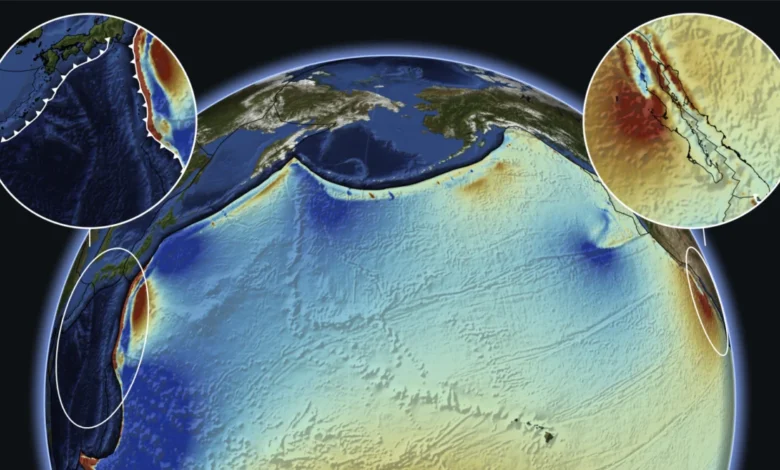
At the heart of this discovery is the concept of a "double subduction zone" that formed off the coast of Japan during the late Miocene epoch. Subduction occurs when one tectonic plate slides beneath another, sinking into the Earth’s mantle. When two such zones operate in tandem, they create significant drag and pressure variations that ripple across the entire Pacific Plate.
The Pacific Plate is the largest tectonic plate on Earth, covering approximately 103 million square kilometers. Because of its massive scale, force applied to one edge of the plate does not disappear; rather, it is transmitted through the rigid lithosphere to the opposite margins. The researchers discovered that the reorganization of the subduction zones near Japan altered the velocity and direction of the Pacific Plate’s motion. This shift effectively "tugged" on the North American plate boundary, creating a zone of crustal extension that allowed the Gulf of California to rift open much more rapidly than previous models had accounted for.
Chronology of a Continental Split
The geological timeline of this event provides a clearer picture of how a distant oceanic process manifested as a continental transformation.
- Late Miocene (approx. 10–12 million years ago): The Pacific Plate begins to adjust its trajectory as subduction dynamics in the Western Pacific undergo a fundamental reorganization.
- 8 Million Years Ago: The tectonic stress reaches the North American margin. The crust in the Basin and Range province begins to stretch significantly, leading to the initial rifting that would become the Gulf of California.
- 6 Million Years Ago: The rifting accelerates, causing the Baja Peninsula to break away from the mainland. This separation creates a new marine basin, fundamentally changing the regional climate and drainage patterns of the American Southwest.
- 5 Million Years Ago to Present: With the lower portion of the Colorado River drainage system redirected by the opening of the Gulf, the river begins to incise deeper into the Colorado Plateau. This period marks the rapid maturation of the Grand Canyon as we recognize it today.
The Link to the Grand Canyon
For decades, geologists have debated the exact age of the Grand Canyon. While the rock layers themselves are billions of years old, the actual cutting of the canyon is a relatively recent event in geological time. The new study provides a missing link in this timeline: the opening of the Gulf of California provided the "base level" drop required for the Colorado River to gain the erosive power necessary to carve through the high-elevation plateau.
As the Gulf widened, the crust subsided, essentially lowering the "exit point" for the Colorado River. This increased the gradient of the river, causing it to flow faster and with more force. The accelerated incision of the Grand Canyon, therefore, is an indirect consequence of the tectonic forces that originated on the other side of the Pacific Ocean. This finding underscores the interconnected nature of Earth’s lithosphere, where events separated by vast distances and deep oceans remain inextricably linked through the mechanics of plate tectonics.
Supporting Data and Methodological Approach
The researchers utilized a combination of high-resolution seismic tomography and paleogeographic reconstructions to map these ancient forces. Seismic tomography works similarly to a medical CT scan, using earthquake waves to image the internal structure of the Earth. By looking at the "slabs" of ancient tectonic plates still descending into the mantle beneath Japan, the team was able to reconstruct the timing of the subduction zone’s reorganization.
Data regarding the velocity of the Pacific Plate’s movement during the Miocene was cross-referenced with the volcanic and sedimentary records found in the Gulf of California. The correlation was striking; the periods of peak tectonic reorganization in the West Pacific matched the periods of accelerated rifting in the Gulf of California with high statistical significance. This provides a robust framework for understanding how global tectonic budgets are balanced.
Scientific Implications and Expert Perspectives
While the lead researchers have emphasized the strength of the correlation, the broader geological community has begun to analyze the implications of these findings. If tectonic forces can be transmitted across entire plates to trigger such profound landscape changes, then current models of plate boundary evolution may need to be revised to include more "far-field" effects.
"This research changes how we view the evolution of the North American continent," noted one external reviewer familiar with the study. "We often treat North American geology as a closed system, but this study reminds us that we are part of a global, dynamic machine. The Pacific Plate acts as a massive conveyor belt that transmits force across the globe, and the Grand Canyon—a symbol of American permanence—is actually a transient feature born of a distant oceanic shift."
Broader Impact on Tectonic Theory
The implications of this discovery extend beyond the history of the Grand Canyon. It suggests that geologists should look more closely at the "teleconnections" between subduction zones and continental rifts. If a subduction event in Japan can cause rifting in Mexico, it is plausible that other major geological features—such as mountain belts, basins, or volcanic chains—are also the result of distant, invisible tectonic drivers.
Furthermore, this study highlights the importance of multi-disciplinary research. By combining deep-mantle geophysics (the study of what is happening 400 miles beneath the surface near Japan) with surface geology (the study of river incision in Arizona), the team was able to bridge a knowledge gap that had persisted for over a century.
Conclusion
The formation of the Gulf of California and the subsequent carving of the Grand Canyon serve as a testament to the Earth’s interconnected complexity. What was once viewed as a localized geological event is now understood to be a byproduct of a planetary-scale reorganization. As research continues to refine our understanding of these deep-time processes, it becomes increasingly clear that the Earth’s surface is a reflection of a hidden, underlying choreography of tectonic plates. The Grand Canyon, while ancient in its rock, is a relatively new creation, etched into the surface of the planet by a river that was nudged into action by a seismic rearrangement halfway around the world. This study does not diminish the wonder of the Grand Canyon; rather, it expands it, framing the landmark as a small part of a vast, global geological narrative.