The Hidden Concentration Risk in American Retirement Portfolios Amidst AI-Driven Market Volatility


Millions of Americans, and their financial futures, may be exposed to the recent AI-fueled swings in the market regardless of whether they have ever used a chatbot or interacted with generative artificial intelligence. The recent turbulence in the technology sector has laid bare a structural vulnerability in the architecture of modern retirement savings: the extreme concentration of the S&P 500. As market indices have become increasingly tethered to the performance of a select group of mega-cap tech stocks, the illusion of broad diversification through passive index investing is facing its most significant test in years.
A Volatile Week for the Tech-Heavy Market
The volatility reached a crescendo this past Wednesday morning as markets opened to a sharp, aggressive sell-off. The Dow Jones Industrial Average plummeted more than 1,000 points in the initial hours of trading, while the Nasdaq Composite, heavily weighted toward technology, shed more than 4% of its value. The primary catalyst for this decline was a second consecutive day of aggressive selling in AI-related chip stocks. Nvidia, the poster child for the artificial intelligence boom, saw its shares tumble as much as 8% before the broader market managed a late-afternoon recovery that saw the Dow turn positive and the S&P 500 pare its losses to roughly half a percent.
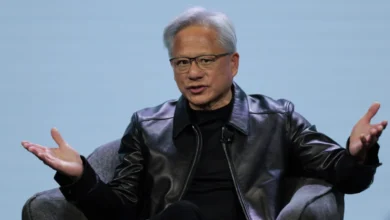
This erratic price action occurred against the backdrop of a broader, tumultuous month for the tech industry. Investors have been whipsawed by the internal governance struggles at Nvidia, including the resignation and subsequent reinstatement of CEO Jensen Huang. Despite the inherent instability signaled by such leadership turnover, the stock had previously surged 31%, adding approximately $950 billion in market capitalization and single-handedly propping up the S&P 500 with a 4.7% gain. Yet, the current environment remains precarious; the S&P 500 is currently trading roughly 8% below its October 6 record high, having recently emerged from a seven-session losing streak—the index’s longest period of sustained decline since the onset of the pandemic in February 2020.
The Anatomy of Concentration
The primary issue confronting the average retirement saver is the unprecedented level of market concentration. According to data provided by Charles Schwab, the market is currently experiencing levels of concentration not seen in the last 35 years. The S&P 500, often touted as the bedrock of a balanced portfolio, is now heavily skewed toward a handful of companies. Specifically, 10 stocks currently account for nearly 39% of the index’s total market capitalization. Even more striking is the dominance of the "Big Five"—all technology giants—which represent 29% of the total index value.
This mathematical reality means that a passive investor with a $100,000 balance in an S&P 500 index fund is essentially placing $29,000 of their nest egg on the performance of just five corporations. Martin Mulyadi, a professor of accounting at Shenandoah University’s College of Business, Engineering & Technology, suggests that this creates a false sense of security. "An index fund spreads your money across 500 companies, but it does not spread the risk evenly," Mulyadi noted. For the millions of Americans who rely on target-date funds—which, according to Fidelity, are utilized by approximately two-thirds of their 401(k) participants—this exposure is often hidden beneath layers of automated asset allocation.
The 401(k) Millionaire Phenomenon and the Risk of Reversal
The recent bull market, driven by the massive expansion of the AI sector, has been an undisputed boon for American retirement accounts. The S&P 500 has climbed just over 50% during the past five years, a trajectory that propelled the number of "401(k) millionaires" at Fidelity to a record 769,000 as of June. While that figure experienced a minor contraction of 2% between the second and third quarters of the year, it remains 15% higher than the previous year’s levels.
Despite the recent volatility, investor behavior remains remarkably resilient. Data from Fidelity’s third-quarter retirement analysis reveals that 96% of 401(k) participants either maintained or increased their savings contributions during the period. Sharon Brovelli, president of workplace investing at Fidelity, emphasized that workers are continuing to take advantage of the long-term structural features of their retirement plans, such as automated contributions and employer matching. However, the paradox remains: while individuals are doing the "right thing" by saving consistently, the underlying investments they are purchasing are becoming increasingly correlated with the volatility of the tech sector.
Implications for Older Workers and Sequence-of-Returns Risk
The danger of this concentration is not uniform; it is particularly acute for those nearing retirement age. The average 401(k) millionaire at Fidelity is 58 years old, placing them in a critical transition phase where portfolio preservation is typically prioritized over aggressive growth. For these individuals, a significant market downturn occurring in the years immediately preceding or following retirement can have a catastrophic impact on their long-term financial security.
Financial planners identify this as "sequence-of-returns risk." If a retiree is forced to liquidate assets during a market trough to cover living expenses, they permanently lock in losses and reduce the principal available to participate in a eventual market recovery. When a portfolio is overly concentrated in high-beta tech stocks that are prone to double-digit daily swings, the probability of being forced to sell during a drawdown increases significantly.
Strategic Adjustments in a Skewed Market
Industry experts are not necessarily advising a mass exit from equities, but rather a more nuanced approach to asset allocation. Sean McEvilly, managing partner and founder of Vistamark Investments, argues that investors must look past the headline index numbers. "The practical move isn’t to bail out of stocks," McEvilly explains. "It’s to look at the whole 401(k), since target-date and large-cap funds often hold the same names, and make sure there’s real exposure to small and midsized companies, international stocks, and bonds."
To mitigate the impact of market volatility, firms like Charles Schwab advocate for the maintenance of a "short-term reserve." This involves keeping a portion of one’s portfolio in highly liquid, low-risk assets—such as cash equivalents or short-term treasury bills—that can be tapped during market downturns. This buffer strategy allows retirees to avoid selling their depreciated equity holdings, thereby allowing their core investments the time required to recover.
Looking Ahead: The Structural Shift
The current market environment serves as a reminder that the passive investing revolution of the last two decades has created a unique market structure. Because so much capital is funneled into index funds, the price discovery process is increasingly dictated by the largest, most influential companies. When those companies—Nvidia, Microsoft, Apple, Alphabet, and Amazon—experience a synchronized sell-off, the entire index moves in lockstep, regardless of the health of the underlying 495 smaller companies.
As the AI hype cycle matures and regulators begin to scrutinize the power of the tech giants, the correlation between these companies and the broader market may only strengthen. For the American worker, the path forward requires a shift from "set it and forget it" mentality to a more active, or at least more informed, oversight of their retirement holdings. The strength of the U.S. labor market and the commitment of employees to save for the future remain robust, but the vehicles for that savings—the index funds and target-date funds that serve as the backbone of the retirement system—must be monitored with an eye toward the inherent risks of modern market concentration. As investors look to the coming fiscal year, the challenge will be balancing the growth potential of technological innovation against the necessity of insulating one’s financial future from the erratic, high-velocity swings of a top-heavy market.