Rock Legend Slash Immortalized in Science as Researchers Name New Guinea Snake Species Lielaphis slashi

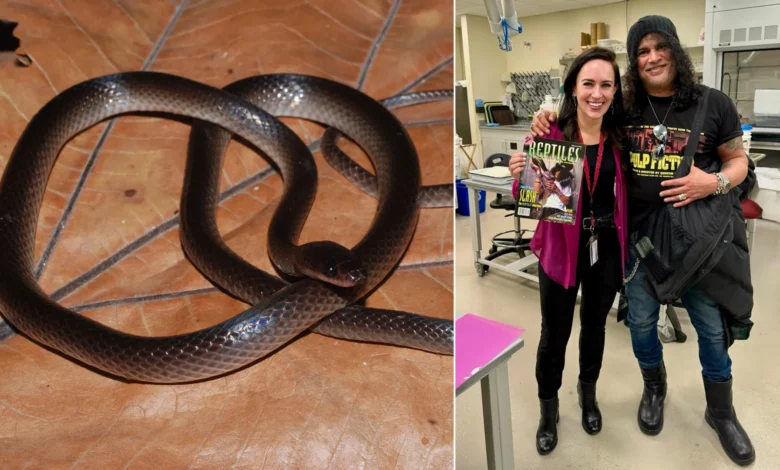
To millions of music fans worldwide, Saul Hudson is universally recognized by his stage name, Slash, the iconic, top-hat-wearing lead guitarist of the legendary hard rock band Guns N’ Roses. However, music has only ever told a fraction of the artist’s life story. Decades before achieving global superstardom on stadium stages, Hudson developed a profound, lifelong fascination with reptiles. Over the years, this enduring passion transformed into active philanthropy, marked by his steadfast support for zoological institutions, natural history museums, and wildlife conservation initiatives. Now, this lesser-known facet of the musician’s life has culminated in a remarkable and unusual scientific tribute: researchers have formally named a newly discovered species of groundsnake from the rainforests of New Guinea Lielaphis slashi, commonly referred to as Slash’s groundsnake.
The formal description of the reptile, published in the peer-reviewed scientific journal Zootaxa, bridges the worlds of rock-and-roll history and modern herpetology. For the scientists behind the discovery, the honor was deeply personal, serving as the realization of a childhood aspiration rooted in the intersection of pop culture and scientific curiosity.
A Lifelong Infatuation Meets Childhood Inspiration
The path to naming a newly discovered serpentine species after a rock musician began decades earlier in the mind of Sara Ruane, the Field Museum’s Associate Curator of Herpetology and the senior author of the research paper. For Ruane, Guns N’ Roses was a defining cultural touchstone during her formative years.
"Guns N’ Roses has been one of my favorite bands since I was in first grade, and by fifth grade, I had already told my teacher that I wanted to be a herpetologist—a scientist who studies reptiles—when I grew up," Ruane reflected.
That dual passion for music and reptiles converged when Ruane was twelve years old and received an issue of Reptiles Magazine in the mail. The cover featured Slash holding his pet reticulated python. For a young aspiring scientist, seeing a mainstream global celebrity openly championing reptiles provided a powerful validation of her own interests. Years later, after completing her doctoral studies and establishing herself as a professional researcher with the authority to designate official scientific names for newly recognized species, Ruane recalled that enduring magazine feature.
Upon rereading the vintage interview, she discovered striking parallels between her own childhood and the musician’s upbringing. Slash spoke candidly about his deep-seated love for museums, zoos, and natural history, alongside childhood memories of exploring the outdoors in search of wild snakes. Recognizing these shared foundational experiences, Ruane determined that honoring the musician with a scientific namesake would be a fitting tribute to an unexpected ally in public science advocacy.
Upon learning of the honor, Slash expressed profound gratitude and disbelief. "As a long-time herpetophile, I am extremely honored and humbled to have Lielaphis slashi from New Guinea named after me. It is really exciting, I never would have imagined this moment would arrive," the musician stated.
Chronology of a Discovery: From the Forests of New Guinea to the Laboratory
The physical specimen that would eventually bear the rock icon’s name was first collected nearly two decades prior to its official classification. New Guinea, situated just north of Australia, stands as the world’s second-largest island—surpassed only by Greenland—and is politically divided between the Indonesian provinces of Papua and West Papua, and the independent nation of Papua New Guinea. Its extensive tropical rainforests harbor an extraordinary wealth of biodiversity, a significant portion of which remains undocumented, understudied, and vulnerable to environmental pressures.
The timeline of the discovery unfolded across multiple phases of field research and advanced laboratory analysis:
- Nightfall in 2006: During nocturnal fieldwork in the dense forests of New Guinea, Chris Austin—a professor and curator of herpetology at the Louisiana State University Museum of Natural Science—encountered an unfamiliar groundsnake. Recognizing that the specimen did not neatly align with known regional classifications, Austin collected it for further study.
- The 2016 Collaboration: Following the completion of her doctorate, Ruane joined Austin at Louisiana State University in 2016. The two researchers initiated a collaborative research initiative aimed at untangling the complex taxonomy of New Guinea’s poorly understood snake populations, establishing a partnership that continues to yield scientific insights.
- Genomic and Physical Analysis: Tianqi Huang, a postdoctoral researcher at the Field Museum working alongside Ruane, spearheaded the laboratory investigations. Utilizing cutting-edge genetic analyses, the research team compared the DNA of Austin’s 2006 specimen against related taxa within the same genus.
- Publication in Zootaxa: Following exhaustive morphological examinations—which included quantifying scale variations—and ecological modeling, the team confirmed that the reddish-brown, 28-inch-long specimen represented a species entirely new to science. The formal description was published in Zootaxa, cementing the binomial nomenclature Lielaphis slashi.
Scientific Differentiation and Ecological Profile
At first glance, the newly classified groundsnake did not immediately present obvious external deviations from other known regional snakes. However, modern integrative taxonomy relies on a synthesis of multiple independent lines of evidence to confirm species boundaries.
"Using multiple cutting-edge genetic analyses, we found that L. slashi is genetically distinct from other similar snakes in the same genus," explained Tianqi Huang, the study’s first author and a researcher affiliated with both the Field Museum and Rutgers University. "The combination of physical characteristics, like differences in numbers of scales when compared with other species, and the genetic evidence is what led us to realize that it is an entirely new species. We also used ecological modeling to show that L. slashi’s preferred habitat is different from similar snakes."
Observing these animals in their natural habitat presents immense challenges for field researchers. Because New Guinea groundsnakes are strictly nocturnal, scientists must conduct surveys during dark hours, typically timing their searches for the periods immediately following sunset. During these nocturnal windows, the snakes emerge at the base of large forest trees to forage for prey. Fieldwork in these environments also requires extreme vigilance, as the island’s nocturnal ecosystem includes several highly venomous species that bear a strong visual resemblance to harmless groundsnakes.
Anatomical assessments of L. slashi provide critical clues regarding its dietary habits and predatory mechanics. Like other members of its genus, the snake features specialized, enlarged teeth situated in the posterior region of its jaw. Rather than employing constriction—the hunting strategy utilized by boas and pythons to subdue larger mammalian prey—these snakes use their specialized rear teeth to secure and consume slippery-scaled lizards and the subterranean eggs of other reptiles.
Despite Guns N’ Roses historically billing itself as "the most dangerous band in the world," its reptilian namesake poses no threat to human populations. L. slashi lacks venom capable of causing serious physiological harm to humans, aligning it with the vast majority of non-aggressive, non-venomous forest floor dwellers.
Conservation Implications and Anthropogenic Threats
While L. slashi is harmless to people, human activity presents a compounding array of severe threats to the survival of the species and the broader ecological integrity of New Guinea’s rapidly changing landscapes. The ecosystems that sustain Slash’s groundsnake are increasingly compromised by commercial expansion, industrial agriculture, and resource extraction.
"The habitats that Slash’s groundsnake is from are under threat from industries like coffee farming and mining," Ruane noted. "That’s part of why describing the species that live there is important. Every species should be recognized in order for us to better understand how ecosystems work, how everything fits into the environment. We can’t conserve animals or other living things that we don’t know about."
The formal documentation of biodiversity serves as a foundational prerequisite for effective environmental policy and conservation planning. Without baseline taxonomical data identifying which organisms exist within a specific geographic zone, international conservation bodies and local governments cannot accurately assess extinction risks or allocate resources for habitat protection. By mapping the genetic lineages and ecological niches of species like L. slashi, the scientific community gains a clearer diagnostic tool for evaluating the health of tropical ecosystems under siege from deforestation and climate stress.
The discovery underscores a broader collaborative effort within international herpetology. In addition to Ruane, Huang, and Austin, the published research paper benefited from contributions by an extensive network of institutions, including Justin Bernstein (Slippery Rock University and the American Museum of Natural History), Bulisa Iova (Papua New Guinea National Museum and Art Gallery), Jackson Roberts (Virginia Museum of Natural History), and Jeffrey Frederick (University of Kentucky).
Ultimately, the naming of Lielaphis slashi transcends a clever pop-culture homage. It stands as a testament to the enduring synergy between public advocacy for the natural sciences and rigorous, empirical fieldwork—ensuring that a quiet, nocturnal predator from the forests of New Guinea is permanently recorded in the annals of science, bearing the name of a rock icon who spent a lifetime championing the quiet, scaly corners of the natural world.