President Donald Trump Addresses White House Correspondents’ Association Dinner with Scathing Remarks and Unconventional Style

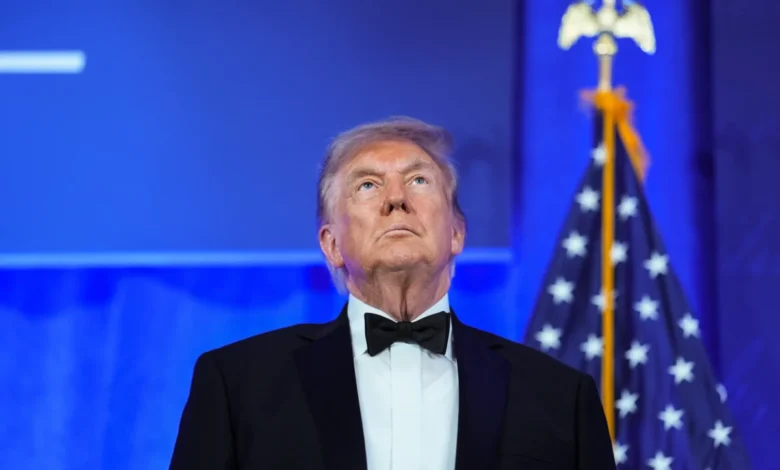
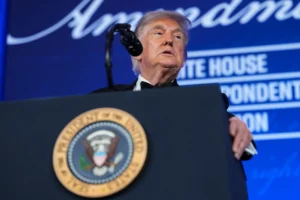
President Donald Trump made his inaugural appearance at the White House Correspondents’ Association Dinner, a long-standing tradition that saw its rescheduled gala held on Friday evening in Washington, D.C. In a speech that stretched for just over an hour, Trump delivered a series of pointed and often contentious remarks to the assembled journalists, politicians, and media figures. The event, which had been disrupted earlier in the year by a security incident, provided a platform for Trump to air his grievances and assert his unique brand of communication.
Trump began his address with a seemingly conciliatory tone, stating, "I am delighted to be here at the White House Correspondents’ Dinner. Amazing people, a lot of people that I like. Some I don’t like at all, but I respect most of them." However, this initial civility quickly gave way to a more characteristic and combative style. He mused on the intended tone of the evening, suggesting that compared to the barbs he had planned for the original, aborted dinner, he was holding back. "What do we do here? Is this supposed to be fun? Am I supposed to be serious? Am I supposed to be a comedian?" he asked the audience, before concluding, "So I guess you said, maybe a little bit of everything."
A Scathing Critique of the Media Landscape
The President’s address soon pivoted to a direct confrontation with the press, launching into a broadside against what he termed the "fake news media." He drew a parallel between the awards presented at the dinner and the Academy Awards, which he criticized for their declining viewership, attributing it to their perceived anti-Trump sentiment. "This evening it’s really all about the fake news media and your handling of prizes – writing and producing and performing made-up stories like the Academy Awards," Trump declared. He elaborated on the decline of the Oscars, stating, "The Academy Awards used to be the the epitome of ratings outside of the Super Bowl… Now it’s down in the dumps. Nobody wants to watch it anymore because they took on Trump. They hit me all night long."
Trump went on to predict dire financial consequences for the media once his presidency concludes. "When I’m gone. You’re all going to be broke. Your business model is going to be finished. No, it’s true. When I’m not around, you’re going to be broke. There’s not going to be anybody to report on. Nobody gives a damn about anybody else," he asserted. He then highlighted his perceived success in bypassing traditional media channels, boasting about his popularity on platforms like TikTok. "I’ve given up on you and the media, so that now I just gave up on you, and I’m number one on TikTok. Did you see that? I gave up on you, people. I gave up on traditional press, and it obviously worked because we did win in a landslide," he claimed, referencing his victory in the 2020 election, a claim that contradicts factual election results. He also mentioned his involvement in the sale of TikTok to a group of wealthy Americans.
A History of Media Friction and Event Context
President Trump’s attendance at this year’s dinner marked a significant departure from his previous four years in office, during which he consistently skipped the event, citing unfair media treatment. "I thought the press treated me very, very unfairly, and I don’t know. I think I made the right decision because they need to go where maybe you’re not wanted, but they did want me. They wanted me for ratings, and they wanted me for other reasons, but not for love. And I said, ‘You know, I’m not going to go.’ First time that ever happened… And I didn’t go for four years because I got treated terribly by the press," he explained.
This year’s dinner was notable for the White House Correspondents’ Association’s decision to forgo a comedian, a traditional element of the event that often involves roasting the sitting president. Trump took aim at prominent late-night hosts, including Jimmy Kimmel, Jimmy Fallon, and Stephen Colbert, dismissing them as lacking talent and being "angry people." "They considered using Jimmy Kimmel, Jimmy Fallon. These guys – they’re terrible. They’re terrible. Stephen Colbert. These are people without talent… They have no talent, but they are not comedians. They’re not funny people. They’re angry people. They’re sick people," he stated.
The gala itself was held at the Waldorf Astoria hotel in Washington, D.C. The original date for the event, April 25th, was disrupted by what authorities described as an assassination attempt on President Trump. A gunman reportedly breached security at the Washington Hilton, where the dinner was initially scheduled, and was subsequently apprehended. Trump acknowledged the incident during his speech, expressing gratitude to law enforcement for their actions. The rescheduled event featured a performance by mentalist Oz Pearlman, a departure from the usual comedian.
Personal Attacks and Unconventional Anecdotes
The President’s speech was peppered with personal insults directed at a range of individuals. He singled out CNN anchor Don Lemon, labeling him the "dumbest man on television" and speculating that he would never make a career comeback. He also criticized CNN anchor Kaitlan Collins, who received a WHCA award for her coverage of a confrontation between Trump and Ukrainian President Volodymyr Zelensky. While congratulating Collins, Trump dismissed her award as "fake" and stated she "shouldn’t get the award." He then embarked on a peculiar tangent about Collins, commenting on her demeanor and suggesting she should smile more. He followed this with a bizarre anecdote comparing Collins to transgender influencer Dylan Mulvaney and Bud Light’s controversial 2023 campaign, which he claimed cost the company significant market capitalization.
Anderson Cooper, another CNN anchor, also received commentary. Trump acknowledged a past working relationship, stating, "I like Anderson actually because he’s covered me well for many years, and he went bad as soon as I went for politics. But for years, he loved interviews. I did so many interviews with him, and he was great."
The President’s ire extended to a broader list of perceived adversaries, including California Governor Gavin Newsom, U.S. Representative Ilhan Omar, Senators Elizabeth Warren and Chuck Schumer, Rosie O’Donnell, and musician Bruce Springsteen. Regarding Springsteen, Trump remarked, "What the hell happened to that guy? He looks like hell… I’m sure he doesn’t like the way I look, but I don’t look so bad." He criticized Springsteen’s concert for its political content, joking that the tour had been renamed "Bored in the USA."
Awards, Lawsuits, and Future Ambitions
A particularly awkward moment arose when Trump acknowledged the Wall Street Journal reporters who had won the Katharine Graham Award for Courage and Accountability for their story about a birthday letter purportedly written by Trump to Jeffrey Epstein. Trump, who has vehemently denied authoring the letter, has been engaged in a high-stakes legal battle with the Journal over the report. He initially filed a $20 billion defamation lawsuit, which was later dismissed by a judge but refiled by Trump. The Journal’s legal team has characterized his lawsuit as "an affront to the First Amendment." Despite the ongoing litigation, Trump shook the hands of the award recipients before mockingly throwing up his hands and returning to his seat. He humorously questioned his own standing in the awards process, asking, "Do I get a say in those awards?"
Towards the conclusion of his lengthy address, Trump donned a "Trump 2028" hat and alluded to a potential fourth term in office, reiterating his unsubstantiated claims of winning the 2020 election. He also expressed his intention to attend the correspondents’ dinner in 2027.
In a lighter, albeit still pointed, moment, Trump made a joke at the expense of Robert F. Kennedy Jr., his Secretary of Health and Human Services, referencing an incident involving a cow and suggesting an appetizer of raccoon roadkill, which he stated was vetoed.
Broader Implications and Media Landscape
President Trump’s engagement at the White House Correspondents’ Dinner underscores the deeply adversarial relationship he has maintained with much of the mainstream media throughout his political career. His consistent denunciation of news organizations as "fake news" and his pattern of attacking individual journalists, coupled with his willingness to pursue legal action against outlets he deems to be providing unfavorable coverage, has created a palpable tension between the press corps and the executive branch. This dynamic has significant implications for the flow of information, public trust in institutions, and the very nature of political discourse in the United States.
The WHCA dinner, traditionally a forum for both celebrating the role of the press and engaging in lighthearted political satire, has increasingly become a focal point for these tensions during Trump’s presidency. His decision to attend and deliver such a confrontational speech, rather than a more traditional humorous roast, signals a deliberate strategy to leverage the platform for his own messaging and to directly challenge the media’s perceived biases. The event, therefore, serves not only as a reflection of the current political climate but also as a battleground where narratives are contested and power dynamics are on full display. The refusal of the WHCA to book a comedian this year, and Trump’s own critique of prominent humorists, further highlights the evolving and often contentious relationship between political power and comedic commentary in the current era.
The legal battles and public confrontations detailed in Trump’s remarks, such as the ongoing lawsuit against The Wall Street Journal, illustrate a broader pattern of using legal and public relations strategies to shape media coverage and to exert pressure on news organizations. The dismissal of his initial lawsuit, followed by its refiling, demonstrates a persistent commitment to challenging reporting he dislikes, raising questions about the First Amendment and the boundaries of journalistic protection.
The appearance of figures like Paramount CEO David Ellison, who reportedly suggested renaming the dinner the "Trump White House Correspondents’ Dinner," and Trump’s own aspirations to attach his name to prominent institutions, speak to a larger theme of personal branding and legacy-building that has characterized his presidency. The mention of Bari Weiss, whose presence at CBS News drew a reaction from the audience, and the comments about White House Press Secretary Karoline Leavitt, suggest an attempt to acknowledge allies while also reinforcing his criticisms of the press.
Ultimately, President Trump’s address at the White House Correspondents’ Association Dinner was a manifestation of his long-standing, often combative, relationship with the media. It was an event marked by personal attacks, unsubstantiated claims, and a clear intention to assert his dominance over the narrative, even within an institution designed to scrutinize and report on power. The event, therefore, served as a microcosm of the broader challenges facing journalism in an era of heightened political polarization and evolving media consumption habits.
Related posts: