A Surprising Snap: Simple Liquids Exhibit Brittle Fracture, Challenging Decades of Fluid Dynamics Theory

In a laboratory discovery that is poised to fundamentally alter our understanding of fluid mechanics, researchers at Drexel University have observed a phenomenon previously thought impossible: simple, non-elastic liquids fracturing like brittle solids. The groundbreaking work, led by research professor Thamires Lima in Drexel’s chemical engineering department, challenges long-held scientific assumptions and opens new avenues for exploration in fields ranging from materials science to industrial engineering.
For years, the prevailing wisdom in fluid dynamics has dictated that viscous liquids, those that resist flow, primarily deform when subjected to stress. Think of honey or molasses; when you stir them, the molecules rearrange, and the liquid flows. This behavior is attributed to viscosity, a measure of a fluid’s internal resistance to flow, which typically involves the sliding and rearrangement of molecules. Elasticity, on the other hand, is the property that allows materials to deform under stress and then return to their original shape once the stress is removed. Brittle fracture, characterized by a sudden, catastrophic break, was understood to be a hallmark of elastic materials and solids, not simple liquids.
However, during a series of experiments conducted in collaboration with the oil and gas giant Exxon Mobil, Lima encountered an anomaly that defied conventional explanation. While studying the extensional rheology of a hydrocarbon blend – a process involving stretching liquids between metal plates to measure the force required for them to flow – she heard a sharp, unexpected crack. Initially attributing the sound to a malfunction in the testing apparatus, Lima soon realized the source of the noise was far more remarkable: the liquid itself had fractured.
"I thought it was the machine," Lima recounted, referring to the incident that occurred several years ago. But the sound emanated from the very substance being tested, a gooey, black mixture of hydrogen and carbon. Instead of stretching as expected, the fluid had snapped apart. This was particularly astonishing because the material under investigation was classified as a simple fluid, possessing minimal to no elasticity. The discovery suggested that a fundamental tenet of fluid behavior might be incomplete, or even incorrect.
The implications of this observation were not immediately clear, but the unexpected nature of the event spurred further investigation. Arnold Mathijssen, a fluid physicist at the University of Pennsylvania, who was not directly involved in the study but is a leading voice in the field, commented on the surprising nature of the findings. "Nobody expected that this would be possible in this kind of simple fluid because viscosity usually just rearranges the molecules," Mathijssen stated. "You don’t expect it to crack. But it does, so I think that’s what’s really surprising." His statement underscores the significant paradigm shift this research represents.
A Brittle Break: Redefining Fluid Fracture
Undeterred by the initial surprise, Lima and her colleagues, including Nicolas J. Alvarez, a professor of chemical engineering at Drexel University whose lab spearheaded the research, embarked on a rigorous process to validate their observation. They repeatedly subjected the hydrocarbon blend to extensional stress, meticulously documenting the results. "Every time that she measured it, the material would break," Alvarez confirmed. He described the event with a vivid analogy: "It makes a loud pop. I mean, like you just took a rubber band and pulled it and stretched it and it snapped."
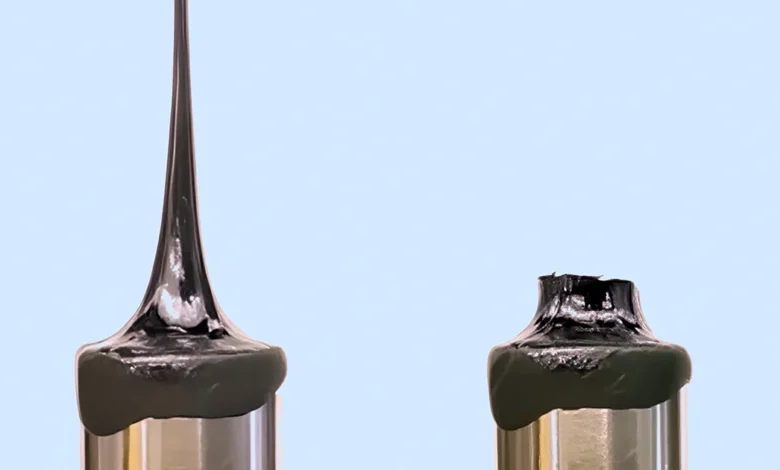
To delve deeper into the mechanics of this unprecedented fracture, the research team employed high-speed cameras. This advanced imaging technology allowed them to capture the phenomenon in exquisite detail, revealing that the liquid’s break was akin to a "brittle fracture." This term is typically reserved for the sudden, catastrophic failure of solid materials, such as glass or porcelain, when subjected to stress beyond their elastic limit.
Understanding brittle fracture in solids provides crucial context for this new discovery. Brittle solids, while exhibiting a degree of elasticity, possess microscopic imperfections, often on the nanometer scale. When stress is applied, these defects can become points of initiation for cracks. Once a critical stress threshold is reached, it becomes energetically more favorable for the material to propagate these cracks rather than to elastically store the applied energy. This leads to a rapid and often irreversible disintegration of the material.
Complex fluids, such as polymer melts, which are essentially melted plastics, can exhibit elastic properties due to the entanglement of their long molecular chains. These entanglements allow the material to store and release energy elastically, making them susceptible to similar fracture mechanisms observed in solids. Indeed, in a significant 2016 study published in Physical Review Letters, Alvarez and his team demonstrated that complex fluids like melted polystyrene could indeed fracture in a manner analogous to brittle solids. At the time, the prevailing hypothesis was that elasticity was a prerequisite for this type of solid-like failure in liquids. "We just thought elasticity was something that was a prerequisite for such solid type of breaking, right?" Alvarez recalled, reflecting on their earlier work. This led them to theorize that elasticity was intrinsically linked to liquid fracture.
However, the hydrocarbon blend studied by Lima and her team presented a stark contradiction. As a simple fluid, it lacked the significant elastic energy storage capabilities of complex fluids. Its response to extreme stress was expected to be flow, not fracture. This discrepancy forced the researchers to question the established understanding of what causes liquids to break. Brato Chakrabarti, a physicist specializing in fluid mechanics at the International Center for Theoretical Sciences in Bengaluru, India, voiced the fundamental question arising from these findings: "If there is no elasticity in a problem, then how can you think about initiation or growth of a crack?"
Revisiting Foundational Theories: The Legacy of Daniel D. Joseph
The unexpected cracking of the simple fluid prompted Lima and Alvarez to revisit the work of Daniel D. Joseph, a pioneering mechanical engineer at the University of Minnesota. As early as the mid-1990s, Joseph had proposed in influential papers published in 1995 and 1998 that any liquid, irrespective of its elasticity, could fracture under a sufficiently high tearing stress. One of his key theoretical contributions, explored in a 1995 Physical Review E paper, suggested that cavitation – the formation of voids or bubbles within the liquid – could be the mechanism enabling this fracture.
Alvarez speculates that the breaking point of a liquid might not be tied to a property like elasticity, but rather to a more fundamental characteristic: the cohesive energy that binds molecules together. "Maybe, just maybe, the thing that causes [certain] fluids to break… [is] somehow related to this cohesive energy that holds the molecules together," he posited. This idea aligns with Joseph’s earlier work, suggesting that if the intermolecular forces holding the liquid together are overcome, the liquid could indeed fracture.
A Burst Bubble: The Role of Cavitation in Fluid Fracture
Simple fluids do possess a natural mechanism for stress relief that does not involve breaking: cavitation. This process involves the formation of temporary intermolecular voids, or bubbles, within the liquid. A common example occurs with the propellers of boats and ships. When a propeller spins rapidly, the fluid on one side of the blade can be forced to move at a significantly higher velocity than on the other. This speed differential can lead to a localized drop in pressure, causing the liquid to vaporize and form bubbles. While engineers strive to prevent cavitation due to the damaging shockwaves generated when these bubbles collapse, it illustrates how pressure changes can lead to void formation in simple fluids.
Joseph’s theoretical predictions indicated that cavitation could indeed serve as the precursor to fracture in simple fluids. Alvarez elaborated on this concept: "If you think about what holds a fluid together, it’s cohesiveness, or the intermolecular interactions between the molecules. If you pull those molecules apart, you can create a bubble." In most viscous liquids, the surrounding fluid’s viscosity allows it to deform and adapt around these newly formed bubbles, maintaining overall cohesion. However, Alvarez suggests that if a sufficient number of these bubbles form in rapid succession, the liquid could theoretically fracture, much like a pane of glass.
The Drexel researchers’ experiments with the hydrocarbon blend provided compelling evidence for this mechanism. They observed that once a crack initiated within the simple fluid, it propagated with astonishing speed. This rapid propagation is attributed to the very lack of elasticity that initially seemed to preclude fracture. "If you can get that nucleation event of the crack to begin, because there is no elasticity in the material, that crack can propagate as fast as physics will allow it," Alvarez explained.
This observation stands in stark contrast to the crack propagation speeds observed in complex fluids. In their previous research on melted polystyrene, the Drexel team measured crack speeds of approximately 0.07 meters per second. In the new study, however, the cracks in the simple hydrocarbon blend propagated at velocities ranging from an astonishing 500 to 1,500 meters per second. This dramatic difference, Alvarez suggests, is related to how the material dissipates energy. In complex fluids, the long molecular chains can absorb some of the energy as they break. But in simple fluids, "there’s really nothing to slow that crack down," he stated. This rapid propagation also influences the visual appearance of the fracture: while cracks in complex fluids often resemble the flared opening of a trumpet horn, those in simple fluids appear as sharp, distinct breaks, much like those seen in glass.
How To Crack a Liquid: Unifying Principles and Future Frontiers
Remarkably, despite their differing mechanisms and appearances, both complex and simple fluids tested by the researchers tended to fracture at a similar critical stress threshold: approximately 2 megapascals. To further investigate this, the team manipulated the temperature of the hydrocarbon blend, thereby altering its viscosity. They discovered that only the least viscous liquid tested failed to fracture, suggesting a relationship between viscosity and fracture resistance. The researchers concluded that the critical stress level at which liquids fracture appears to be proportional to their viscosity multiplied by the strain rate – essentially, how quickly the liquid is being stretched and how its diameter is changing.
The limitations of the testing equipment, specifically its maximum pulling speed of 500 millimeters per second, have prompted speculation about the potential for fracturing even less viscous liquids. "There are very few instruments comparable to ours," Lima noted. She believes that with a machine capable of higher pulling speeds, it might be possible to induce fracture in liquids like honey or even water, materials that are currently considered far too fluid to exhibit such behavior.
Looking ahead, Lima intends to refine her experimental setup to better visualize the fracture process. She plans to use more transparent liquids and employ advanced microscopy techniques to examine the crack formation at the nanometer scale. The prospect of capturing the moment of fracture in real-time, and then instantly freezing and probing the resulting structure, offers an unprecedented window into the fundamental physics of liquid behavior.
The implications of this research extend far beyond theoretical fluid dynamics. Alvarez is particularly interested in exploring the potential applications of this discovery in materials science, specifically in the process of spinning materials into fibers. Such advancements could have significant impacts on industries ranging from textiles to biomedical engineering, where the precise control of fiber formation is crucial. Furthermore, the understanding of liquid fracture could inform developments in inkjet printing technologies, the design of advanced protective materials for applications like brain injury prevention, and the creation of more sophisticated soft robotics.
However, for Alvarez and the wider scientific community, the most profound aspect of this discovery lies in its challenge to established knowledge. "It’s different than what we’ve been thinking about in the literature for a very long time," he concluded, emphasizing the transformative potential of understanding how and why simple liquids can, against all previous expectations, shatter. This research not only rewrites a chapter in fluid dynamics but also opens the door to a deeper appreciation of the complex and often surprising behaviors of matter at its most fundamental level.