PGMO Chief Refereeing Officer Howard Webb Explains Divergent Penalty Decisions in Manchester United’s Draw at Bournemouth

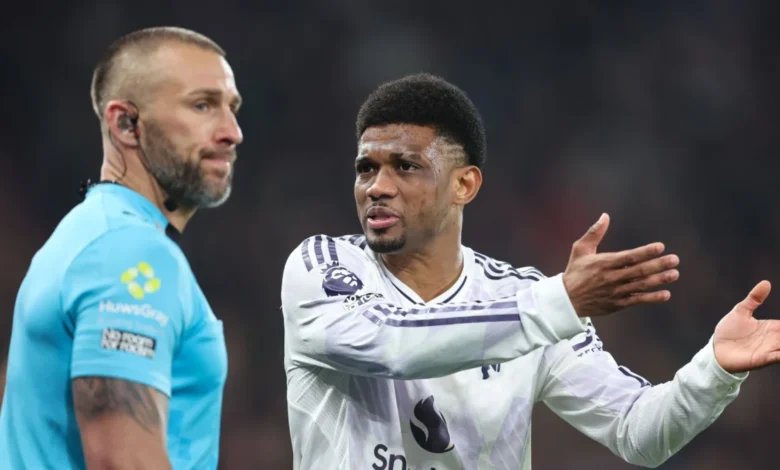
PGMO chief refereeing officer Howard Webb has provided an in-depth explanation for the contrasting penalty decisions that influenced Manchester United’s dramatic 2-2 draw against Bournemouth on the south coast in March, attributing the discrepancy primarily to the "difference in the speed the attackers are moving at." The controversial calls, which left Manchester United officials and players questioning the officiating, have been a focal point of discussion following the incident-packed Premier League encounter.
The match saw Manchester United take the lead twice through goals from Bruno Fernandes and an own goal by James Hill. However, Bournemouth fought back, with Ryan Christie pulling one back before a late penalty converted by Eli Junior Kroupi secured a point for the hosts. The outcome was significantly shaped by two key penalty incidents, one awarded to Manchester United and another, which was a penalty and a red card, awarded to Bournemouth.
A Tale of Two Halves and Two Penalty Decisions
The first significant penalty decision of the match occurred when Manchester United was awarded a spot-kick. Bruno Fernandes converted this opportunity after Alex Jimenez was judged to have pulled the arm of Matheus Cunha. This decision appeared to set a precedent for similar challenges in the penalty area.
However, controversy erupted in the second half when Manchester United winger Amad Diallo had a penalty appeal dismissed by both the on-field referee and the Video Assistant Referee (VAR). Diallo went down in the box under a challenge from Adrien Truffert, with Manchester United arguing that the contact was sufficient to warrant a penalty. Crucially, this incident occurred moments before Bournemouth equalized through Ryan Christie, intensifying the debate around the officiating.
The second contentious moment came late in the game when Manchester United centre-back Harry Maguire was shown a straight red card. Maguire was penalized for denying a clear goalscoring opportunity by pulling back Bournemouth’s Evanilson. The foul resulted in a penalty for Bournemouth, which Kroupi successfully converted to level the scores.
Webb’s Analysis: The Crucial Factor of Attacker Speed
Howard Webb, speaking on the program Match Officials Mic’d Up, detailed the reasoning behind the differing interpretations. He emphasized that while both incidents involved contact, the context and the dynamic of the play were fundamentally different.
"They’re both pushing actions, but there are some differences," Webb stated. "Most of the difference sits around the speed the attackers are moving at."
Webb elaborated on the Amad Diallo incident, noting: "In Amad’s case, he wasn’t moving particularly quickly. There was some contact. It’s a judgment call on how impactful it is." He explained that the assistant referee, Constantine Hatzidakis, was focused on the offside line at the time of the incident, and the referee, Stuart Attwell, believed that Diallo was "waiting for the contact" rather than being genuinely impeded. The VAR, Craig Pawson, concurred, deeming the contact "not sufficient for how he goes down."
In stark contrast, Webb highlighted the nature of the challenge on Evanilson that led to Maguire’s red card and the penalty. "Evanilson is going past Maguire. It’s a completely different pace, in my opinion, to Amad. Maguire desperately pushes him over to stop him from going through to score. A very clear situation of a foul."
Webb underscored the principle of VAR intervention: "The on-field decision was foul. In both cases, the referee’s decision was respected by the VAR and the referee’s call stood." He further clarified that had the on-field referee not awarded the penalty for Maguire’s challenge, VAR would have intervened due to the clear nature of the foul. "In this situation [Maguire foul], if the referee hadn’t given a penalty, then I think VAR would have stepped in because, in my opinion, it’s clearly and obviously a penalty."
Manchester United’s Frustration and Carrick’s Bafflement
The officiating decisions drew sharp criticism from Manchester United personnel. Captain Bruno Fernandes expressed his frustration at the perceived inconsistency, questioning how one penalty was awarded for a situation he deemed "the same" as the one denied to his teammate.
Manchester United head coach Michael Carrick echoed this sentiment, describing the decision not to award a penalty for the challenge on Diallo as "crazy" and "baffling."
"We should have had another penalty," Carrick stated in his post-match interview with Sky Sports. "Obviously, if you get one, you must get the other. It’s pretty much identical for me, two-hand grab. Either way, he’s got one wrong, but to give one and not give the other, I can’t get my head around it, I think it’s crazy. It’s a bit baffling, really."
Carrick emphasized the potential impact of the missed penalty on the game’s outcome: "Because of that, they score and then it’s chaos after that, really. We should have had another penalty and the game would have been totally different."
The Subjectivity of Penalty Decisions and VAR’s Role
Webb’s explanation delves into the inherent subjectivity in refereeing, particularly concerning fouls in the penalty area. He acknowledged that Truffert’s challenge on Diallo involved contact, but the critical factor was the perceived impact given Diallo’s pace.
"Truffert takes a risk. He places his hands on Amad, who is not moving at a great pace, but he is moving and there is definitely contact," Webb explained. "We know that players come into contact quite often, particularly in and around the penalty area. The referee has to make a judgment on how impactful that action is."
The PGMO chief refereeing officer reiterated the guidance for VAR intervention, emphasizing that referees are encouraged to err on the side of caution and not to be overly intrusive. "The referee deemed it wasn’t sufficient to award a penalty. The referee’s call is an important part of the way we apply VAR. Time and time again, people tell us not to be too intrusive, only step in when something is really clearly wrong."
Regarding the Diallo incident, Webb noted that VAR Craig Pawson considered it a subjective call. "In this situation, the VAR deemed it was a subjective call – could be a penalty, but it’s one of those grey situations." He revealed that the Key Match Incident panel, which reviews contentious decisions, was also divided on the Diallo incident but ultimately agreed that it did not meet the threshold for a "clear penalty," thus supporting the on-field decision.
Broader Implications and the Importance of Consistency
The contrasting penalty decisions in the Bournemouth vs. Manchester United match highlight a persistent challenge in football: achieving consistent application of the laws of the game, especially in situations involving subjective interpretation. While Webb’s explanation provides clarity on the specific reasoning, the outcome has inevitably fueled debate about whether the same criteria were applied across both incidents.
The Premier League, as a highly competitive and scrutinized league, places immense importance on accurate and consistent officiating. Incidents like these can have significant ramifications for team performance, league standings, and fan sentiment. The fact that both the on-field referee and VAR agreed on the decisions, as per Webb’s explanation, underscores the complex nature of officiating in real-time.
However, the perception of inconsistency can erode trust in the officiating system. For managers and players, understanding the nuances of these decisions is crucial for tactical preparation and on-field conduct. The emphasis on attacker speed as a key differentiating factor in foul assessment is a technical point that referees will continue to grapple with.
The incident also brings into focus the role of VAR. While designed to correct clear and obvious errors, its application in subjective situations remains a subject of ongoing discussion. The Key Match Incident panel’s divided opinion on the Diallo penalty suggests that even expert reviewers can find such incidents challenging.
The Premier League’s commitment to transparency, as exemplified by programs like Match Officials Mic’d Up, aims to provide insight into these complex decisions. However, the emotional stakes of matches mean that such explanations may not always assuage the frustration felt by clubs when they believe crucial calls have gone against them. The debate over these penalties is likely to continue, serving as a reminder of the fine margins and intricate judgments that shape the modern game.
Chronology of Key Events:
- First Half: Manchester United takes the lead through Bruno Fernandes from a penalty awarded for a foul on Matheus Cunha.
- Second Half: Amad Diallo’s penalty appeal for a challenge by Adrien Truffert is dismissed by the on-field referee and VAR.
- Shortly After Diallo Incident: Bournemouth equalizes through Ryan Christie.
- Late in Second Half: Harry Maguire is sent off for a foul on Evanilson, resulting in a penalty for Bournemouth.
- Late in Second Half: Eli Junior Kroupi converts the penalty to level the score at 2-2.
The final whistle confirmed a 2-2 draw, with the penalty decisions remaining a central talking point. The insights provided by Howard Webb offer a technical breakdown, but the emotional and competitive impact on the teams involved underscores the ongoing challenge of perfect officiating in football. The discussion around the Diallo incident and the Maguire foul highlights the fine line between contact and impediment, and how player movement speed can be a critical determinant in such judgments.
Related posts: