Colorful 1,800-Year-Old Roman-Era Belt Buckle Discovered in Ukraine Suggests Ancient Nomadic Connections

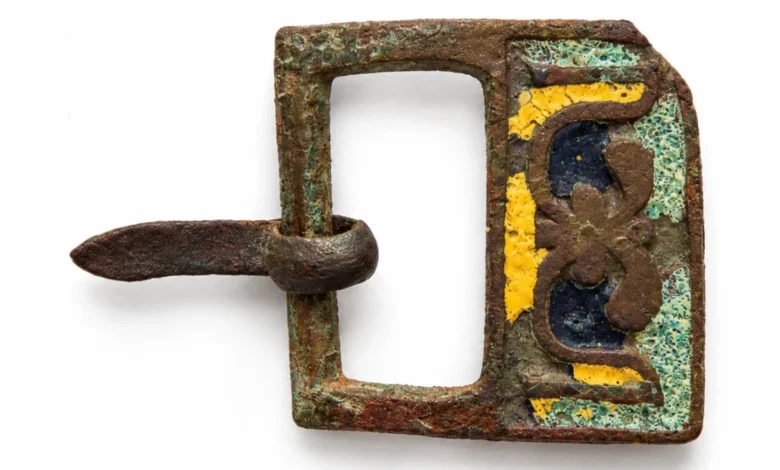
The discovery of a vibrantly decorated belt buckle in the Tsetsyn Forest of southeastern Ukraine has provided archaeologists with a compelling new window into the complex cultural and political interactions that occurred on the fringes of the Roman Empire nearly two millennia ago. The artifact, a compact, square metal piece measuring approximately 0.8 inches (2.1 centimeters) on each side, features intricate enamel work in shades of teal, blue, and yellow. Its recovery, facilitated by local residents and brought to the attention of academic authorities, underscores the rich, often hidden historical tapestry of a region that served as a dynamic frontier between the Roman world and the migratory tribes of the Eurasian steppe.
The Provenance of the Discovery
The buckle was unearthed by civilians in the Tsetsyn Forest, a locale already known to researchers for its historical significance. Following its discovery, the item was handed over to Antonii Moisei, a professor at the Bukovinian State Medical University, who has been instrumental in documenting local archaeological finds. According to the official statement released by the university, the artifact dates back approximately 1,800 years, placing its origin squarely within the 2nd or early 3rd century CE.
This timeframe is critical, as it corresponds with a period of intense volatility and transformation for the Roman Empire, particularly along its Danubian and northern frontiers. During this era, Rome was frequently engaged in diplomatic and military negotiations with various Germanic and Sarmatian tribes, whose nomadic equestrian warriors roamed the vast territories beyond the empire’s borders.
The Role of Enameling in Roman Craftsmanship
The buckle’s aesthetic, characterized by its vibrant enamel inlay, is a hallmark of "provincial Roman" art. While Roman central workshops were known for their sophisticated metallurgy, the use of bright, contrasting enamels became particularly popular in the frontier provinces—such as Gaul, Britain, and along the Danube—during the 2nd century. This style, often referred to by scholars as "champlevé" enameling, involved cutting troughs into the metal surface and filling them with powdered glass, which was then fired to create a durable, vitreous finish.
The presence of this craftsmanship in southeastern Ukraine suggests that the buckle was likely a prestige item. For a nomadic warrior, such an object would have served not only a functional purpose—securing a belt or harness—but also a symbolic one. It functioned as a status symbol, marking the wearer as a person of consequence who had either traded with Roman merchants or, more likely, served as an auxiliary or mercenary within the Roman military structure.
Chronology of Frontier Dynamics
To understand the significance of this discovery, one must look at the geopolitical climate of the 2nd and 3rd centuries. The chronology of the Roman presence in this part of Eastern Europe is defined by a series of shifts:
- 106 CE: Emperor Trajan completes the conquest of Dacia, bringing a large portion of what is now Romania and parts of neighboring regions into the Roman fold.
- 117–138 CE (Reign of Hadrian): Roman policy shifts toward the consolidation of borders, leading to the establishment of stable trade networks with the tribes living beyond the Limes (the fortified frontier).
- 160–180 CE (Reign of Marcus Aurelius): The Marcomannic Wars erupt, forcing the Roman Empire to contend with massive movements of nomadic peoples, including the Marcomanni, Quadi, and various Sarmatian groups.
- Late 2nd Century: The Tsetsyn Forest area becomes a crossroads for these shifting populations, as nomadic groups pushed westward and southward, interacting with the Roman frontier defense systems.
The buckle likely dates to this latter period, representing a time when Roman goods were moving deep into the "barbarian" territories as either diplomatic gifts, trade commodities, or spoils of war.
Archaeological Context and Regional Implications
The Tsetsyn Forest region, located near the modern city of Chernivtsi, sits at a geographical nexus. Historically, this area was a corridor for movement between the Carpathian Mountains and the Dniester River basin. For nomadic equestrian warriors, this terrain offered both grazing lands for their horses and strategic cover for maneuvers.
Professor Moisei and his colleagues have emphasized that the find is not an isolated incident. The Bukovinian region has yielded several artifacts over the years that point to a sustained, if complex, relationship between the local population and the Roman world. These findings suggest that the border was not a rigid wall but a porous zone of exchange. The "nomadic equestrian warrior" hypothesis is supported by the size and durability of the buckle; such items were designed to withstand the rigors of long-distance travel and the physical demands of horseback riding.
Expert Analysis and Academic Response
Archaeologists who have reviewed the initial reports on the Tsetsyn find note that the buckle’s design elements align with patterns found in the Roman provinces of Pannonia and Dacia. According to independent specialists, the preservation of the enamel suggests that the item was buried in a relatively stable soil environment, potentially within a burial site or a ritual deposit.
"What we are seeing here is the material manifestation of a ‘middle ground’ culture," says Dr. Elena Volkov, a scholar specializing in Eurasian frontier studies (speaking generally on the implications of such finds). "When we find Roman-style luxury goods in the hands of nomadic people, we aren’t just looking at trade. We are looking at a process of identity construction. A warrior wearing a Roman-made buckle was adopting a symbol of imperial power to enhance their own authority back home."
The academic community has welcomed the donation of the artifact to university archives, as it ensures the piece will be subjected to professional conservation. Future analyses, such as X-ray fluorescence (XRF) testing on the metal alloy and microscopic inspection of the enamel, are expected to reveal the exact geographical origin of the buckle—whether it was produced in a central Roman workshop or by provincial artisans catering to frontier markets.
Broader Impact on Historical Understanding
The discovery challenges the traditional, binary view of "Roman vs. Barbarian." By providing physical evidence of a high-quality, decorative Roman object in the hands of a nomadic warrior, the find validates the narrative that the Roman Empire exerted influence far beyond its garrisoned frontiers through cultural soft power.
Furthermore, this discovery underscores the importance of local community involvement in archaeology. In many parts of Eastern Europe, the preservation of history is heavily dependent on the cooperation between local residents and academic institutions. The prompt reporting of the buckle to Professor Moisei prevented the loss of this item to the illicit antiquities trade, ensuring that its context—however limited—remains preserved for future study.
Future Research Directions
As research continues, the focus will shift toward contextualizing the Tsetsyn Forest site itself. Archaeologists are planning to conduct non-invasive geophysical surveys in the surrounding area to determine if the buckle was part of a larger grave goods assemblage or perhaps part of a hidden hoard. If a burial site is located, it could provide researchers with bioarchaeological data, such as stable isotope analysis of human remains, which would offer clues regarding the warrior’s diet, birthplace, and migratory patterns.
This finding serves as a reminder that even the smallest artifact can be a significant piece of a much larger puzzle. As the study of the Roman frontier continues to evolve, the colorful, 1,800-year-old buckle stands as a testament to the interconnectedness of ancient societies, bridging the gap between the structured administration of Rome and the fluid, horseback-bound existence of the nomadic tribes that once shaped the history of the European continent.
The ongoing documentation of this find will eventually be integrated into a larger regional database, contributing to a more nuanced understanding of how Roman influence rippled outward, shaping the cultures and material traditions of the peoples who lived on the edge of the known world. For now, the buckle remains a symbol of an era where art and conflict were inextricably linked, and where a small, teal-and-yellow object could represent a lifetime of travel, combat, and cross-cultural contact.