Macklemore Embarks on Free Palestine Concert Tour Following High-Profile Removal from Ed Sheeran Global Stadium Trek

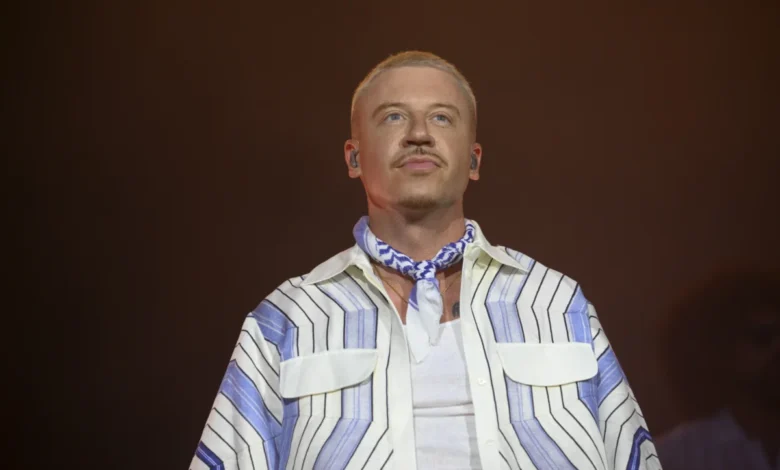
The intersection of global celebrity culture and geopolitical advocacy reached a volatile apex this year, culminating in the launch of a targeted three-show concert series by the rapper Macklemore. The artist, known for his socially conscious lyricism, kicked off his tour in Dublin, Ireland, in late October, framing the performances as a dedicated effort toward “love and liberation.” This series serves as the definitive response to his controversial removal from Ed Sheeran’s “Loop” stadium tour just six weeks prior—an event that ignited a polarized debate regarding the boundaries of political expression on international concert stages.
The Dublin performance, which featured surprise appearances by Hozier and the Irish hip-hop trio Kneecap, served as both a musical event and a platform for political discourse. Addressing the crowd, Macklemore reflected on the brevity of the two words that cost him his opening slot on one of the world’s most lucrative tours. “Six weeks ago, it was two words. Two words is all that it took,” the rapper told the audience. “Not against anybody, not divisive. Not a call for hatred. But a call to recognize our shared humanity. Free Palestine. I said free Palestine!”
A Chronology of the Conflict
The friction between the artist and the touring industry began in early September, following a series of statements made by Macklemore during his tenure as an opening act for Ed Sheeran.
On September 4, 2026, while performing at MetLife Stadium in East Rutherford, New Jersey, Macklemore used his platform to advocate for Palestinian liberation. He underscored the urgency of the message, stating, “I want those words to be loud and clear, so that people all the way in Gaza to the occupied West Bank know that we have not forgotten about them.” He repeated these sentiments during the following night’s show, adding a clarifying note that his advocacy was not intended as a critique of the Jewish community.
The fallout was rapid. The Israeli American Council (IAC) spearheaded a public pressure campaign, petitioning for the rapper’s removal. The IAC’s argument centered on the professional expectation of a concert environment, stating, “This was an Ed Sheeran concert—not a political rally, not a protest and not an activist event. The issue is not whether Macklemore has the right to hold political views. The question is where the line should be drawn when an opening act uses a global concert platform to advance a one-sided political agenda.”
By mid-September, the Messina Touring Group, the promoter for the tour, issued a statement confirming that Macklemore would no longer be participating. The promoter cited logistical and safety concerns, noting that various venues had refused to host concerts featuring the rapper, threatening the viability of the entire tour. “We were notified by venues that they will not allow a concert to take place with Macklemore on the lineup, which would result in the cancellation of the tour and impact hundreds of thousands of fans,” the statement read.
Industry Solidarity and Economic Fallout
The removal of the artist triggered a chain reaction of solidarity within the music community. Several other opening acts, including Finneas, Lukas Graham, and Aaron Rowe, as well as a significant portion of Sheeran’s backing band, exited the tour in protest.
The economic implications of the move were significant. Macklemore, who had reportedly earned a $1 million salary for his involvement in the tour, publicly announced that he would donate the entirety of those funds to humanitarian causes supporting Palestine. Furthermore, the rapper alleged that Robert Kraft, owner of Gillette Stadium, had played a pivotal role in lobbying for his removal. In a move aimed at de-escalating the situation, Kraft and Sheeran subsequently announced a joint $2 million donation to aid in the humanitarian crisis in the region, a gesture intended to bridge the divide between the artists’ political actions and the stadium owners’ corporate stances.
The Debate Over Artistic Neutrality
The controversy forced a broader industry conversation regarding the role of musicians in political discourse. Ed Sheeran, initially silent on the specifics of the conflict, eventually released a comprehensive statement addressing the situation. He sought to distance himself from the decision-making process of the promoters while clarifying his own philosophy on public advocacy.
“There is a reason I do not use my professional platform for politics—my audience includes young people, often children, of all backgrounds,” Sheeran wrote. “I choose to use my fame and platform to be a place of safety and sanctuary, to maintain diplomacy and keep conversations open, not closed.”
However, the pressure of the moment forced an evolution in Sheeran’s approach. By September 19, during a performance in Philadelphia, Sheeran broke his own policy of neutrality, acknowledging the complexities of the Israel-Gaza conflict. He described the events of October 7 as “horrific” while simultaneously characterizing the ongoing military action in Gaza as “catastrophic and unjustifiable.”
This pivot highlighted a growing trend: artists are finding it increasingly difficult to remain detached as fans, industry stakeholders, and activist organizations demand public stances on international human rights crises.
Humanitarian Commitments and Future Implications
Macklemore’s post-Sheeran tour itinerary, which includes dates in Paris and London, has been structured with a clear philanthropic intent. The rapper has committed all proceeds from these shows to organizations dedicated to relief efforts in Gaza. This move has solidified his status as one of the most vocal advocates in the music industry, effectively rebranding his professional setbacks as a catalyst for deeper humanitarian engagement.
The implications of this episode extend far beyond the career of a single artist. The incident at MetLife Stadium has established a precedent for how stadium owners, promoters, and touring artists interact when personal politics clash with corporate risk management.
Data from the event suggests that the “culture of neutrality” that has dominated the music industry for decades is under severe strain. Audiences are increasingly bifurcated; some demand that concerts remain “safe spaces” free from political agitation, while others argue that high-profile artists have a moral imperative to use their reach to highlight global suffering.
The Broader Context of Cultural Advocacy
Historically, music has functioned as a conduit for social change, from the Vietnam War protest songs of the 1960s to the anti-apartheid movements of the 1980s. However, the current digital landscape, where clips of on-stage speeches can reach millions within minutes, has changed the stakes. The “viral” nature of Macklemore’s speech was a primary driver of the subsequent backlash, demonstrating that an artist’s reach is now global, regardless of the physical size of the venue.
The incident has also highlighted the power of organized advocacy groups. The petition by the Israeli American Council represents a modern form of consumer activism that can exert significant pressure on corporate entities like the Messina Touring Group. By framing the issue as one of “professional conduct” rather than “political censorship,” these groups have found an effective mechanism to compel venues to take action.
As Macklemore continues his tour, the industry remains in a state of flux. The tension between the desire to maintain a neutral commercial environment and the push for artists to align their professional platforms with their personal values shows no sign of abating. The Dublin concert was not merely a set of songs; it was a defiant continuation of a debate that is redefining the parameters of what an artist can—and should—say when the world is watching.
With the tour continuing in Paris and London, the focus will likely remain on whether these performances can maintain their momentum without further industry pushback. For now, the events of this autumn serve as a case study in the power of the microphone and the cost of wielding it in an increasingly polarized global climate. The intersection of art, commerce, and human rights remains a precarious path, one that more artists are choosing to walk despite the potential for professional fallout.