Two Decades of Smitten Kitchen: How Culinary Blogger Deb Perelman Streamlined Thanksgiving Cooking and Perfected the Ultimate Pecan Pie Bar

For twenty years, culinary innovator Deb Perelman has documented the evolution of home holiday cooking through her influential food platform, Smitten Kitchen. Marking two decades of Thanksgiving recipe development, advice, and troubleshooting, Perelman’s journey reflects a broader shift in modern domestic cooking: a movement away from overly complex, multi-day culinary projects toward streamlined, high-impact efficiency. Over the course of her career, Perelman has transformed from an enthusiastic home cook into a trusted digital authority, offering strategic solutions for the perennial challenges of holiday meal preparation, oven management, and time constraints.
The Evolution of Modern Thanksgiving Cooking

The landscape of American holiday cooking has undergone significant transformations over the past two decades. In the mid-2000s, when food blogs were first emerging as a dominant cultural force, Thanksgiving curation often emphasized elaborate techniques, multi-step preparations, and intimidating ingredient lists designed to replicate restaurant-quality meals in standard domestic kitchens.
Over time, however, culinary commentators and home cooks alike began to encounter the practical limitations of these methods. Oven space scarcity, conflicting baking temperatures, and the sheer physical exhaustion of hosting large gatherings forced a culinary reckoning. Perelman’s approach mirrors this industry-wide maturation. Through years of rigorous recipe testing and personal hosting experience, her Thanksgiving philosophy has pivoted toward radical simplification without sacrificing depth of flavor.
According to Perelman, the governing principle of contemporary holiday cooking is efficient resource allocation—maximizing flavor while minimizing the consumption of time, stove real estate, and mental energy. This philosophy is evident across her signature holiday menu items. Her approach to the centerpiece turkey relies on dry brining, a method that minimizes active preparation while yielding a deeply seasoned bird and intensely flavorful roasted onions using just six foundational ingredients. Similarly, her holiday stuffing utilizes store-grade challah paired with accessible aromatics and butter, proving that exceptional results do not require scratch-made bread.

Chronology of a Modern Dessert Classic: The Pecan Pie Bar
Perhaps no recipe in Perelman’s repertoire better illustrates this culinary evolution than her approach to pecan pie. The dish has undergone three distinct iterations over her twenty-year tenure, charting a clear course toward user-friendly efficiency.
In the early years of Smitten Kitchen, Perelman published a classic, round pecan pie. While universally praised for its flavor profile, the traditional format presented a structural limitation: it typically yielded only eight servings, an inefficient output for standard holiday gatherings.

Seeking to resolve this constraint, Perelman introduced a chocolate pecan slab pie in her second cookbook, Smitten Kitchen Every Day. Designed to feed larger crowds, the slab format successfully increased portion yields. However, the recipe demanded a significant time commitment, requiring two separate homemade doughs, intricate pastry lattice work, and a distinct chocolate layer.
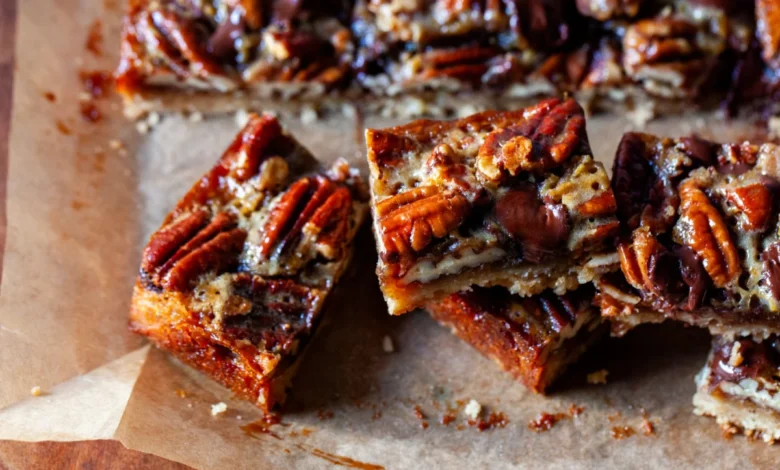
Recognizing the need for a lower-friction dessert that retained the indulgence of the slab pie, Perelman streamlined the concept several years ago into the current iteration: the Pecan Pie Bar. By transitioning from a rolled pastry crust to a press-in shortbread base, and consolidating the filling preparation into a single saucepan, the recipe eliminated multiple labor-intensive steps. The resulting bar cookie preserves the rich flavor profile of toasted pecans, brown butter, honey, dark brown sugar, vanilla bean, dark chocolate chips, and sea salt, while drastically reducing preparation time and simplifying the post-baking serving process.
Anatomy and Recipe Specifications for Pecan Pie Bars

The modern culinary adaptation of the pecan pie bar successfully balances structural integrity with rich, complex flavor notes. Culinary analysis of the recipe reveals several strategic technical choices designed to optimize both texture and taste.
The inclusion of apple cider vinegar in the pecan filling serves a vital chemical function: the acid cuts through the high sugar content of the honey and brown sugar, preventing the dessert from becoming cloying. Furthermore, the extensive use of brown butter—incorporated into both the shortbread crust and the pecan layer—infuses the dessert with nutty, caramelized undertones that elevate standard holiday baking flavors.
For home cooks executing the recipe, adherence to specific methodological steps ensures optimal results:

Shortbread Crust Ingredients and Preparation
- 9×13-inch baking pan lined with parchment paper for seamless removal.
- Flour, sugar, and salt combined with measured browned butter to form a soft, crumbly dough.
- Even distribution and pressing of the dough across the bottom and slightly up the edges of the pan.
- Baking at 350°F (175°C) for 15 to 17 minutes until fragrant and golden at the edges.
Pecan Layer Ingredients and Preparation
- Remaining browned butter combined in a saucepan with brown sugar, honey, heavy cream, flaky salt, cider vinegar, and vanilla bean.
- Whole eggs incorporated sequentially to maintain emulsion stability.
- Toasted pecan halves and dark chocolate chips folded in to complete the filling.
- Assembly by pouring the warm mixture directly over the baked crust.
- Final baking duration of 25 to 30 minutes until edges are set and the center maintains a slight structural jiggle.
- Complete cooling prior to slicing, with storage viability extending up to one week under refrigeration.
Broader Industry Impact and Implications

The longevity of platforms like Smitten Kitchen underscores a fundamental shift in how culinary media interacts with its audience. In an era dominated by short-form, highly stylized video content, long-standing food blogs that prioritize rigorous testing and practical problem-solving continue to serve as essential infrastructure for home cooks.
The persistent demand for reliable, scalable holiday recipes highlights the ongoing challenges of modern entertaining. As household sizes fluctuate and time constraints intensify, culinary developers who successfully bridge the gap between gourmet flavor and kitchen efficiency occupy a crucial space in the food media ecosystem. Perelman’s two decades of digital publishing demonstrate that the future of home cooking lies not in culinary intimidation, but in accessible mastery—empowering everyday cooks to execute sophisticated meals with confidence, precision, and minimal stress.