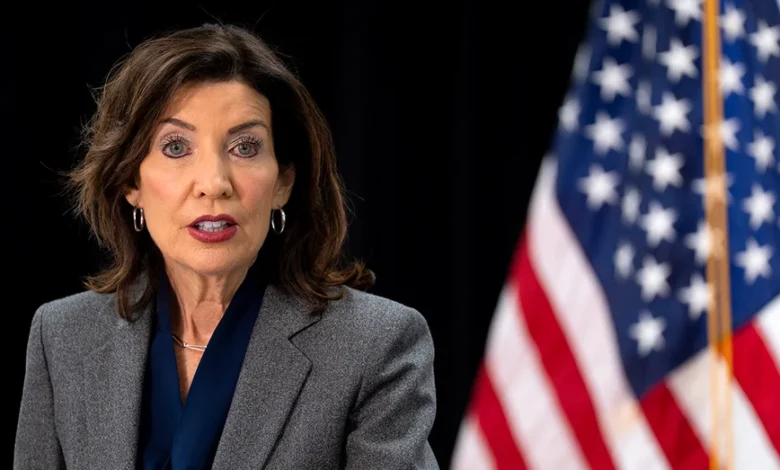
The legal battle over the constitutional rights of noncitizens facing prolonged immigration detention has taken an unexpected turn at the highest level of the American judicial system. The Supreme Court of the United States will no longer hear oral arguments in a pivotal case concerning whether lawfully present noncitizens possess a legal right to bond hearings after extended periods of confinement. This development follows a strategic executive action by New York Democratic Governor Kathy Hochul, who granted a full pardon to a Dominican citizen convicted of second-degree assault. The decision has effectively rendered the federal government’s pending appeal moot, sparking sharp debates among legal scholars, state officials, and federal authorities regarding the intersection of state executive clemency powers and federal immigration enforcement priorities.
The controversy centers around Keisy Guerrero Mariano, identified in court documents as "Keisy GM," a lawfully present Dominican citizen residing in New York. In late August, Governor Hochul issued a pardon for Mariano just as the federal government’s legal brief was due to be submitted to the nation’s highest court. This executive intervention abruptly derailed the Trump administration’s appeal, which sought to overturn a lower court ruling that favored bond hearings for noncitizens enduring prolonged detention while awaiting deportation proceedings for crimes that mandate removal under federal law.
Solicitor General John Sauer formally acknowledged the mootness of the case, known as Genalo v. Black, but emphasized that the administration remains undeterred. Federal officials have signaled their intent to find an alternative legal vehicle to challenge the underlying appellate court precedent, aiming to secure a definitive ruling from the Supreme Court during its upcoming 2026-27 term. Meanwhile, the strategic use of gubernatorial pardons to influence federal immigration litigation has ignited a nationwide controversy over executive overreach, state sovereignty, and public safety.
Chronology of a Multi-Year Legal Battle

The origins of the legal conflict trace back more than a decade, weaving through immigration courts, federal district courts, and appellate circuits before reaching the Supreme Court. The core dispute involves the limits of federal authority to detain criminal noncitizens indefinitely without a bond hearing while removal proceedings are pending.
In 2015, Keisy Guerrero Mariano was convicted of second-degree assault in a New York state court, serving a term of incarceration that rendered him eligible for mandatory deportation under federal immigration statutes. Several years later, in 2020, Immigration and Customs Enforcement (ICE) officers formally arrested Mariano, placing him into prolonged immigration detention.
Mariano remained in ICE custody for nearly two years until 2022, when he was released under a nationwide federal court injunction that required the temporary release of detainees due to severe health risks associated with the COVID-19 pandemic. Prior to that release, U.S. District Judge John P. Cronan of the Southern District of New York had denied Mariano’s habeas corpus petition in November 2021, upholding the legality of his continued detention without a bond hearing.
The legal landscape shifted dramatically in May 2024, when the U.S. Court of Appeals for the Second Circuit overturned Judge Cronan’s decision. The appellate panel ruled that the federal government is constitutionally obligated under the Fifth Amendment’s due process clause to grant noncitizens a bond hearing once their detention becomes "unreasonably long." This ruling dealt a significant blow to the federal government’s enforcement mechanisms, establishing a binding precedent within the Second Circuit that prolonged confinement without individualized bond assessments violates constitutional protections.
Seeking to restore federal detention policies, the Department of Justice appealed the decision to the Supreme Court, which agreed on June 15 to hear the consolidated case. The lawsuit also encompassed the legal challenges of Carol Williams Black, a Jamaican national with lawful standing who was convicted in New York in 2000 of sexually abusing a minor under the age of eleven. However, the Supreme Court ultimately dismissed Black’s portion of the case as well, noting he had voluntarily departed the United States and filed a formal declaration confirming he would not return. With both primary litigants either pardoned or having left the country, the high court was left with no active controversy to adjudicate, prompting the formal declaration of mootness.

Reactions and Political Fallout
The timing and nature of Governor Hochul’s pardon have drawn intense criticism from state and federal legal officials, who argue that the executive clemency was weaponized specifically to evade federal judicial review. Critics contend that utilizing state pardons to shield aggravated felons from federal deportation undermines the integrity of immigration laws and frustrates the enforcement mechanisms established by Congress.
Eric Wessan, Iowa’s solicitor general, voiced sharp disapproval on social media, writing: "Pretty wild to fully pardon an aggravated felon to (1) stop the felon from getting deported and (2) stop the Supreme Court from ruling on an issue. (Especially as this litigation has been going on for years)." Wessan further questioned the broader implications of such executive actions, asking how many non-American felons state governors might choose to release to circumvent federal immigration consequences.
The controversy also unfolds against a broader backdrop of escalating tensions between the federal government and state executives who oppose aggressive immigration enforcement measures. Governor Hochul has consistently championed immigrant rights and pushed back against federal enforcement crackdowns within New York, framing her administration’s actions as a defense of local values and due process. Supporters of the governor’s clemency powers argue that state executives retain absolute constitutional authority to grant pardons for state-level convictions, and that exercising this authority is a legitimate check within the federalist system.
Broader Legal Implications and Future Outlook

Although the Supreme Court dodged a direct ruling on the merits of Genalo v. Black, the underlying constitutional question regarding the duration of mandatory immigration detention remains profoundly unresolved. Federal immigration authorities maintain that individuals who have committed serious crimes and are subject to mandatory deportation must remain in secure custody throughout removal proceedings to protect public safety and ensure they do not abscond. Conversely, immigrant advocacy groups and civil liberties organizations argue that indefinite detention without access to a bond hearing constitutes an arbitrary deprivation of liberty that runs afoul of fundamental constitutional guarantees.
Legal analysts note that the Second Circuit’s 2024 ruling remains binding law within its jurisdiction—covering New York, Connecticut, and Vermont—forcing federal authorities to provide bond hearings to detainees whose confinement crosses the threshold of being "unreasonably long." This creates a fragmented legal landscape where immigration detention standards vary significantly depending on the federal judicial circuit in which a detainee is held.
Recognizing the urgency of establishing a uniform national standard, Solicitor General Sauer assured the judiciary that the Department of Justice will actively monitor ongoing litigation across the country. The administration plans to identify a suitable alternative vehicle—a case involving an active detainee who cannot be easily removed via executive pardons or voluntary departures—to present the issue back to the Supreme Court during the 2026-27 term.
As federal authorities continue their pursuit of a definitive Supreme Court precedent, the interaction between state executive clemency and federal immigration enforcement is expected to remain a prominent flashpoint in American jurisprudence. For now, the legal skirmish over bond rights for detained noncitizens has paused, but the fundamental debate over the constitutional boundaries of federal detention power is far from settled.
Related posts: