NASA Neil Gehrels Swift Observatory to plunge back to Earth following historic two-decade mission studying cosmic explosions

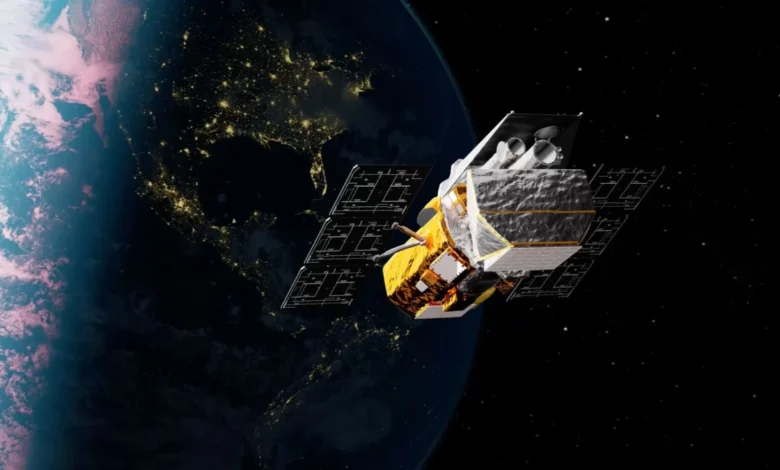
The Neil Gehrels Swift Observatory, a cornerstone of high-energy astrophysics for more than two decades, is nearing the end of its operational life as it descends into Earth’s atmosphere. NASA officials confirmed that the 3,200-pound (1,450-kilogram) spacecraft has reached a critical stage in its orbital decay. Current projections indicate that the satellite is expected to reenter the atmosphere as early as tonight, November 3, or during the early hours of November 4.
According to the latest orbital tracking data provided by NASA, the spacecraft’s anticipated reentry window centers around 3:30 a.m. EST on Wednesday, November 4. However, due to the dynamic nature of atmospheric drag at low altitudes and the inherent complexities of predicting orbital decay, agency scientists have established an uncertainty margin of plus or minus 11 hours. This window suggests that while the primary estimate targets the early morning, the observatory could potentially breach the atmosphere as soon as this evening.
A Legacy of Gamma-Ray Discovery
Launched on November 20, 2004, the Swift Observatory was designed to solve one of the most enigmatic puzzles in modern astronomy: the origin and nature of Gamma-Ray Bursts (GRBs). These events, which represent the most powerful explosions in the universe since the Big Bang, occur when massive stars collapse into black holes or when neutron stars collide.
Swift was engineered with a unique, rapid-response capability. Upon detecting a gamma-ray trigger with its Burst Alert Telescope, the satellite could autonomously pivot its onboard instrumentation—the X-ray Telescope (XRT) and the Ultraviolet/Optical Telescope (UVOT)—toward the source within minutes. This agility allowed astronomers to observe the "afterglow" of these explosions in real-time, providing unprecedented data on the physics of distant galaxies and the life cycles of stars.
Over its 22-year tenure, Swift revolutionized the field of time-domain astronomy. It identified thousands of GRBs, mapped the sky in high-energy wavelengths, and provided crucial data that informed gravitational wave research, particularly following the landmark detection of neutron star mergers in 2017.
Chronology of an Orbital Descent
The mission’s conclusion was not sudden, but the result of a gradual loss of altitude caused by the thin, outer layers of Earth’s atmosphere exerting drag on the spacecraft. As the observatory’s altitude dropped over the years, the density of the atmosphere it encountered increased, leading to an exponential acceleration of its orbital decay.
In the final months of its mission, the spacecraft’s onboard propulsion systems—which might have been used to boost its orbit—were exhausted. By late 2026, the satellite began its final, uncontrolled descent. The following timeline outlines the transition from a productive scientific platform to a reentering object:
- 2004–2024: Operational excellence. The satellite conducts thousands of observations, consistently exceeding its original mission requirements and serving as a critical asset for the global astronomical community.
- Early 2026: Orbital altitude reaches a threshold where atmospheric drag begins to significantly impact the satellite’s trajectory.
- October 2026: NASA mission control monitors a sharp increase in the rate of decay. Plans for decommissioning are finalized.
- November 2, 2026: Official NASA reports confirm that the satellite is on a trajectory for atmospheric reentry, with current models narrowing the window of impact to within a 22-hour timeframe.
- November 3–4, 2026: The forecasted window for the satellite to burn up upon entry into the Earth’s atmosphere.
Technical Analysis of Reentry Risks
The question of whether space debris poses a risk to the surface is a standard component of NASA’s end-of-mission protocols. For the Neil Gehrels Swift Observatory, the agency has provided assurances based on structural analysis.
The spacecraft is primarily constructed from materials that are expected to fragment and disintegrate due to the extreme heat generated by atmospheric friction during reentry. Because Swift was not designed with the heavy thermal shielding required for survival through the atmosphere, the vast majority of its mass is expected to vaporize at altitudes between 45 and 55 miles (72 to 88 kilometers).
NASA’s orbital debris office conducts rigorous modeling for every retiring mission. For a spacecraft of this size, the probability of any surviving fragments causing injury to people on the ground is infinitesimally small, consistently falling well below the agency’s safety thresholds. Most of the Earth’s surface is covered by water or sparsely populated regions, and debris from such satellites rarely, if ever, reaches the surface in a way that poses a threat to public safety.
The Scientific Impact and Broader Implications
The decommissioning of Swift marks the end of an era for high-energy astrophysics. The data collected by the observatory has been cited in thousands of peer-reviewed papers, fundamentally altering our understanding of the high-energy universe. By linking gamma-ray signatures to specific cosmic events, Swift helped bridge the gap between theoretical models of stellar evolution and observational evidence.
"Swift was a game-changer," noted one astrophysicist familiar with the mission. "Before Swift, we were catching these explosions long after they occurred. Swift gave us the ability to see the birth of the event, the physics in motion. Its contribution to the ‘multi-messenger’ era of astronomy—where we combine light, particles, and gravitational waves—cannot be overstated."
The broader implications of this event extend to how space agencies manage the lifecycle of aging assets. As low Earth orbit (LEO) becomes increasingly crowded with commercial satellites and research platforms, the process of "de-orbiting" has become a central focus of space policy. Swift serves as a case study for responsible end-of-life planning. While the reentry is uncontrolled, the satellite’s design inherently limits the danger it poses, a standard that modern space agencies aim to apply to all future missions.
Looking Toward the Future
As the scientific community prepares to lose the Swift Observatory, focus is shifting toward the next generation of space telescopes designed to pick up where it left off. Missions like the Imaging X-ray Polarimetry Explorer (IXPE) and upcoming gamma-ray monitoring projects are already building on the foundational data provided by Swift.
The observatory’s legacy is preserved in the vast, publicly available archive of its observations. For decades to come, researchers will continue to mine the Swift dataset to uncover new secrets about black holes, the formation of the early universe, and the extreme physics of the most violent events in the cosmos.
As the sun rises on November 4, the final signals from the Neil Gehrels Swift Observatory will likely have ceased. While the physical hardware will be consumed by the atmosphere, the information it transmitted back to Earth remains a lasting testament to the success of international scientific cooperation and the relentless human pursuit of knowledge regarding our place in the universe. NASA remains in contact with global space monitoring entities to track the final moments of the spacecraft, providing updates as the window of reentry narrows. For now, the observatory is a silent traveler, completing its final circuit around the planet it spent 22 years observing.