Julianne Hough Defends Bold Dancing With the Stars Fashion Choices and Embraces Her Leading Lady Era

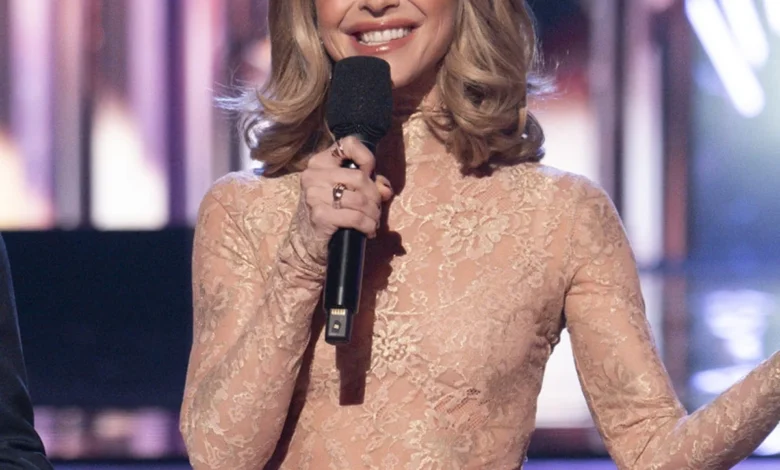
Julianne Hough is unapologetically stepping into a new chapter of her life and career, addressing the online criticism she faced regarding her daring fashion choices during season 35 of Dancing With the Stars. As the cohost of ABC’s hit reality competition series alongside Alfonso Ribeiro, Hough has consistently captured audience attention not only for her hosting dynamic but also for her high-fashion ensembles. Rather than shying away from polarizing reviews, Hough has embraced the discourse, emphasizing that fashion should provoke conversation rather than conform to safe expectations.
In a candid joint interview published alongside her stylist, Brad Goreski, Hough opened up about her evolving personal style and professional mindset as she navigates her late 30s. Reflecting on the criticism she received for several daring looks throughout the season—including a viral moment sparked by a transparent Valentino skirt paired with a skin-toned leotard—Hough made it clear that external approval is no longer her primary metric for success.
The Evolution of a Leading Lady Era
Entering her late thirties has brought a profound shift in perspective for Hough, who began her career as a professional dancer before expanding into acting, singing, and television hosting. She described this current phase as an "inflection point" defined by autonomy and self-expression.
"When you get into your late 30s, you just don’t give a f–k anymore," Hough remarked during her interview with Glamour. "You’re like, ‘Who am I? What do I want to wear? What makes me feel incredible?’ It has more intention rather than trying to fit into what’s hot."
This newfound confidence extends far beyond her wardrobe. Hough noted that she views her current trajectory as her "leading lady era," applying the concept both to the substantial creative projects she is pursuing and to her personal identity. For her return to the Dancing With the Stars ballroom, this philosophy translated into a deliberate aesthetic pivot. Moving away from her traditionally wholesome, girl-next-door image, Hough and her styling team opted for a sharper, more dramatic persona.
"I’ve gone a little bit more vixen-y this year than I have girl next door because we’re trying to find that character," she explained, highlighting the calculated nature of her broadcast appearance. "It’s been very strategic."
The Valentino Controversy and the Value of Debate
Fashion on Dancing With the Stars has always served as a major talking point for viewers, but season 35 elevated sartorial commentary to new heights. The focal point of the season’s style debate occurred during the November 17 episode, when Hough appeared in a sheer Valentino gown that exposed a nude-toned foundation garment. While avant-garde and high-fashion red carpets frequently welcome such silhouettes, the mainstream television audience offered mixed reactions.
Social media platforms quickly lit up with commentary, with some internet users expressing strong disapproval. One particular Instagram video critiquing the look went viral, with a commenter jokingly or seriously calling for Hough’s stylist to be dismissed.
However, Brad Goreski viewed the online commotion through a pragmatic and artistic lens. With over a decade and a half of experience as a high-profile celebrity stylist, Goreski argued that passionate public feedback—positive or negative—is a sign of successful art.
"Any conversation, good or bad, around fashion is great," Goreski stated. He praised Hough for her ability to command attention and translate conceptual designs into wearable moments on live television. "I think Jules ultimately brings the looks to life. I’m glad that there’s another part of the show that people talk about. Not every person’s going to love every look. I know that from being a stylist for 15 years. And that’s okay."
Hough echoed this sentiment, adopting a personal motto for the season that prioritizes engagement over universal praise. "Apathy is canyons apart from the enemy," she summarized. "The reason things exist and have charge and stay visible [is because] people either love it or hate it. They still want to talk about it."
Behind the Scenes of Dancing With the Stars: Compensation and Production Realities
As Dancing With the Stars wraps up yet another commercially successful season, public fascination frequently extends beyond the ballroom fashion to examine the inner workings of the long-running production. Over the years, former contestants, professional dancers, and insiders have gradually demystified the financial structures, rigorous rehearsal schedules, and complex pairing processes that sustain the franchise.
Understanding Celebrity and Professional Compensation
Financial transparency on reality television is rarely absolute, but various alumni have provided concrete estimates regarding how participants are compensated. According to industry reports originally detailed by Variety and supplemented by statements from former contestants such as radio personality Bobby Bones, the compensation model for celebrity competitors is structured around longevity in the competition.
Historically, celebrity contestants receive an upfront payment covering the initial rehearsal period and the first two weeks of live shows. Industry sources in 2019 estimated this starting figure to be approximately $125,000, with incremental increases awarded for each week a celebrity manages to avoid elimination, capping out near $300,000 for finalists. However, participants from more recent seasons suggest that earning potential can vary based on negotiation and overall budget adjustments. Bones, who won season 27 in 2018 alongside professional partner Sharna Burgess, revealed on a podcast appearance that his earnings scaled rapidly with each survived week, ultimately totaling close to $400,000.
Professional dancers operate under a distinct contract system. While individual salaries remain closely guarded secrets, veteran pros have confirmed that compensation is tied to guaranteed weekly minimums. Interestingly, winning the coveted Len Goodman Mirrorball Trophy does not trigger a massive cash prize. Jenna Johnson, a multi-time champion, clarified that while finalists receive full-season pay and a performance bonus, the victory itself brings prestige, bragging rights, and the physical trophy rather than a financial jackpot split.
The Demoting and Promoting of Troupe Members
The financial hierarchy within the professional dance roster can also shift dramatically. Lindsay Arnold, a former pro and troupe member, shared insights into the stark contrast in compensation between roles. When Arnold was temporarily transitioned from a main professional partner to a troupe member, her salary was reduced by more than half, illustrating the economic stratification within the show’s dance ensemble.
The Pairing Process: Chemistry Meets Strict Secrecy
For viewers wondering how celebrities and professional partners are matched, the process is entirely producer-driven. Professional dancers have repeatedly confirmed that they have virtually no input in selecting their celebrity partners.
"You get no say," Arnold explained during a podcast appearance. "It’s very much just, ‘Here’s your partner. Make it work.’"
Furthermore, the reveal is heavily guarded by production to capture authentic reactions on camera. Jenna Johnson noted that details are kept confidential until the cast members meet face-to-face for the first time during live broadcasts or controlled initial meetups, discouraging leaks and maintaining genuine emotional responses for the audience.
When assigning partners, producers prioritize physical compatibility—such as height and build—alongside psychological matching. Former showrunner Rob Wade emphasized that compatibility is essential given the intense, high-pressure environment of the show. Pairing individuals who clash personality-wise would create an untenable work environment for both the celebrity and the professional, a mistake the production team learned to avoid early in the series’ run.
Rigorous Schedules and High-Stakes Production
The physical demands placed on the cast of Dancing With the Stars are exceptionally high. Professional dancers and their celebrity partners commit to exhaustive daily schedules. Rylee Arnold, speaking about her time partnered with Olympic gymnast Stephen Nedoroscik, detailed a routine consisting of mandatory four-hour daily rehearsals, supplemented by choreography planning, meetings with creative directors, and video study.
The weekly schedule follows a relentless cycle: live shows take place on Tuesdays, followed by uninterrupted rehearsals from Wednesday through Sunday. Mondays are dedicated to comprehensive camera blocking and technical run-throughs, leaving virtually no downtime throughout the multi-month television season.
Simultaneously, the costume department operates at a breakneck pace to ensure every routine has a distinct visual identity. Lead costume designers, including Daniela Gschwendtner and Steven Norman Lee, oversee a massive enterprise responsible for designing, cutting, fitting, and embellishing custom outfits for every single competitive routine within a matter of days. With a team of roughly 20 dedicated staff members and an independent tailor shop, the department rarely reuses competition garments, ensuring that each performance looks fresh and tailored specifically to the narrative of the dance.
Broader Implications for Hough and the Franchise
Julianne Hough’s handling of the season 35 style discourse highlights a broader shift in how public figures manage online criticism. By leaning into the dialogue rather than apologizing for taking aesthetic risks, Hough has reinforced her status as a cultural influencer who dictates trends rather than merely following them. As she continues to expand her footprint into major film, television, and hosting projects, her refusal to conform to antiquated expectations signals a maturation of her public brand.
Concurrently, the enduring popularity of Dancing With the Stars underscores the resilient appeal of traditional event television. Despite the grueling behind-the-scenes labor, massive financial investments in costume and production, and high-pressure performance schedules, the franchise continues to captivate millions of viewers. Whether audiences are tuning in to critique the choreography, debate the fashion choices of the cohosts, or track the competitive journeys of underdog celebrities, the show remains a dominant force in entertainment culture—one where even a contested Valentino skirt serves as proof of its vibrant, ongoing relevance.