MIT Engineers Pioneer In-Body Nanoparticle Technology to Transform Immune Cells Into Precision Cancer and Autoimmune Fighters

In a breakthrough that could fundamentally alter the landscape of modern medicine, researchers at the Massachusetts Institute of Technology (MIT) have engineered a revolutionary technique that reprograms immune cells directly inside the human body. Published in the prestigious journal Nature Biotechnology, the study details how lipid nanoparticles can be deployed to transform natural killer (NK) cells into specialized cancer and disease fighters in vivo. This innovation bypasses the notoriously complex, time-consuming, and expensive ex vivo manufacturing processes required for contemporary cell therapies like CAR-T and CAR-NK treatments.
Spearheaded by a team of renowned bioengineers and materials scientists at MIT, including senior author Daniel Anderson and co-contributors Robert Langer, Yuang Chen, Julia Monkovic, and Haseeb Mughal, this milestone achievement holds the promise of democratizing advanced immunotherapies, bringing down exorbitant production costs, and drastically widening patient access for both oncology and immunology indications.
The Evolution and Bottlenecks of Cell-Based Immunotherapy
To understand the magnitude of the MIT breakthrough, one must examine the trajectory of cellular immunotherapy over the past decade. The U.S. Food and Drug Administration (FDA) has historically approved a handful of pioneering chimeric antigen receptor (CAR) T-cell therapies. These treatments rely on extracting a patient’s own T cells, shipping them to specialized and tightly regulated external laboratories, genetically modifying them using viral vectors to target specific cancer antigens, expanding them by the millions, and then reinfusing them back into the patient.
While these personalized therapies have yielded remarkable remissions in liquid tumors—most notably B-cell leukemias, lymphomas, and multiple myelomas—the logistical hurdles remain immense. The vein-to-vein turnaround time can span several weeks, a dangerous delay for patients with aggressive, fast-moving cancers. Furthermore, the manufacturing infrastructure requires specialized cleanrooms, highly trained personnel, and rigorous quality-control protocols, driving the price tag of a single treatment into the hundreds of thousands of dollars.
Compounding these complexities is an intrinsic limitation of CAR-T therapies when applied to T-cell malignancies and autoimmune disorders. Because the therapeutic agent and the target are both T cells, engineered CAR-T cells frequently recognize and destroy one another—a phenomenon known as fratricide—which severely compromises the efficacy of the treatment.
Enter Natural Killer Cells and the In Vivo Advantage
Seeking to circumvent the logistical bottlenecks and biological limitations of CAR-T cell therapies, scientists have increasingly turned their attention to natural killer cells. As a distinct branch of the innate immune system, NK cells do not suffer from the fratricide issues plaguing T-cell therapies when directed against aberrant T cells. Consequently, CAR-NK cells present a viable pathway for treating T-cell cancers, such as T-cell lymphoma, as well as destructive T-cell-driven autoimmune conditions like autoimmune hepatitis.
However, traditional manufacturing of CAR-NK cells has historically mirrored the arduous process of CAR-T production. Cells still had to be harvested, manipulated in a laboratory setting, expanded, and reintroduced. Recognizing this roadblock, the MIT research team asked a fundamental question: What if the genetic engineering could happen inside the patient’s body via a straightforward injection?
"The manufacturing challenges with CAR NK cells are significant. The idea here is you can deliver a nanoparticle that will modify your own NK cells with a CAR construct and teach them to attack tumor cells," explains Daniel Anderson, a professor in MIT’s Department of Chemical Engineering and a core member of both the Koch Institute for Integrative Cancer Research and the Institute for Medical Engineering and Science.
By removing the laboratory phase entirely, patients could theoretically receive an off-the-shelf infusion of specialized nanoparticles, drastically simplifying the workflow, slashing administrative and production overhead, and making treatments available within hours rather than weeks.
The Mechanics of mRNA-LNP Reprogramming
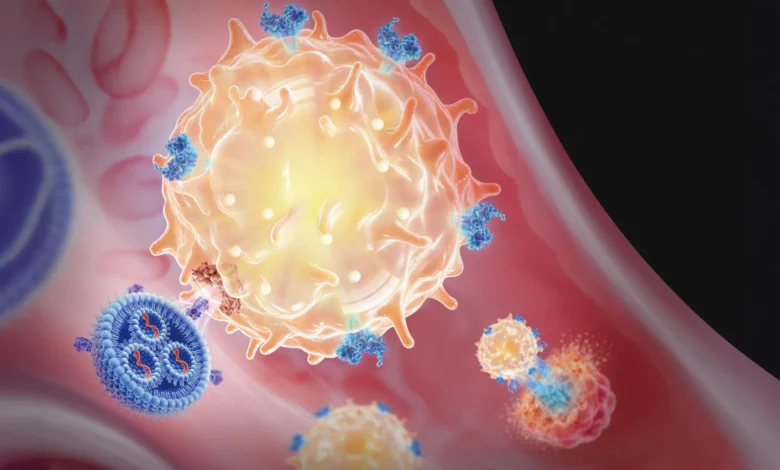
At the core of the MIT technology is a sophisticated delivery system utilizing lipid nanoparticles (LNPs)—the same foundational lipid chemistry that proved instrumental in enabling rapid global deployment of mRNA-based vaccines. These microscopic fatty spheres are engineered to safely encapsulate and transport messenger RNA (mRNA) molecules through the bloodstream without degradation by endogenous enzymes.
The encapsulated mRNA carries precise genetic instructions designed to instruct the host’s natural killer cells to synthesize chimeric antigen receptors (CARs). These custom receptors act as biological homing devices, guiding the reprogrammed NK cells to pinpoint and neutralize targeted pathogenic cells.
To ensure the nanoparticles home exclusively to the intended immune cells rather than off-target tissues, the research team functionalized the surfaces of the lipid nanoparticles with specialized antibody fragments. These surface markers recognize and bind specifically to receptors natively expressed on the surface of natural killer cells, facilitating efficient cellular uptake.
Once the LNP crosses the cellular membrane and releases its mRNA payload into the NK cell cytoplasm, the cellular machinery translates the genetic code into the targeted CAR proteins. Within a short window, the endogenous NK cell acquires a novel surface receptor tailored to hunt down specific disease markers—such as CD19, found on B cells, or CD3, present on malignant and autoreactive T cells.
Preclinical Validation: Tumor Remission and Tissue Repair in Animal Models
To evaluate the translational viability of their platform, the MIT team tested the nanoparticle constructs in rigorous animal models. The preliminary findings demonstrated striking efficacy across multiple disease paradigms.
In initial biodistribution and targeting assays, a single injection of the engineered nanoparticles successfully modified approximately 80 percent of the targeted natural killer cell population in vivo. Building on this success, the researchers tested the system on murine models afflicted with aggressive melanoma. Following nanoparticle administration, three out of five treated subjects achieved complete tumor remission.
To investigate efficacy against T-cell malignancies, the team employed humanized mouse models—animals engrafted with human blood cells to simulate human immunological responses. Subjecting these models to a regimen of five nanoparticle injections resulted in robust tumor destruction and the complete elimination of T-cell lymphomas. Notably, these therapeutic outcomes matched the efficacy of conventional CAR-NK therapies generated through traditional ex vivo laboratory expansion, proving that in-body cellular programming can match the potency of conventional processing methods without the associated complexity.
Beyond oncology, the researchers expanded their investigation into autoimmune pathologies, where the immune system erroneously targets healthy host tissues. They focused on autoimmune hepatitis, a debilitating disease characterized by autoreactive T cells destroying hepatocytes, the primary functional cells of the liver.
Administration of a single nanoparticle injection designed to prompt NK cells to eliminate the autoreactive T cells yielded remarkable results. The treatment successfully cleared the pathogenic T cells from circulation, subsequently allowing the damaged liver tissue to repair and regenerate.
Broader Implications and Future Clinical Horizons
While the initial data generated in murine models is exceptionally promising, the scientific community emphasizes that clinical translation to human patients remains a deliberate, multi-step journey. Comprehensive toxicology studies, pharmacokinetic profiling, and extensive clinical trials are mandatory prerequisites before regulatory bodies such as the FDA can consider human evaluations.
Nevertheless, the long-term implications of successfully scaling this technology are profound. If validated in clinical settings, in vivo immune cell reprogramming could expand well beyond oncology and autoimmune hepatitis. The research team has already begun mapping out potential applications for other complex autoimmune diseases driven by dysfunctional T-cell responses, including multiple sclerosis and rheumatoid arthritis.
By collapsing a multi-week, high-cost manufacturing protocol into a single, scalable nanoparticle infusion, the MIT breakthrough heralds a potential paradigm shift in translational medicine. As funding from institutional bodies like the National Cancer Institute, the Marble Center for Cancer Nanomedicine, and industry partners like Sanofi continues to drive further development, the medical community moves one step closer to making advanced cell therapies as routine and accessible as a standard outpatient injection.