Take Center Stage as Prestigious Houses Bring Million-Dollar Rarities and Historic Timepieces to Market

The global market for vintage and rare timepieces has once again converged on Switzerland for what is widely regarded as the most significant weekend of the year in horological collecting. The year-end Geneva watch auctions have officially commenced, drawing international collectors, high-net-worth investors, and industry aficionados to witness the public sale of some of the rarest items ever to bear Swiss hallmarks. This season’s auctions follow a remarkably robust first half of the year, during which the total volume of million-dollar watch transactions nearly eclipsed the figures recorded for the entirety of the previous calendar year. With several premier lots carrying pre-sale estimates exceeding seven figures, the events in Geneva are projected to set new benchmarks for secondary market valuation, rare provenance, and collector demand.
The Macroeconomic Landscape and Auction Context
The current surge in high-value watch auctions is indicative of a broader maturation within the alternative asset class. Over the past decade, vintage wristwatches have transitioned from a niche hobby into a heavily capitalized institutional and private investment category. Major auction houses including Phillips, Christie’s, Sotheby’s, and Antiquorum have adapted to this structural shift by curating increasingly selective catalogs. Rather than offering sheer volume, houses are prioritizing exceptional provenance, factory originality, and historical significance.

Market analysts note that the current climate is characterized by a "flight to quality." While modern hype watches experience normal market fluctuations, blue-chip vintage pieces—particularly those produced in limited stainless-steel configurations by legacy houses like Patek Philippe, Rolex, and Vacheron Constantin—continue to command resilient prices. The staggering estimates seen this weekend reflect an ongoing scarcity of museum-grade artifacts available for public acquisition.
Standout Lots and Market Highlights
The Geneva catalogs feature an array of extraordinary pieces spanning early 20th-century experimentation to contemporary independent watchmaking. Among the most anticipated offerings are unique or extremely low-production timepieces that challenge traditional historical narratives of major brands.

Rolex ref. 3830 Anti-Magnetique Verga
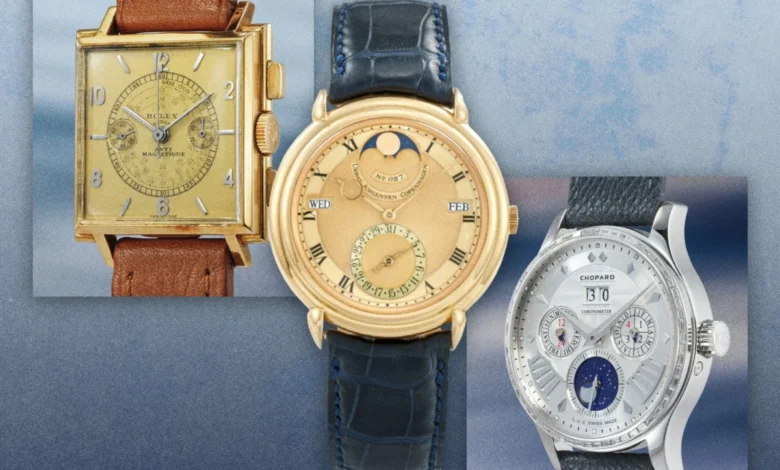
Standing out immediately due to its aggressive valuation is a uniquely configured Rolex from the early 1940s. Estimated in excess of $1.21 million, the Rolex reference 3830 Anti-Magnetique, retailed by Verga, challenges the modern perception of the brand as a standardized tool-watch manufacturer. Long before establishing its signature aesthetic with models like the Submariner, Rolex frequently engaged in bespoke and experimental design. This square-cased architectural wonder last appeared at public auction in two decades ago. Its blocky silhouette bears an uncanny resemblance to the design language later popularized by Heuer with the Monaco, despite preceding it by more than twenty-five years. Because of its singular configuration, the auction house has omitted a ceiling on its pre-sale estimate, signaling expectations of an intense bidding war.
Patek Philippe ref. 1436 Split-Seconds Chronograph
At the absolute apex of the valuation spectrum sits a masterpiece of mid-century haute horlogerie: a stainless-steel Patek Philippe reference 1436. Featuring a split-seconds (rattrapante) complication—a mechanism that allows the measurement of intermediate times during a continuous event—this piece represents the intersection of maximum mechanical complexity and utilitarian casing. Historically, Patek Philippe reserved its most intricate movements for precious metal cases. Consequently, stainless steel chronographs from this era were produced in exceedingly small quantities. Market experts confirm that only two stainless steel examples of the reference 1436 are currently known to exist. With a high estimate reaching $4.8 million, the watch represents the pinnacle of collecting ambition, combining extreme rarity, pristine condition, and museum-level historical importance.

A. Lange & Söhne Lange 1 in Stainless Steel
Representing the pinnacle of modern German watchmaking, a rare stainless-steel A. Lange & Söhne Lange 1 is slated to cross the block with a high estimate of approximately $365,800. Dating to 1999 and originally retailed in Germany, this piece is one of an estimated 30 stainless-steel Lange 1s ever produced. Initially delivered with a standard silvered dial, the watch was later fitted with a striking navy-blue two-tone configuration featuring contrasting darker subdials. It stands as one of only two known stainless-steel Lange 1s to exist in this specific aesthetic layout, bridging the gap between Saxon technical mastery and ultra-exclusive collector customization.
Rolex ref. 3525 Bariletto
For enthusiasts of pre-Daytona chronographs, the appearance of a Rolex reference 3525 "Bariletto" from the 1940s is a major event. Estimated at up to $609,000, this manually wound chronograph is historically significant as the very first Rolex chronograph housed in an Oyster waterproof case. Furthermore, this specific stainless-steel example is unique in carrying the signature of Proud’s, a prominent historical Rolex retailer based in Sydney, Australia. Measuring a classic 36mm and fitted with a beads-of-rice bracelet, the watch arrives with impeccable provenance, having previously resided in the celebrated collection of Italian scholar and collector Pucci Papaleo.

Independent Watchmaking, Accoutrements, and Ephemera
Beyond the traditional heavyweight giants of Swiss manufacturing, the Geneva auctions highlight a growing appreciation for independent watchmakers, rare enamel artistry, and horological ephemera.
Urban Jürgensen ref. 2
The enduring legacy of independent watchmaking is represented by an early-1990s Urban Jürgensen reference 2. Housed in a 37.7mm yellow-gold case featuring cow-horn lugs and a stepped bezel, this perpetual calendar moonphase watch exemplifies classic classical design. Re-gaining substantial market attention following the brand’s recent revitalization efforts led by industry luminary Kari Voutilainen, the watch highlights the sophisticated finishing and observatory-style handset that defined the manufacturer’s revival era.

Chopard L.U.C. Lunar One
Demonstrating that exceptional craftsmanship extends beyond the usual collector favorites, a Chopard L.U.C. Lunar One in precious metal commands an estimate of $36,600. Combining a perpetual calendar with a moonphase complication, the timepiece showcases Chopard’s high-horology manufacturing capabilities in Fleurier. The dial features striking architectural Roman numerals that appear pressed beneath the central complications, offering an avant-garde aesthetic combined with traditional mechanical excellence.
F.P. Journe Wall Clock and Accessories
The extraordinary demand for contemporary independent master François-Paul Journe has extended far beyond wristwatches into the realm of branded accessories and ephemera. Alongside lots featuring rare empty presentation boxes and collectible figurines, a large stainless-steel wall clock styled after Journe’s signature Octa Réserve de Marche is expected to fetch up to $73,200. This phenomenon underscores a broader cultural shift wherein brand identity and conceptual scarcity command substantial market premiums independent of traditional functional utility.

Market Implications and Future Outlook
The results of the Geneva auction weekend will serve as a vital economic barometer for the luxury secondary market. As macroeconomic pressures fluctuate globally, the performance of these multi-million-dollar lots will indicate whether the post-pandemic speculative boom is stabilizing into a sustainable, collector-driven market or continuing its aggressive upward trajectory.
Industry analysts suggest that regardless of short-term economic headwinds, the long-term trend favors institutional-grade assets with documented historical provenance, pristine mechanical integrity, and absolute rarity. As the final hammer falls on these exceptional lots over the coming days, the global watch community will receive a definitive update on the state of horological valuation for the foreseeable future.