New dwarf planet candidate 2026 ED138 discovered in the far reaches of the solar system by the Vera C. Rubin Observatory

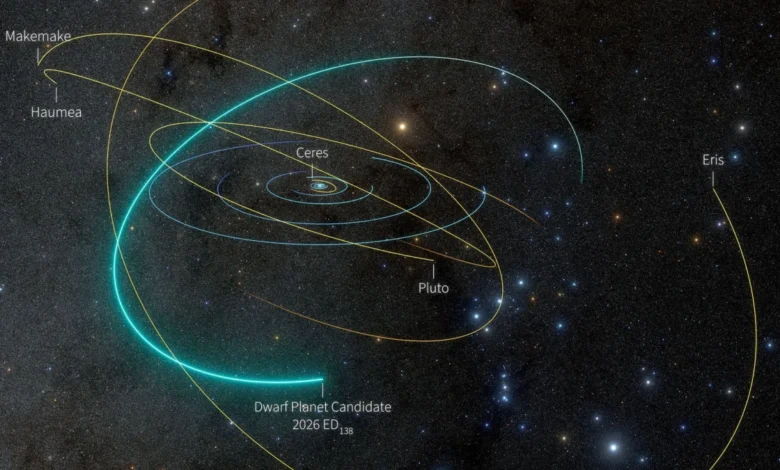
The Vera C. Rubin Observatory has identified a significant new celestial object residing in the dark, icy expanse beyond the orbit of Neptune. Cataloged as 2026 ED138, this distant candidate for dwarf planet status represents one of the most substantial and luminous objects ever detected in the outer reaches of our solar system. The discovery, facilitated by the state-of-the-art imaging capabilities of the Rubin Observatory, provides a rare glimpse into the composition and distribution of Trans-Neptunian Objects (TNOs), potentially reshaping our understanding of the outer solar system’s evolution.
The Discovery of 2026 ED138
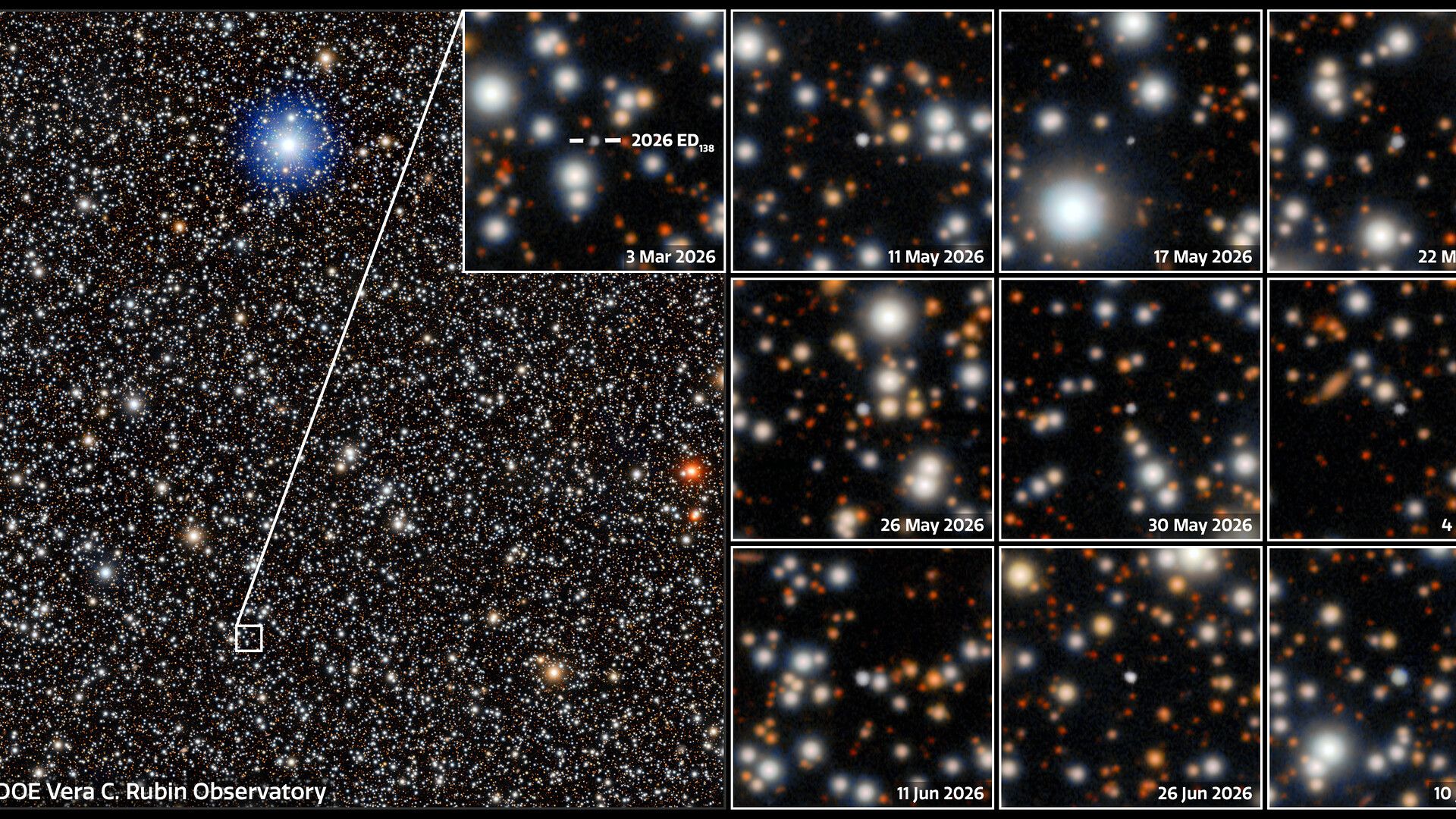
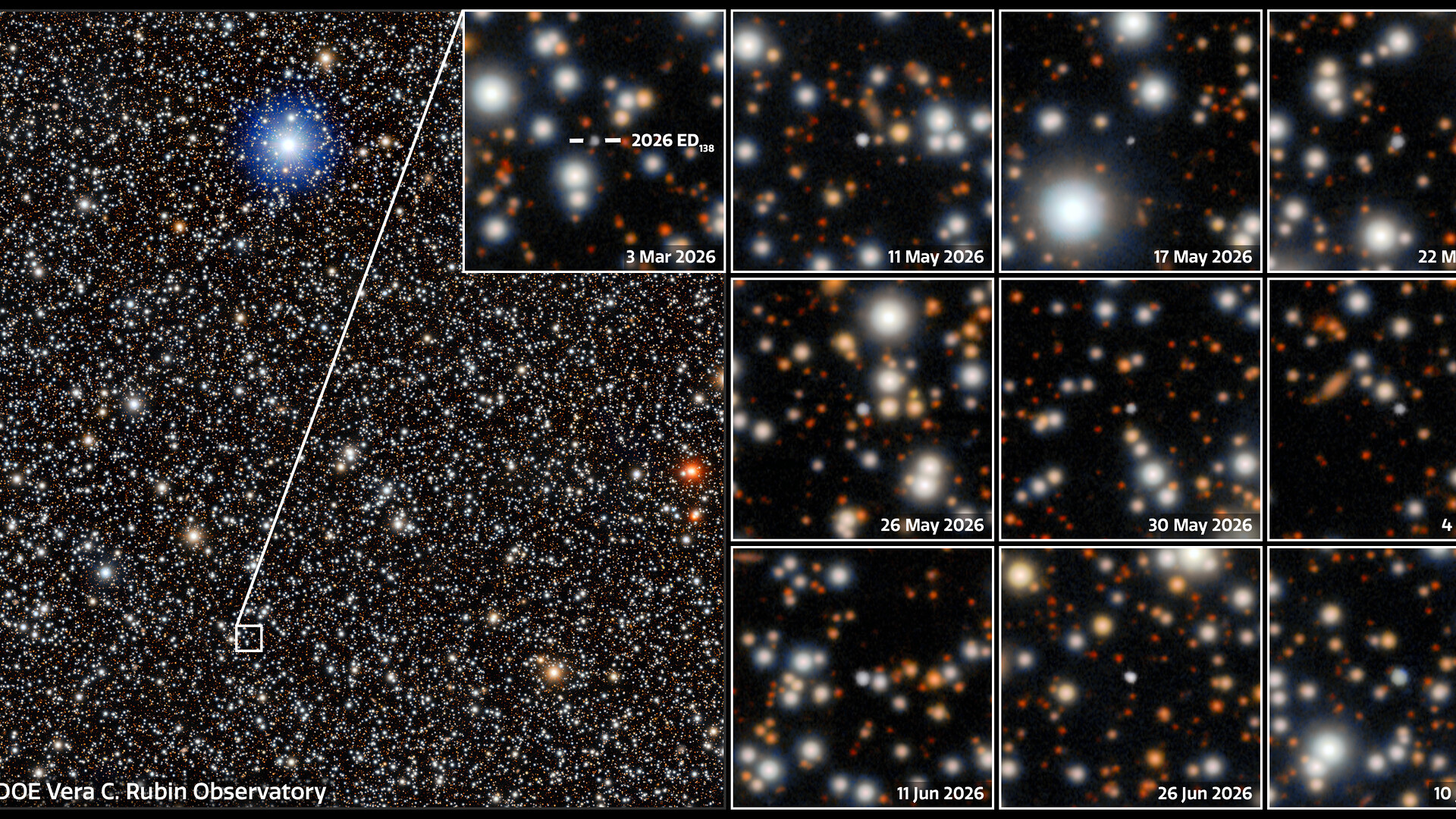
The identification of 2026 ED138 was made possible through the early operational phases of the Vera C. Rubin Observatory, located in Chile. As part of its primary mission to conduct the Legacy Survey of Space and Time (LSST), the observatory is designed to map the southern sky with unprecedented depth and speed. By capturing high-resolution, time-lapse mosaics of the sky, astronomers can identify objects that shift position relative to the stationary backdrop of distant stars.
2026 ED138 was flagged during routine observational data processing throughout 2026. Its movement patterns confirmed that it was not a background star or a galaxy, but a localized body bound by the Sun’s gravity. Initial brightness measurements indicate that the object reflects a significant portion of sunlight, suggesting a surface that may be composed of volatile ices or a complex organic crust, both of which are characteristic of larger objects in the Kuiper Belt or the scattered disc.
Physical Characteristics and Potential Classification
While 2026 ED138 currently carries the status of a "dwarf planet candidate," the criteria for official classification as a dwarf planet—as defined by the International Astronomical Union (IAU)—require that an object be in orbit around the Sun, have sufficient mass to assume a nearly round shape due to its own gravity (hydrostatic equilibrium), and have not "cleared the neighborhood" around its orbit.
Current estimates place the diameter of 2026 ED138 at approximately 50% to 60% of Pluto’s diameter. While size estimates for distant objects are subject to refinement based on assumed albedo (reflectivity) and distance, even the lower-end estimates suggest a body of substantial mass. If follow-up observations confirm its size and shape, 2026 ED138 would join the exclusive ranks of Pluto, Eris, Haumea, Makemake, and Ceres, becoming the sixth officially recognized dwarf planet in our solar system. Its relative brightness—compared to other objects at similar distances—suggests it may be one of the larger members of the population currently residing in the outer reaches of the solar system.
The Chronology of Exploration Beyond Neptune
The quest to categorize the outer solar system has been a multi-decade endeavor. The timeline of major TNO discoveries underscores the technological leaps made by observatories like the one at the Vera C. Rubin site:
- 1930: The discovery of Pluto by Clyde Tombaugh at the Lowell Observatory changed the perception of the solar system’s periphery.
- 1992: The discovery of (15760) 1992 QB1 confirmed the existence of the Kuiper Belt, a vast ring of icy bodies beyond Neptune.
- 2005: The discovery of Eris, which was initially thought to be larger than Pluto, triggered the 2006 IAU reclassification of Pluto as a dwarf planet.
- 2026: The identification of 2026 ED138 marks the first major candidate discovery of the late 2020s, enabled by the wide-field survey capabilities of the Rubin Observatory.
This timeline highlights a transition from accidental discovery to systematic, automated detection. The Vera C. Rubin Observatory is unique in its ability to scan the entire visible sky every few nights, creating a "movie" of the universe that allows for the detection of fast-moving or faint, slow-moving objects that were previously invisible to smaller telescopes.
Supporting Data and Observational Context
Astronomers rely on the "opposition effect" and orbital mechanics to determine the distance and trajectory of objects like 2026 ED138. Because the object is located well beyond the orbit of Neptune, its orbital period is likely measured in centuries. Its current position suggests an orbit that could be highly elliptical, typical of objects that have been gravitationally perturbed by Neptune or other massive bodies early in the solar system’s history.
Data from the Rubin Observatory indicates that 2026 ED138 maintains a consistent trajectory, which allows for accurate modeling of its path. By analyzing the light curve—the variation in brightness as the object rotates—scientists hope to infer its rotational period, shape, and surface composition. A smooth light curve would suggest a relatively spherical shape, supporting the case for dwarf planet classification, while a more erratic light curve might indicate an elongated or irregularly shaped body.
Scientific and Institutional Perspectives
While the IAU has yet to issue an official statement regarding the formal designation of 2026 ED138, the astronomical community has reacted with significant interest. The discovery is viewed as a validation of the Rubin Observatory’s mission. "The ability to survey the sky at this depth and frequency is a game-changer," noted one researcher familiar with the survey data. "Objects like 2026 ED138 have been hiding in plain sight, waiting for the technology to catch up to their distance."
The collaboration between the National Science Foundation (NSF) and the Department of Energy (DOE) in the development of the Rubin Observatory has been instrumental in this success. By combining a 8.4-meter telescope with a 3,200-megapixel camera, the facility is able to process terabytes of data daily, using sophisticated machine-learning algorithms to filter out noise and identify legitimate astronomical targets.
Broader Implications for Planetary Science
The discovery of 2026 ED138 has broader implications for our understanding of planetary migration and the formation of the solar system. The presence of large objects in the far outer solar system serves as a "fossil record" of the early gravitational dynamics that shaped the orbits of the major planets.
If 2026 ED138 is indeed a large dwarf planet, it suggests that the region beyond Neptune may be more densely populated with large, icy bodies than previously estimated. This, in turn, provides data for the "Planet Nine" hypothesis—the theory that an undiscovered, massive planet may be influencing the orbits of distant TNOs. By tracking 2026 ED138 over the coming years, astronomers will be able to determine if its orbit shows any anomalies that could be attributed to the gravitational pull of a more massive, unseen body.
Furthermore, the study of such objects allows scientists to compare the chemical composition of the outer solar system with that of the inner solar system. Since these objects have remained largely undisturbed since the dawn of the solar system, they hold primordial material that provides clues about the conditions present during the Sun’s formation 4.6 billion years ago.
Conclusion and Future Outlook
The identification of 2026 ED138 is not merely a tallying exercise; it is an expansion of our cosmic neighborhood. As the Vera C. Rubin Observatory continues its decade-long survey, it is expected that many more such objects will be discovered. This will likely lead to a new census of the outer solar system, forcing astronomers to refine their models of how planets and smaller bodies interact in the dark, cold reaches of space.
For now, 2026 ED138 stands as a testament to the power of modern instrumentation and the persistent human drive to understand the extent of our solar system. As researchers continue to analyze the light, orbit, and potential composition of this distant world, the scientific community eagerly awaits further confirmation that we have indeed found another neighbor on the edge of the abyss. The coming years of observation will be critical in transforming 2026 ED138 from a distant, blinking pixel on a sensor into a fully characterized member of our planetary family.