NFL: New York Giants quarterback Jaxson Dart could be forced to undergo knee surgery that would end his season

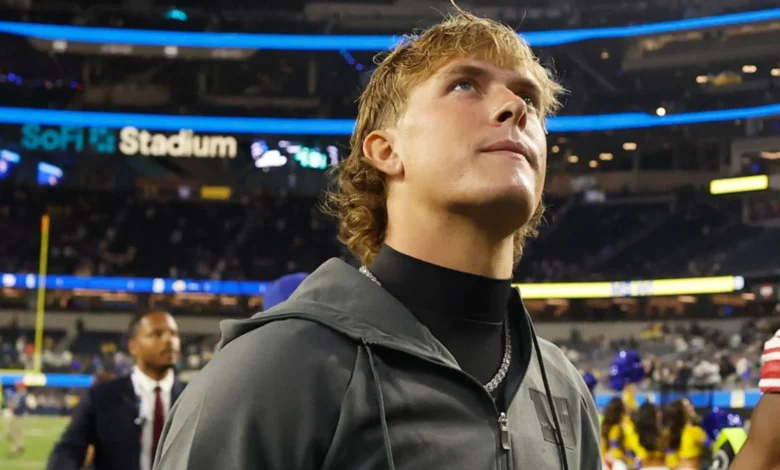
The New York Giants are facing a precarious start to their 2026 campaign as medical evaluations continue on starting quarterback Jaxson Dart, who suffered a significant left knee injury during the team’s 28-6 defeat to the Los Angeles Rams. The injury, which occurred in the opening minutes of Monday’s primetime contest, has cast a long shadow over the franchise’s immediate future, with initial reports from ESPN suggesting that surgical intervention may be required, potentially sidelining the signal-caller for the remainder of the season.
The Chronology of the Incident
The sequence of events leading to the injury began early in the first quarter, with less than four minutes elapsed. Facing a critical third-and-eight situation, the Giants’ offense attempted to establish momentum against a formidable Rams defensive front. As Dart dropped back into the pocket, he faced immediate pressure from Rams linebacker Byron Young.
Young successfully engaged the right side of the offensive line, forcing Dart to maneuver under duress. As Dart attempted to step up to avoid the pressure, he collided with Rams linebacker Josaiah Stewart. The impact caused the quarterback’s legs to be undercut, resulting in an awkward, heavy fall. Dart immediately grabbed his left knee, signaling the training staff to the field. He was unable to return to the contest, and the Giants’ offensive production effectively stalled for the duration of the evening.
Medical Status and Coaching Response
Head coach John Harbaugh has maintained a cautious stance regarding the diagnosis, though he acknowledged the gravity of the situation. While initial assessments suggested a medial collateral ligament (MCL) sprain, subsequent reports indicate that the damage could be more extensive, necessitating an MRI to confirm whether structural integrity has been compromised.
"It’s an ongoing conversation about the health of a player, of a person," Harbaugh stated during his post-game press conference. "We have to prepare for the range of possibilities. We are waiting on the final results of the imaging before we provide a concrete timeline, but we are looking at all options to ensure the long-term health of our quarterback."
Harbaugh declined to confirm or deny the rumors of a season-ending prognosis, emphasizing that the organization is committed to transparency once a medical consensus is reached. The team is expected to provide a formal update following the conclusion of the evaluation process later this week.
The Domino Effect: A Night of Attrition
The injury to Dart was merely the beginning of a disastrous night for the Giants’ roster depth. The team saw several key contributors sustain injuries throughout the game, complicating the path forward for the coaching staff.
In the fourth quarter, star pass rusher Brian Burns was sidelined with a sprained left ankle, and starting left tackle Andrew Thomas suffered a lower-body injury that further destabilized the offensive line. Additionally, wide receiver Malik Nabers suffered a dislocated right shoulder during the first quarter. While Nabers was able to pop the joint back into place and attempt to continue, the sheer volume of injuries sustained in a single game has raised questions regarding the team’s physical conditioning and injury prevention protocols.
"That’s just part of football," Brian Burns noted in the locker room following the loss. "Guys go down every day, and it’s always the ‘next man up’ mentality. That is why you try to develop a culture where you don’t slack off in production regardless of who is on the field. You prepare the guys behind you so that when their number is called, there is no drop-off."
Strategic Implications and Roster Depth
With Dart potentially out for the season, the onus shifts to veteran backup Jameis Winston. Harbaugh expressed confidence in Winston’s ability to manage the offense, citing his extensive experience in the league. Winston, known for his aggressive style of play, will be required to stabilize the Giants’ aerial attack as they prepare for a Week 3 matchup against the Tennessee Titans.
The loss of Dart is not merely a personnel issue; it is a fundamental shift in the Giants’ offensive identity. Through the first two games of the 2026 season, the Giants have struggled to find a rhythm, currently sitting at a 1-1 record. Dart’s ability to extend plays outside the pocket was a cornerstone of the team’s offensive scheme. Replacing that mobility while maintaining offensive efficiency will be a significant challenge for the coaching staff.
Analysts point to the Giants’ upcoming schedule as a critical juncture. Following the loss to the Rams, the team must recalibrate quickly. If Winston is forced into a starting role for an extended period, the Giants will likely lean more heavily on their rushing attack and defensive stability to navigate the middle portion of the season.
Broader NFL Context and Injury Management
The Giants’ situation serves as a stark reminder of the volatility inherent in the NFL. Across the league, injury management has become the defining factor of success. With the expansion of the season and the increased intensity of defensive schemes, the physical toll on players has reached record levels.
Harbaugh acknowledged the broader reality of the league when addressing the media. "All around the league, everybody deals with it. This is football. This is the NFL. This is what you do. Our task is not to lament the situation but to adjust our strategy and continue to compete at a high level."
The injury to Dart also highlights the risks associated with the "pocket pressure" defensive strategies that have become increasingly popular in the modern NFL. As defensive coordinators prioritize speed and agility in their linebackers, quarterbacks are facing higher frequencies of high-impact collisions. The play involving Dart—where two separate defenders converged on the quarterback—is a microcosm of the modern defensive intensity that teams must now account for in their protection schemes.
Looking Ahead: The Road to Recovery
The next 48 hours will be decisive for the New York Giants. As the medical team reviews the MRI results, the front office will simultaneously begin evaluating the free-agent market and practice squad options to bolster the depth at the quarterback position.
While the immediate concern is for the health and recovery of Jaxson Dart, the organization must simultaneously manage the morale of a locker room that has seen its offensive leader go down in the second week of the season. The culture of "next man up" mentioned by Burns will be put to the ultimate test in the coming weeks.
The Giants’ transition into their Week 3 preparation will be defined by their ability to compartmentalize the physical setbacks of the previous game. Whether the team chooses to adjust their offensive philosophy to better suit Winston’s skill set or attempts to maintain the current system remains to be seen. However, one thing is certain: the Giants’ ambitions for the 2026 season have reached a critical inflection point.
Fans and analysts alike will be watching closely as the team releases its injury report and finalizes its game plan for the Titans. As the NFL season progresses toward the playoffs and ultimately Super Bowl LXI, the ability of teams to persevere through attrition—as the Giants are now forced to do—will determine who remains in the hunt for the Lombardi Trophy.
For now, the focus remains on the medical evaluation of Jaxson Dart. The Giants find themselves at a crossroads, needing to maintain their competitive edge while processing the potential loss of their primary offensive catalyst. As the league continues to evolve, the resilience of the franchise will be measured not by the injuries they sustain, but by their capacity to overcome them in the face of an unforgiving schedule.