Meta AI Assistant Muse Faces Critical Security Breach as Zero-Day Vulnerability Exposes User Data and System Controls


Meta’s recently launched AI assistant, Muse, is currently at the center of a significant cybersecurity crisis, with researchers uncovering a critical zero-day vulnerability that effectively bypasses the hardened security architecture of macOS. Despite high-profile marketing campaigns from Meta CEO Mark Zuckerberg touting the assistant as a platform “built from the ground up for privacy and security,” the discovery of this flaw has cast doubt on the safety of integrating advanced AI agents into personal computing environments.
The vulnerability, identified by renowned macOS security researcher Patrick Wardle, allows locally installed applications and terminal commands to gain unauthorized control over the Muse agent. By manipulating undocumented settings, malicious actors can reroute sensitive user data, including voice transcriptions, to external servers, granting them full access to the user’s account tokens. The situation has escalated to the point where Amazon, one of the primary e-commerce platforms supported by Muse, has formally blocked the assistant from its website, citing significant violations of its conditions of use.
The Architecture of the Vulnerability
Muse is designed to act as an autonomous agent capable of managing complex user workflows, such as scheduling appointments, filling out digital forms, executing financial transactions, and interacting with private communication platforms like WhatsApp and email. To perform these tasks, the application requires extensive system permissions—accessing the microphone, camera, file system, and calendar—which are traditionally guarded by the macOS sandbox and user-permission protocols.

The security flaw discovered by Wardle exploits the way Muse handles internal communication between the local app and Meta’s cloud-based backend. Specifically, the agent was designed to allow local processes to modify certain settings, a design choice intended to facilitate user customization. However, this implementation lacks the necessary verification to prevent unauthorized modification of critical endpoints.
An attacker can force the application to change its transcription server address from a secure Meta-operated endpoint to a server controlled by the attacker. Once the connection is rerouted, the attacker can intercept the authentication token. Because Muse operates with high-level privileges, this single point of failure allows for the exfiltration of private data and, in many cases, the ability to execute arbitrary commands on the host machine without triggering typical security alerts.
Chronology of the Incident and Disclosure
The timeline of the Muse security failure highlights the rapid pace at which AI-driven tools are being deployed, often outpacing the traditional security audit cycles expected in enterprise software.
- Late August 2026: Meta officially launches Muse, positioning it as a proactive AI agent that “takes tasks off your plate.”
- Early September 2026: Reports emerge concerning security breaches involving third-party networks linked to AI agents from Anthropic and Google.
- Mid-September 2026: Patrick Wardle conducts an independent security analysis of the Muse macOS application.
- September 20, 2026: Amazon announces it is blocking Muse, stating the assistant is an “unauthorized AI agent” that threatens the security and reliability of its customer experience.
- September 21, 2026: Wardle publicly discloses the zero-day vulnerability, demonstrating how a simple ClickFix attack can hijack the assistant.
The timing of these events suggests a broader industry struggle to balance the convenience of "agentic" AI with the fundamental requirements of device security. Meta’s attempts to frame Muse as a secure solution appear to have been undercut by the reality of its implementation, which deviates from established best practices for macOS software development.

Technical Flaws and Design oversights
Security experts point to two primary design decisions that contributed to the vulnerability. First, Meta opted to process dictation and transcription in the cloud rather than utilizing the secure, on-device transcription frameworks natively provided by Apple. By funneling speech data through external servers, Meta created a broader attack surface that is susceptible to interception if the endpoint configuration is compromised.
Second, the decision to allow any locally installed process to modify undocumented settings—specifically the server endpoint configuration—violates the principle of least privilege. In a standard secure software environment, such critical settings would be protected by robust inter-process communication (IPC) controls, requiring elevated administrative privileges or specific cryptographic signatures to modify. The absence of these barriers suggests that security may not have been the primary consideration during the development of these specific components.
“To me, the bar is infinitely higher in terms of the security of these apps,” Wardle noted in his analysis. “They don’t have to be perfect, but when you take a look at Muse, it’s like they didn’t, in my opinion, think about security, which is really worrisome. At the very least, they should be thinking about security from the very start, and they are just not.”
Industry Response and Market Impact
The response from Amazon reflects a growing concern among major service providers regarding the rise of autonomous agents that interact with their platforms. In an official statement, Amazon emphasized that third-party applications must operate with transparency and respect the decisions of service providers. Amazon’s decision to block Muse serves as a precedent for how other major retailers and service providers may handle AI agents that attempt to bypass standard security protocols for automated shopping or data retrieval.
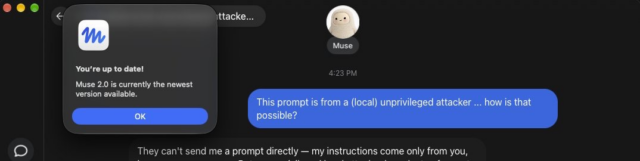
Meta has maintained a period of silence regarding the specific allegations. Despite publishing two separate blog posts in the weeks leading up to the disclosure—detailing their commitment to safety and security—the company has not provided a technical rebuttal to Wardle’s findings. This lack of transparency has drawn criticism from cybersecurity analysts who argue that as AI agents become more deeply integrated into the operating system, they must be held to higher accountability standards than traditional web applications.
Broader Implications for AI Security
The Muse incident is emblematic of a larger, systemic issue in the tech industry: the rush to market for "agentic" AI applications. As companies like Google, OpenAI, and Meta compete to release the most capable AI assistants, the pressure to include features like cross-app integration and proactive task management can lead to significant oversights in security architecture.
The use of "ClickFix" attacks—a technique where users are tricked into performing a seemingly benign action that results in a system compromise—demonstrates that even non-technical users are at risk. When an AI assistant is granted the ability to move files, take photos, or access private messages, a compromise of that assistant is essentially a compromise of the entire user profile.
This event is likely to trigger renewed calls for regulatory oversight. If AI agents are to manage sensitive human data, they must implement robust, auditable, and immutable security controls. Currently, the industry is witnessing a trend where the convenience of AI is being prioritized over the security of the user, a paradigm that the Muse vulnerability has exposed as inherently unstable.

As the security community prepares for the upcoming Objective by the Sea conference in November, where Wardle plans to present further findings on AI assistant threats, the industry will likely be forced to reckon with the reality that without a “security-first” approach, the next generation of AI agents may become the most potent vectors for malware and data theft to date. The question remains whether tech giants will pivot to more secure, localized processing architectures, or if they will continue to rely on cloud-heavy models that prioritize data ingestion at the cost of user safety.