Volcanic Eruption Unveils Natural Mechanism for Methane Destruction and Climate Insights

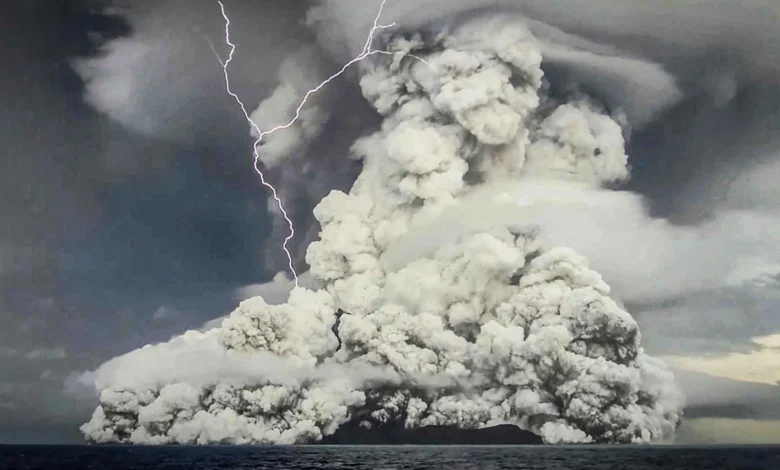
When the submarine volcano Hunga Tonga-Hunga Ha’apai erupted violently beneath the South Pacific Ocean in January 2022, it unleashed one of the most cataclysmic natural explosions of the modern era. The blast sent shockwaves around the globe, triggered tsunami waves across multiple continents, and injected unprecedented volumes of water vapor, sulfur dioxide, and ash straight into the stratosphere. Months later, as atmospheric scientists meticulously analyzed satellite data to understand the lingering atmospheric aftermath, they stumbled upon an entirely unanticipated consequence of the cataclysm: the colossal volcanic cloud was actively destroying methane, a potent greenhouse gas, at a remarkable rate.
This groundbreaking discovery, recently detailed in the journal Nature Communications, suggests that nature possesses chemical pathways for mitigating short-term atmospheric warming that scientists had previously overlooked. While the findings do not offer a silver bullet for the climate crisis, they provide critical new data regarding the global methane budget, open up novel avenues for atmospheric research, and may even inspire humanity to explore engineered methods of atmospheric methane removal.
Chronology of an Unprecedented Eruption and Detection
The sequence of events began on January 14 and culminated on January 15, 2022, when the Hunga Tonga-Hunga Ha’apai volcano—situated about 65 kilometers north of Tongatapu, the main island of Tonga—suffered a colossal paroxysmal explosion. The eruption punched a hole through the atmosphere, thrusting millions of tons of water vapor and volcanic debris higher than 50 kilometers into the stratosphere.
Within days, international space agencies began monitoring the colossal plume using advanced Earth-observation satellites. Among the instruments keeping a watchful eye was TROPOMI (TROPOOMI Monitoring Instrument), an advanced payload aboard the European Space Agency’s Sentinel-5P satellite. TROPOMI is engineered to scan the globe daily, tracking trace gases linked to air pollution, stratospheric ozone, and climate dynamics.
As researchers analyzed the atmospheric data collected by TROPOMI in the weeks following the blast, they detected an anomalous chemical signal: record-high concentrations of formaldehyde lingering within the stratospheric plume. Formaldehyde typically has a very short atmospheric lifespan, breaking down within hours under solar radiation. Therefore, tracking unusually high concentrations of the chemical over an extended period served as a brilliant chemical fingerprint, indicating that a continuous, large-scale chemical reaction was actively destroying methane within the drifting volcanic cloud. The research team successfully tracked this unique formaldehyde-rich plume for ten consecutive days as it traveled across the South Pacific and all the way to South America, proving that the chemical processing of methane was sustained for over a week.
The Chemistry of the Plume: Salt, Sunlight, and Chlorine
To understand how a volcanic cloud could act as a methane scrubber, scientists had to look closely at the unique ingredients thrown into the upper atmosphere by the underwater eruption. Hunga Tonga-Hunga Ha’apai is a submarine volcano, meaning its violent explosion blasted enormous quantities of salty seawater directly into the sky alongside pulverized volcanic ash and sulfur compounds.
The underlying chemical mechanism, while entirely novel in the stratosphere, shares conceptual roots with recent atmospheric discoveries made closer to the Earth’s surface. In 2023, independent atmospheric researchers discovered that Saharan dust blown across the Atlantic Ocean can mix with sea salt aerosols produced by breaking ocean waves. When sunlight strikes these combined mineral and sea salt particles, photo-chemical reactions liberate highly reactive chlorine atoms.
Chlorine is exceptionally reactive, capable of aggressively attacking and breaking apart methane molecules ($CH_4$) in the troposphere. However, scientists previously assumed this specific aerosol-chlorine chemistry was largely confined to the lower layers of the atmosphere. The Hunga Tonga eruption forced a re-evaluation of this assumption by demonstrating that the exact same mechanism can unfold under the vastly different physical conditions of the stratosphere.
When sunlight illuminated the mixture of volcanic ash and oceanic salts suspended high above the Earth, it catalyzed the release of reactive chlorine atoms. These atoms immediately went to work destroying a significant fraction of the methane molecules co-emitted by the eruption. The massive spikes in formaldehyde detected by satellite instruments served as the undeniable smoking gun for this process.
Quantifying the Phenomenon: Data and Methane Budgets
To gauge the scale of this natural chemical reaction, the research team calculated both the emissions generated by the volcano and the concurrent destruction rate within the plume. According to their atmospheric modeling and satellite data analysis, the Hunga Tonga-Hunga Ha’apai eruption released approximately 300 gigagrams (Gg) of methane into the atmosphere—an amount roughly equivalent to the annual methane emissions produced by more than two million cattle.
Simultaneously, however, the reactive plume managed to neutralize approximately 900 megagrams (Mg) of methane per day. This daily destruction rate matches the daily methane footprint of another two million cows, demonstrating that while the volcano injected significant greenhouse gases into the air, the unique aerosol chemistry partially offset the damage by dismantling a measurable portion of that pollution in real time.
These findings carry profound implications for the global methane budget—the scientific accounting system used to track sources of methane emissions versus the natural sinks that remove the gas from the atmosphere. Historically, global climate models have thoroughly accounted for methane sources like wetlands, enteric fermentation in livestock, fossil fuel extraction, and geological seeps, alongside standard chemical sinks such as reactions with hydroxyl ($OH$) radicals in the troposphere.
However, atmospheric mineral dust and volcanic ash have not been systematically factored into global methane budget calculations. Because volcanic eruptions and wind-blown dust storms inject massive quantities of mineral aerosols into the atmosphere globally, the new study indicates that scientists must revise their data models to account for aerosol-driven methane destruction. Adjusting these calculations will allow for more accurate predictions of how methane concentrations fluctuate over time.
Broader Impacts and the Role of Methane in Climate Action
Methane represents one of the most critical targets in contemporary climate policy. Although carbon dioxide ($CO_2$) remains the primary long-term driver of anthropogenic climate change due to its immense cumulative volume and centuries-long atmospheric persistence, methane packs a far more immediate punch.
Over a 20-year timescale, methane is approximately 80 times more potent at trapping heat in the atmosphere than carbon dioxide. Currently, methane is responsible for roughly one-third of all contemporary global warming. Fortunately, unlike carbon dioxide, which can persist for centuries, methane has a relatively short atmospheric lifetime, breaking down naturally within approximately a decade through chemical reactions.
Because of this short lifespan, aggressive reductions in methane emissions are frequently described by climate scientists as an "emergency brake" on global warming. Slashing methane pollution today can yield tangible climate cooling benefits within ten to twenty years, helping humanity avoid near-term tipping points. However, researchers emphasize that methane mitigation is entirely complementary to, rather than a substitute for, deep decarbonization; stabilizing global temperatures in the long run still requires aggressive, sustained reductions in carbon dioxide emissions.
Technological Implications: Mimicking Nature’s Methane Scrubber?
The realization that volcanic activity can trigger rapid, large-scale methane destruction has sparked intense interest among researchers and climate technology firms investigating atmospheric methane removal (AMR). While traditional climate mitigation focuses almost exclusively on preventing methane from leaking into the air from fossil fuel infrastructure, agriculture, and landfills, emerging scientific discussions explore whether humanity can safely accelerate the natural chemical destruction of methane already present in the global background air.
Hunga Tonga-Hunga Ha’apai has provided a dramatic, real-world proof of concept showing that aerosol-mediated chlorine chemistry can destroy methane at scale. Nevertheless, moving from a natural volcanic phenomenon to an engineered climate intervention presents monumental challenges. Atmospheric scientists point out that proving the efficacy and safety of any proposed geoengineering or atmospheric remediation technology is notoriously difficult, primarily because methane is diluted across vast expanses of the global atmosphere, making small concentration changes notoriously hard to measure.
This is precisely where the satellite methodologies developed in the new study prove invaluable. By demonstrating that spaceborne instruments like TROPOMI can successfully detect and track chemical indicators of methane destruction within a complex atmospheric plume, the researchers have established a framework for monitoring large-scale atmospheric chemistry from orbit.
"How do you prove that methane has been removed from the atmosphere? How do you know your method works? It’s very difficult. But here we address that problem by showing that methane breakdown can in fact be observed using satellites," explained Dr. Jos de Laat of the Royal Netherlands Meteorological Institute, a senior author of the study.
Navigating the Path Forward
Any future attempt to deliberately replicate the natural chemistry observed after the Hunga Tonga eruption will require rigorous scientific study, comprehensive environmental impact assessments, and international oversight to guard against unintended consequences. Introducing reactive chlorine or engineered aerosols into the upper atmosphere could pose risks to the stratospheric ozone layer if not managed with absolute precision.
Yet, the study serves as a powerful reminder of the complex, interconnected nature of Earth’s geochemical systems. The eruption of Hunga Tonga-Hunga Ha’apai was undeniably destructive, but it has inadvertently gifted the scientific community a precious blueprint. By uncovering the hidden chemistry of volcanic plumes and proving that space-based assets can monitor atmospheric remediation in real time, researchers are now better equipped to understand the planet’s natural balancing acts—and perhaps, one day, harness those very lessons to protect the global climate.