The Brittle Break: Drexel Researchers Discover Simple Fluids Can Fracture Like Glass

A groundbreaking discovery by researchers at Drexel University is challenging long-held scientific assumptions about the behavior of liquids. Thamires Lima, a research professor in chemical engineering, has demonstrated through meticulous experimentation that even seemingly simple, non-elastic fluids can fracture under stress, behaving in a manner previously thought exclusive to brittle solids. This revelation, detailed in a recent study, has sent ripples through the fluid dynamics community, prompting a re-evaluation of fundamental principles and opening new avenues for research with significant implications across various scientific and engineering disciplines.
The research, led by Nicolas J. Alvarez, a professor of chemical engineering at Drexel, began with an unexpected observation during routine testing. Lima was employing a technique known as extensional rheology, a method that involves stretching liquids between metal plates to measure the force required for them to flow. Her focus was on the properties of highly viscous substances, materials akin to honey or molasses, though in a laboratory setting, these often involve more complex compounds like polypropylene or crude oil. The specific experiment involved a collaboration with the oil and gas giant Exxon Mobil, focusing on a blend of hydrogen and carbon – a common component in the energy sector.
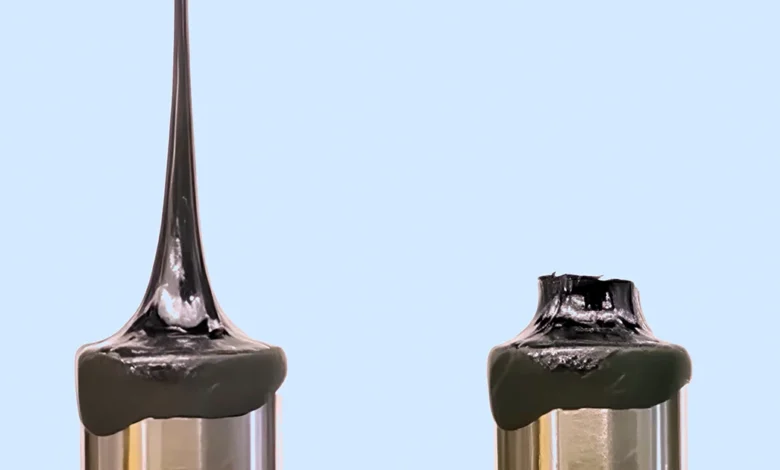
During one such test, Lima heard a distinct, sharp crack. Initially attributing the sound to a malfunction of the testing apparatus, she soon realized the source of the noise was far more extraordinary. The fluid itself, a viscous, black concoction, had not stretched as anticipated. Instead, it had fractured, exhibiting a behavior akin to a solid breaking. This observation was particularly perplexing because the fluid in question was characterized as a "simple fluid," lacking the inherent elasticity that typically allows for such brittle fracturing in more complex materials.
"Nobody expected that this would be possible in this kind of simple fluid because viscosity usually just rearranges the molecules," commented Arnold Mathijssen, a fluid physicist at the University of Pennsylvania, who was not directly involved in the study but is familiar with the research area. "You don’t expect it to crack. But it does, so I think that’s what’s really surprising."
A Surprising Snap: The Unforeseen Fracture
Undeterred by the initial anomaly, Lima meticulously repeated the experiment, stretching the fluid numerous times to confirm that the observed fracture was not an isolated incident. "Every time that she measured it, the material would break," stated Alvarez, underscoring the consistency of the phenomenon. He vividly described the sound as "a loud pop. I mean, like you just took a rubber band and pulled it and stretched it and it snapped."
The consistent nature of the fracture compelled Lima and Alvarez to investigate further, employing high-speed cameras to capture the event in unprecedented detail. Their analysis revealed that the cracking mechanism was indeed a "brittle fracture," a term typically reserved for the catastrophic failure of solid materials like glass or porcelain. This type of fracture occurs when a material, under stress, deforms minimally before breaking. In brittle solids, microscopic defects, often at the nanoscale, act as initiation points for cracks. When the applied stress exceeds a critical threshold, it becomes energetically more favorable for these defects to grow into macroscopic fractures rather than for the material to absorb the stress elastically.
Challenging Established Paradigms: Elasticity and Fracture
Historically, the scientific community has linked brittle fracture in fluids to elasticity. Complex fluids, such as viscoelastic liquids, possess an elastic component due to the entanglement of their long molecular chains. In a 2016 paper published in Physical Review Letters, Alvarez and his colleagues had already demonstrated that complex fluids like melted polystyrene could exhibit solid-like fracture behavior. Their findings suggested a strong correlation between elasticity and the propensity for fracture, leading to the prevailing theory that elasticity was a prerequisite for such material failure.
However, the hydrocarbon blend used in the Drexel study was a simple fluid, characterized by a minimal elastic component. These fluids are primarily governed by viscosity, meaning they tend to flow and rearrange their molecular structure under stress rather than store elastic energy. The very notion that a simple fluid could undergo brittle fracture directly contradicted the established understanding.
"If there is no elasticity in a problem, then how can you think about initiation or growth of a crack?" posed Brato Chakrabarti, a physicist specializing in fluid mechanics at the International Center for Theoretical Sciences in Bengaluru, India, highlighting the theoretical quandary posed by the discovery.
Revisiting the Classics: Joseph’s Hypothesis
The surprising fracture of the simple fluid prompted the Drexel researchers to revisit the work of Daniel D. Joseph, a distinguished mechanical engineer from the University of Minnesota. In seminal papers published in 1995 and 1998, Joseph had theorized that any liquid, irrespective of its elastic properties, could fracture under a sufficient amount of tearing stress. His hypothesis suggested that cavitation, the formation of microscopic voids or bubbles within the fluid, could be the underlying mechanism for such fractures.
Alvarez mused that the breaking point of a liquid might not be tied to a property like elasticity but rather to something more fundamental to the liquid’s intrinsic structure. "Maybe, just maybe, the thing that causes [certain] fluids to break… [is] somehow related to this cohesive energy that holds the molecules together," he suggested, hinting at a deeper molecular-level explanation.
The Role of Cavitation: Bubbles and Breaks
Simple fluids possess an inherent mechanism for stress relief that does not involve breaking: cavitation. This process involves the formation of intermolecular voids or bubbles. A common example occurs with the blades of a spinning propeller in a liquid. The rapid movement of the blades can create a pressure differential, leading to a drop in pressure on one side. This localized pressure drop can cause the fluid to cavitate, forming bubbles. Engineers actively work to prevent cavitation because the subsequent collapse of these bubbles generates powerful shock waves that can damage machinery.
Joseph’s earlier predictions aligned with this phenomenon, suggesting that cavitation could indeed facilitate the fracture of simple fluids. "If you think about what holds a fluid together, it’s cohesiveness, or the intermolecular interactions between the molecules," Alvarez explained. When these intermolecular forces are overcome, bubbles can form. While viscous liquids typically maintain their integrity by deforming around these bubbles, a rapid and widespread formation of numerous bubbles could, in theory, lead to a fracture, much like a pane of glass shattering.
The Drexel team observed that once a crack initiated within the simple fluid, it propagated with astonishing speed. This rapid propagation was attributed to the fluid’s lack of elasticity. "If you can get that nucleation event of the crack to begin, because there is no elasticity in the material, that crack can propagate as fast as physics will allow it," Alvarez stated.
This speed of propagation stands in stark contrast to observations in complex fluids. While cracks in melted polystyrene have been recorded propagating at approximately 0.07 meters per second, the simple liquids studied by Lima and her colleagues exhibited crack velocities ranging from 500 to 1,500 meters per second.
"That has something to do with the way that the material is able to dissipate energy," Alvarez elaborated. One prevailing hypothesis suggests that in complex fluids, the long molecular chains absorb energy as they break, acting as a natural dampener. However, in simple fluids, with their less complex structures, "there’s really nothing to slow that crack down," he concluded. This difference in propagation speed also appears to influence the visual morphology of the fracture; while cracks in complex fluids often resemble the flared opening of a trumpet, those in simple fluids more closely mimic the sharp, clean break seen in glass.
Quantifying the Fracture: Stress, Viscosity, and Strain Rate
Despite their divergent mechanisms of fracture, both complex and simple fluids tested by the researchers exhibited a remarkably similar critical stress threshold for breaking: 2 megapascals. The team systematically varied the temperature of the hydrocarbon blend to alter its viscosity. They discovered that only the least viscous liquid tested failed to fracture, indicating a strong correlation between viscosity and the material’s ability to withstand stress before fracturing. The researchers determined that the critical stress level at which liquids fracture is directly proportional to their viscosity multiplied by the strain rate – essentially, how quickly they are being stretched and how their diameter is changing.
The limitations of the testing apparatus, which could pull on the liquids at a maximum rate of 500 millimeters per second, suggest that even less viscous liquids, such as honey or even water, might be capable of fracturing if subjected to even higher strain rates. "There are very few instruments comparable to ours," Lima noted, expressing her conviction that with more advanced equipment capable of greater pulling speeds, the range of liquids that can be induced to fracture could be significantly expanded.
Future Frontiers: Unraveling the Mysteries of Fluid Fracture
The implications of this discovery are far-reaching. Lima’s immediate future research plans include utilizing more transparent liquids to visually capture the precise moment of crack formation. She also intends to explore methods for rapidly freezing the liquid surface immediately after fracture, allowing for high-resolution nanoscale analysis of the fracture surface using advanced microscopy techniques.
Alvarez is particularly interested in exploring the practical applications of understanding simple fluid fracture, especially in the context of fiber spinning – a process with potential applications in advanced materials, engineering, and medicine. Beyond this, the research could have significant implications for fields such as inkjet printing, the development of advanced protective materials for applications like brain injury protection, and the design of soft robotics.
However, for Alvarez, the most profound aspect of this discovery lies in its fundamental challenge to established scientific thinking. "It’s different than what we’ve been thinking about in the literature for a very long time," he concluded, emphasizing the paradigm shift this research represents in our understanding of fluid mechanics. The ability of simple fluids to fracture, a phenomenon once considered impossible, opens a new chapter in the study of materials science and fluid dynamics, promising to unlock novel technologies and deepen our comprehension of the physical world around us.