Shifting Landscape of Medical Debt Collection: Non-Hospital Providers Now Dominate Patient Lawsuits in Connecticut


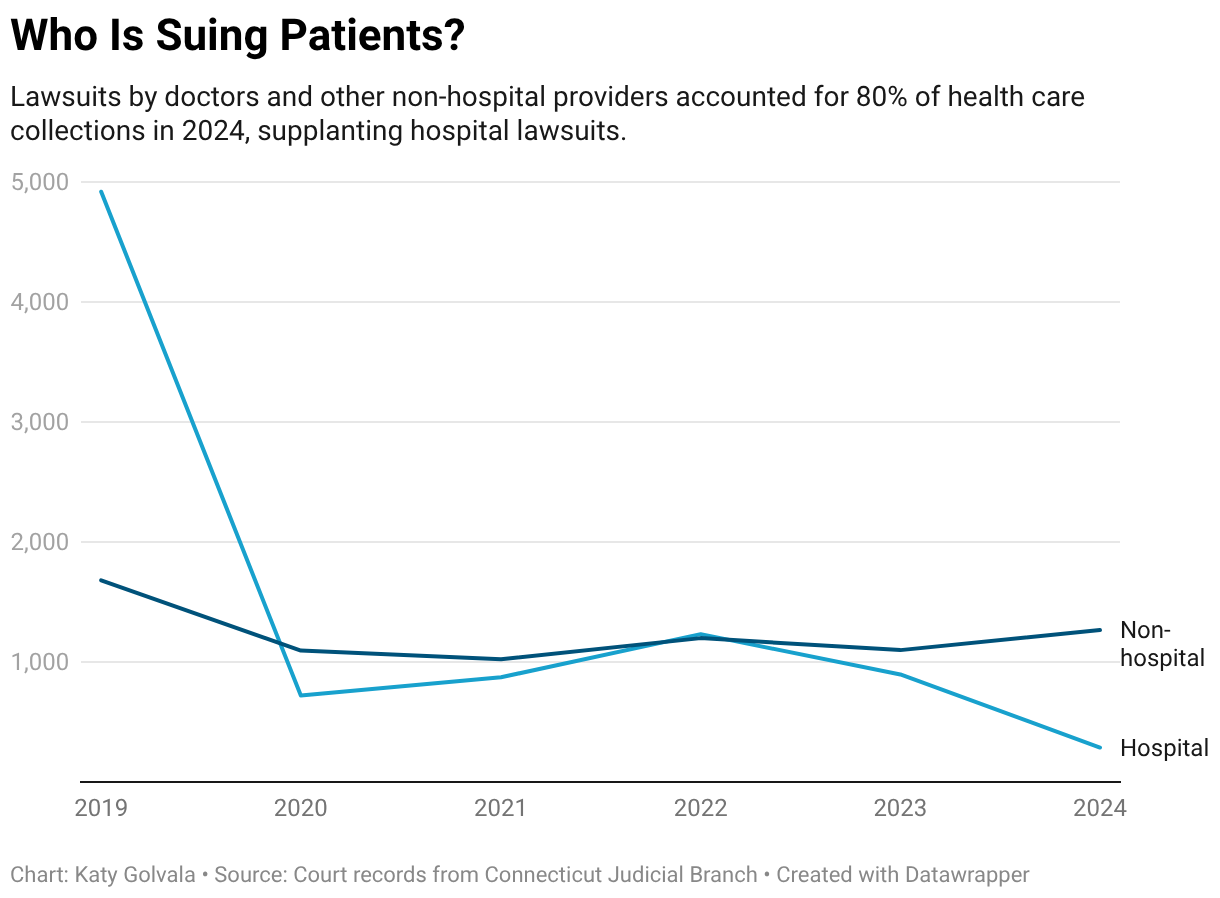
BRISTOL, Conn. — While many hospital systems in Connecticut have ceased suing patients over unpaid medical bills, facing public outcry over aggressive collection tactics, a significant shift has occurred: physicians, dentists, ambulance companies, and other independent healthcare providers now account for the vast majority of such legal actions. A comprehensive investigation by CT Mirror and KFF Health News into state legal records reveals that these non-hospital providers initiated over 80% of healthcare-related collection lawsuits filed against patients and their families in 2024, a stark reversal from just five years prior when hospital systems were responsible for three-quarters of these cases.
This transition signals a move towards medical debt collection operating within a less regulated environment. Nonprofit hospitals, often tax-exempt, are generally bound by federal regulations requiring them to offer financial assistance to low-income patients and limiting aggressive collection practices. However, private medical groups and other independent providers are typically exempt from these stringent rules, allowing them greater latitude in pursuing legal recourse for outstanding debts.
The Growing Burden of Medical Debt Litigation
The lawsuits, often initiated for bills under $3,000, can have devastating consequences for patients. These legal actions are a significant byproduct of a pervasive medical debt crisis affecting an estimated 100 million Americans. Legal battles over medical expenses can lead to wage garnishments, liens on personal property, and substantial increases in debt due to accumulated interest and court fees. Beyond the direct financial strain, these lawsuits can exacerbate existing financial pressures on struggling families, deter individuals from seeking necessary medical care, and erode trust in the healthcare system.
Allie Cass-Wilson, a nurse from Bristol, Connecticut, experienced firsthand the impact of these aggressive tactics. She was sued by an OB-GYN practice for a $1,972 debt, despite having been a patient years earlier. "It’s really messed up," Cass-Wilson stated. "How can they do that to people?" Court records indicate she did not contest the lawsuit. Cass-Wilson learned of the outstanding balance only through the legal action. When she attempted to schedule a follow-up appointment, she was informed she had been "blacklisted" and her doctor would no longer see her, a situation she found bewildering and a disruption to her ongoing care. She subsequently sought medical attention elsewhere.
A Detailed Look at the Litigious Providers

Over a six-year period, from 2019 to 2024, CT Mirror and KFF Health News identified more than 16,000 healthcare-related debt cases in Connecticut courts. This extensive database was compiled from online court records with the assistance of January Advisors, a data science consulting firm.
While the majority of Connecticut’s over 25,000 licensed physicians and dentists did not resort to legal action against patients for outstanding balances, the records show that more than 400 medical providers, including some hospital systems, did initiate lawsuits. The range of specialists involved is broad, encompassing radiologists, anesthesiologists, ophthalmologists, podiatrists, allergists, and pediatricians.
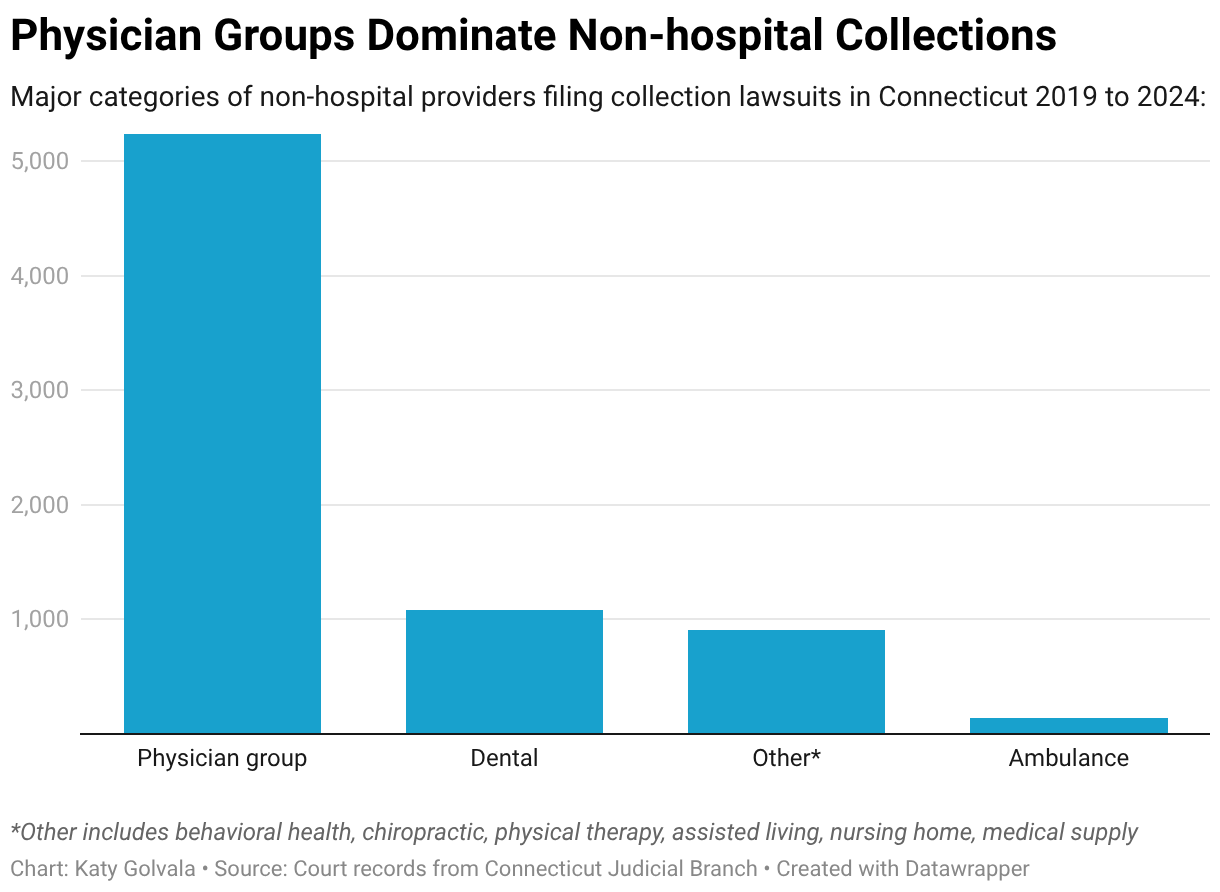
Dental providers, including dentists and periodontists, filed over 1,000 lawsuits. Ambulance companies also pursued legal action, initiating more than 140 cases. Med-Aid, a company specializing in orthopedic braces and medical supplies, based outside New Haven, sued over 400 individuals, according to court records. The company’s president, Frank Dilieto, did not respond to multiple requests for comment.
Physician Groups at the Forefront of Collections
The Briar Rose Network in Bristol, part of the larger Physicians for Women’s Health network of OB-GYN practices across Connecticut, was the entity that sued Allie Cass-Wilson. In 2024 alone, members of this network filed nearly 100 lawsuits against patients, according to available records.
Paula Greenberg, CEO of Women’s Health Connecticut, which manages the business operations for Physicians for Women’s Health, emphasized that these lawsuits represent a small fraction of the over 300,000 patients the network serves annually. "This is an organization committed to patients," Greenberg stated, adding that the group offers various payment solutions, including installment plans and financial aid.
Geoffrey Manton, president of Naugatuck Valley Radiological Associates, echoed a similar sentiment, noting that his practice endeavors to work with patients facing financial difficulties. However, he also highlighted instances where patients become unresponsive to billing inquiries. "Hiding from your problems isn’t going to solve them," Manton commented. "If we didn’t take any action, there could be that person that is in that late-model Mercedes that just chooses not to pay any bills." Naugatuck Valley Radiological Associates filed over 125 lawsuits against patients between 2019 and 2024.
Many medical providers point to the increasing prevalence of high-deductible health plans as a primary driver for aggressive collection practices. These plans often leave patients responsible for thousands of dollars in out-of-pocket expenses before insurance coverage fully applies. Greenberg and Manton both stressed that as businesses, physician groups must manage their operating costs and ensure revenue collection. "This is a business," Greenberg reiterated. "We have to look at our operating costs."
Critics, however, argue that pursuing legal action for relatively small debts is disproportionate, especially considering the substantial revenues of many medical practices. Court records show that the average debt pursued by members of Physicians for Women’s Health in 2024 was less than $1,100, a figure that pales in comparison to the network’s reported annual revenues in the tens of millions of dollars. Patient advocates contend that even modest debts, often inflated by interest and fees, can impose significant hardship on families already struggling with illness and financial instability. Lisa Freeman, director of the Connecticut Center for Patient Safety, lamented, "We don’t have a realistic choice in using health care. To then get sued for it, when people have less and less funds available for anything extra, that’s very disheartening."
Real-Life Impacts: A Stroke, Then a Lawsuit
Matthew Millman, 54, a former IT support worker, faced a double blow when a stroke led to job loss, followed by a lawsuit from Meriden Imaging Center over an $1,891 bill. Millman and his wife reported their financial struggles to the imaging center, which is affiliated with Midstate Radiology Associates, a large physician group operating imaging centers and medical offices throughout Connecticut. "It was very frustrating," Millman shared from his modest New Britain apartment. The family now subsists on his two part-time jobs—bagging groceries and assisting homebound seniors—earning approximately $1,500 monthly to support himself, his wife, and their teenage daughter. The imaging center’s attempt to garnish his wages proved unsuccessful due to his unemployment from his previous IT role. "It’s all about money," Millman reflected sadly. "If you are trained in helping somebody with their health, it shouldn’t be about the money first. It should be about their health."
Court records indicate that Midstate Radiology and its affiliated entities, including Meriden Imaging Center, filed over 1,000 collection lawsuits against patients between 2019 and 2024, making them the most litigious non-hospital providers in the state. In a pattern common to medical debt litigation, these plaintiffs largely prevailed in their cases. Gary Dee, president of Midstate Radiology, did not respond to inquiries.
Across town, Joseph Lentz, 59, also faces financial hardship. Unemployed since losing his job during the pandemic, his family lost their home to foreclosure. In 2023, Orthopedic Associates of Hartford sued Lentz for a $3,644 bill related to shoulder surgery performed in 2018. "I’d pay it if I could, I guess," Lentz stated, expressing concern about affording next month’s rent. "But I don’t even know where next month’s rent is coming from. I’m trying to climb out as best I can. I guess this is just one more thing to shovel in." Orthopedic Associates of Hartford filed over 580 lawsuits between 2019 and 2024, predominantly winning their cases. David Mudano, CEO of the orthopedic group, stated in a press release, "As an independent physician practice, we strive to balance compassion for patients with the financial responsibility required to sustain our practice."
Disputed Bills and Systemic Flaws
While Lentz acknowledged the debt, many patients embroiled in collection lawsuits question the accuracy of their medical bills. These disputes often stem from claims that insurance should have covered the services, or, in some instances, bills for services never received. This issue is symptomatic of broader problems within the healthcare system, including widespread aggressive collection tactics and a lack of robust mechanisms for resolving disputes over medical bill accuracy, delayed insurance claims, or denied coverage.
A 2022 report by the Consumer Financial Protection Bureau found that nearly half of all medical debt complaints involved bills that consumers believed were erroneous or had already been paid. Lester Bird, a researcher specializing in debt collection lawsuits at The Pew Charitable Trusts, noted that courts are ill-equipped to adjudicate complex medical billing disputes, particularly when debt collection lawsuits lack sufficient documentation. "It’s complicated before it gets to the courts, and it’s very complicated when it gets into the courts," Bird explained.
Connecticut State Senator Saud Anwar, a Democrat and practicing physician, expressed concern that these billing complexities place an undue burden on patients. "Patients are left to deal with it," he said. Andrew Skolnick, an attorney in Milford, found himself in a similar situation. In 2023, an imaging center sued his wife for services rendered in 2020, alleging over $2,000 in unpaid debt plus interest. Skolnick stated that he had attempted to inform the imaging center that they had submitted the claim to the wrong insurance plan, but his concerns were dismissed. While Skolnick possessed the legal expertise and resources to contest the lawsuit, ultimately settling for $1,700, he emphasized, "It wasn’t a tremendous amount, but I knew that they had made a mistake. The system is not working."
Towards Greater Patient Protections?
Senator Anwar voiced concerns that the practice of physicians suing their patients erodes the fundamental trust inherent in the doctor-patient relationship. "It’s a sacred relationship," he stated. "If your physician, who is taking care of you, is suing you for money, that’s a problem."
In response to negative publicity, many hospitals have curtailed their practice of suing patients for unpaid bills. The number of hospital collection lawsuits in Connecticut courts plummeted from over 4,900 in 2019 to fewer than 300 in 2024. Furthermore, several states, including Connecticut, have enacted legislation to enhance patient protections regarding unpaid medical bills. Connecticut now prohibits medical debt from appearing on consumer credit reports, and lawmakers are actively advocating for increased hospital provision of financial aid. Other states have implemented restrictions on wage garnishment and property liens for medical debt collection.
However, state efforts to curb aggressive medical debt collection have primarily targeted hospitals. Connecticut State Senator Matt Lesser, a Democrat and co-chair of the Human Services Committee, suggests this focus may need to broaden. He is a proponent of a bill introduced this year that would prohibit hospitals from billing patients who receive public benefits or earn less than twice the federal poverty level. This restriction, however, would not extend to bills from independent physicians and other non-hospital providers. "We may have to go bigger if that’s where the heart of the matter is," Lesser indicated.

Connecticut Governor Ned Lamont, also a Democrat, who has championed initiatives to erase medical debt for over 150,000 state residents, expressed his unease with physicians pursuing legal action against their patients. "Everyone should do the right thing by patients," he urged.
Methodology: Unraveling Connecticut’s Medical Debt Litigation Data
Determining the frequency with which healthcare providers sue patients for unpaid bills is a complex task in most states, as court systems often do not specifically categorize debt collection lawsuits as medical in origin. However, Connecticut’s legal framework provides a unique advantage: debt collection cases filed in small claims court for unpaid medical or dental bills are specifically classified as healthcare debt.
CT Mirror and KFF Health News collaborated with January Advisors, a data science consulting firm with extensive experience in analyzing debt collection data from state courts, to extract and analyze these cases from the Connecticut court database. January Advisors has assisted numerous nonprofits and researchers nationwide in similar data collection efforts.
The investigation initially focused on healthcare collection cases filed in small claims court between 2019 and 2024, covering debts under $5,000. To capture lawsuits for larger bills exceeding $5,000, the team broadened their scope. Connecticut courts do not maintain a specific "medical" category for large-claim cases. Therefore, all large-claim records were reviewed for any plaintiff that appeared in the medical small-claims dataset. Additionally, cases involving plaintiffs with common medical terminology in their names, such as "hospital" or "DDS," were included, even if they did not appear in the initial small-claims dataset.
Each case was then manually reviewed to confirm the plaintiff’s status as a medical or dental provider and to determine if the provider was part of a larger hospital system or physician group. Plaintiffs were categorized by provider type (e.g., hospital system, dental, physician group). In instances where data was incomplete, online court records were accessed, and information was manually entered into the database. The Connecticut Judicial Department’s online portal purges case records after a certain period; for these cases, the agency was contacted to provide summonses and claims for manual data entry. Cases involving out-of-state defendants or plaintiffs, and those with insufficient records to confirm provider information, were excluded from the final analysis.