President Trump Weighs Declassification of Records Concerning Saudi Arabia and the September 11 Terrorist Attacks

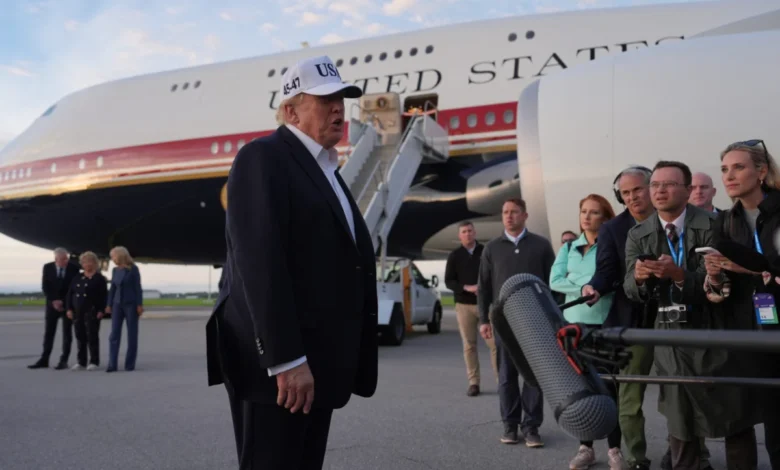
President Donald Trump confirmed on Sunday that he intends to review requests from families of September 11 victims regarding the declassification of government records that could potentially clarify the extent of Saudi Arabia’s involvement in the 2001 terrorist attacks. The commitment follows a direct plea from advocates during the 25th-anniversary commemorations in New York City, marking a significant, albeit preliminary, development in a legal and political saga that has spanned over two decades.
Speaking to reporters on the tarmac in Ireland before boarding Air Force One to return to Washington, the president acknowledged the Friday meeting with family representatives. "I’m going to look at it when I get back," Trump stated. "I know they asked me Friday." This response has reignited discussions surrounding the "28 pages"—a redacted section of the Joint Congressional Inquiry into the 9/11 attacks—and the broader question of whether U.S. administrations have prioritized diplomatic relations with Riyadh over transparency for the families of the nearly 3,000 people killed.
The Allegations and the Long Road to Accountability
The core of the families’ contention lies in the assertion that a network of extremist religious figures within the Saudi government, or individuals with close ties to the Saudi state, provided logistical and financial support to the 19 hijackers. It is a well-documented fact that 15 of the 19 hijackers were Saudi nationals. Despite this, the Saudi government has consistently and vehemently denied any official role in the planning or execution of the attacks, characterizing the hijackers as rogue actors who acted against the interests of the Kingdom.
For victims’ families, the pursuit of these documents is not merely an academic exercise but a central pillar of their ongoing litigation under the Justice Against Sponsors of Terrorism Act (JASTA). Terry Strada, a prominent voice among the families who lost her husband, Tom, during the attacks, has become a leading figure in demanding that the U.S. government cease what she describes as a decades-long pattern of protectionism toward the Saudi leadership.
"It has been one betrayal after another," Strada remarked during the recent memorial proceedings. "President Trump can still change that." Her plea captures the frustration of a community that believes evidence of Saudi complicity has been systematically withheld to preserve the strategic U.S.-Saudi alliance.
A Chronology of Conflict and Transparency
The relationship between the U.S. government, the victims’ families, and the Saudi state has been defined by a series of legal and bureaucratic milestones:
- September 11, 2001: Nineteen terrorists affiliated with al-Qaeda hijack four commercial airplanes, crashing them into the World Trade Center, the Pentagon, and a field in Shanksville, Pennsylvania.
- 2002: The Joint Congressional Inquiry releases its report. Section Four, the infamous "28 pages," is classified by the Bush administration, citing national security concerns.
- 2016: After years of pressure from families and members of Congress, the Obama administration finally declassifies the "28 pages," revealing intelligence leads suggesting that some hijackers had contact with individuals who had connections to the Saudi government. However, the report remained inconclusive regarding direct state sponsorship.
- 2016: Congress overrides President Obama’s veto to pass the Justice Against Sponsors of Terrorism Act (JASTA), allowing families to sue foreign states for their role in terrorist attacks on U.S. soil.
- 2021: President Biden signs an executive order directing the Department of Justice and other agencies to conduct a declassification review of documents related to the FBI’s "Operation Encore," the investigation into the 9/11 attacks.
- 2025: As the 25th anniversary approaches, families continue to seek the release of additional underlying documentation that was referenced in the 9/11 Commission Report but remained shielded from public view.
The Role of Intelligence and National Security
The debate over these documents frequently centers on the tension between transparency and the protection of intelligence sources and methods. The U.S. intelligence community has historically argued that releasing certain documents could expose the identities of informants or compromise current diplomatic efforts in the Middle East.
Critics of the classification argue that after 25 years, the risk to intelligence sources is negligible compared to the moral imperative of providing closure to the families. Furthermore, the information contained within these files is central to the civil lawsuits currently pending in federal court. Lawyers representing the families argue that the Saudi government has engaged in a "denial and delay" strategy, knowing that the U.S. government holds the keys to the most damaging evidence.
Broader Implications for U.S.-Saudi Relations
The potential release of these records carries significant weight for modern geopolitics. The U.S.-Saudi relationship has evolved from a Cold War-era energy and security partnership into a complex, often strained, geopolitical entanglement. Saudi Arabia remains a critical, if controversial, partner in the Middle East, particularly regarding regional security and counter-terrorism initiatives.
Should the administration decide to release records that implicate high-ranking Saudi officials or entities, the diplomatic fallout could be substantial. Such a move would likely complicate ongoing negotiations regarding regional stability and energy markets. However, failing to act could lead to further political friction at home, as the 9/11 families command a unique level of moral authority that few politicians are willing to openly oppose.
The Legal Framework of Accountability
The legal battle remains the primary venue for these grievances. Under JASTA, the burden of proof rests on the plaintiffs to establish that the Kingdom of Saudi Arabia provided material support to the hijackers. The requested documents are believed to contain bank records, communication intercepts, and field reports that could bridge the evidentiary gap between the hijackers and the Saudi state apparatus.
Legal experts note that even if the documents do not provide a "smoking gun" linking the Saudi Royal Family directly to the planning of the attacks, they may reveal a broader culture of support for extremist elements within the Saudi bureaucracy during the late 1990s and early 2000s. This distinction is crucial for the litigation, as it addresses the concept of "state sponsorship" in a modern legal context.
Analysis: What Comes Next?
President Trump’s promise to "look into" the request is the first step in a process that will likely involve the Department of Justice, the Central Intelligence Agency, and the Office of the Director of National Intelligence. These agencies will perform a "damage assessment" to determine if the disclosure of specific records would cause harm to national security.
The political optics of this situation are particularly acute. With the 25th anniversary having brought the issue back into the public consciousness, the administration faces a binary choice: prioritize the transparency demanded by survivors or maintain the established diplomatic protocols that have kept these files under seal for a quarter of a century.
As the families await the President’s decision upon his return to Washington, the broader American public remains attentive. The quest for 9/11 transparency has become a litmus test for institutional integrity. For the families, the release of these records is the final chapter in a long search for the truth, regardless of where that truth may lead or which diplomatic bridges it may burn. The coming weeks will likely reveal whether the administration views the closure of this dark chapter as a priority that outweighs the sensitivities of one of the world’s most enduring and difficult international partnerships.