The James Webb Space Telescope Unveils Cosmic Enigma of Black Hole Stars in the Early Universe

When the James Webb Space Telescope (JWST) began returning its initial observations of the early universe, astronomers were met with a confounding assortment of light anomalies. Designed primarily to peer into the chaotic epoch spanning the first billion years after the Big Bang—a turbulent era when vast clouds of primordial hydrogen and helium coalesced into the earliest galactic structures—the infrared observatory instead captured a pervasive population of unusual point sources. Appearing as minuscule, single-pixel pinpricks of intense red light scattered abundantly across nearly every deep-field exposure, these objects immediately captured the attention of the global astrophysical community.
Initially designated simply as "little red dots" by researchers in 2023, these mysterious celestial entities defied immediate classification. Glowing with a brilliance rivaling entire mature galaxies yet compressed into spatial dimensions barely broader than a single telescope pixel, they presented a profound interpretive challenge. As observational data accumulated and detailed spectroscopic breakdowns revealed the complex chemical signatures hidden within their light, these dots ignited an intense, ongoing debate. Today, they stand at the center of a revolutionary hypothesis suggesting that JWST has captured a previously theoretical class of objects: "black hole stars"—colossal, short-lived cocoons of hydrogen housing ravenous supermassive black holes at their cores.
The Evolution of the Mystery: From Universe Breakers to Black Holes
To understand the significance of the little red dots, astronomers first had to grapple with their apparent luminosity. Early theories posited that these objects were extraordinarily distant galaxies shining brightly on the cosmic horizon. However, standard astrophysical models dictated that galaxies of such immense brightness should be physically massive—a scale that conventional cosmology suggested was impossible to achieve in just a few hundred million years of cosmic time. This apparent contradiction earned them the moniker of "universe breakers," as they seemed to threaten the established standard timeline of cosmic evolution.
Subsequent deep-field surveys, such as the Red Unknowns: Bright Infrared Extragalactic Survey (Rubies) led by Anna de Graaff of the Max Planck Institute for Astronomy and the Mirage or Miracle (MOM) survey co-led by Rohan Naidu of the University of Hawaiʻi, subjected these dots to hours of focused JWST spectroscopy. By analyzing the exact shades and intensities of light emitted—specifically the spectrum of hydrogen—researchers made a pivotal discovery. The hydrogen emission lines were markedly "broadened," a spectral hallmark typically associated with dense clouds of gas whipping around an exposed black hole at extreme velocities.
This led to a broad consensus that little red dots were actually compact, dust-obscured supermassive black holes. The dust acted as a veil, filtering out short-wavelength blue light while allowing long-wavelength red light to escape. Yet anomalies persisted: unlike typical supermassive black holes observed in the local universe, these little red dots largely failed to exhibit high-energy X-ray emissions or the characteristic optical flickering associated with erratic gas accretion.
The 2025 Breakthrough: The Discovery of Black Hole Stars
The interpretive landscape shifted dramatically in the spring of 2025, when de Graaff and Naidu’s research teams independently unveiled observations of two little red dots that defied existing black hole models entirely. These specific sources exhibited an extreme degree of redness, characterized by a sudden and dramatic leap in brightness at a precise wavelength known as a Balmer break.
In astrophysics, a Balmer break is the definitive signature of a hot ball of hydrogen gas, typically found on the surface of a star where nuclear fusion or intense internal heating generates a thermal profile that blocks blue light while permitting red light to form a smooth, hump-shaped spectral curve. Yet, these objects were vastly too bright to be ordinary stars, nor did they display the complex multi-temperature ring structures characteristic of standard black hole accretion disks.
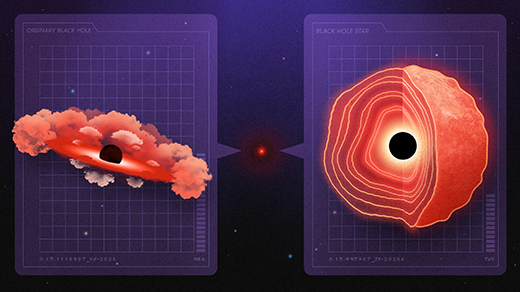
Faced with this observational paradox, the research teams proposed a radical synthesis: they were observing a "black hole star." In this theoretical architecture, the object appears from the outside as a bloated, unstable envelope of hydrogen gas comparable in scale to systems stretching far beyond the orbit of Pluto. Deep within the core, invisible to external observers, sits an active black hole acting as an energy engine. The black hole violently consumes surrounding gas, generating outward thermal pressure that prevents the outer hydrogen envelope from collapsing. This internal mechanism generates a stable, star-like surface temperature of approximately 5,000 Kelvin, producing the observed Balmer break, while the surrounding gas cocoon effectively suppresses X-ray emissions and stabilizes the system’s luminosity.
Simultaneously, a separate group including Vadim Rusakov of the University of Manchester re-evaluated the broad spectral lines of hydrogen in other little red dots. By accounting for the optical effect of electron-induced light scattering—a process that digitally alters the apparent width of spectral lines—Rusakov’s team demonstrated that the observed broadening could originate not from high-speed rotation around an exposed black hole, but rather from light filtering through a sluggishly churning shell of hydrogen gas. The synchronized publication of these findings on March 20, 2025, marked what some astrophysicists colloquially termed "black hole star date."
Theoretical Precedents: The Return of the Quasi-Star
The black hole star hypothesis breathed new life into older theoretical frameworks, most notably the concept of the "quasi-star." Originally proposed in 2006 by Mitchell Begelman of the University of Colorado, Boulder, alongside Marta Volonteri and Martin Rees, quasi-stars were hypothesized as a mechanism to account for the existence of impossibly massive black holes in the early universe.
In 2025 and 2026, Begelman and collaborator Jason Dexter successfully applied the quasi-star model to the little red dot data, demonstrating that such entities could assemble rapidly within a few million years and maintain stable phases lasting tens of millions of years—ample time for JWST to detect them. Mauro Giavalisco of the University of Massachusetts, Amherst, working with a separate research team, further refined this model to show that quasi-star dynamics could successfully mask the violent accretion signatures of a feeding black hole behind a serene stellar exterior, fitting the JWST spectra with remarkable precision.
Proponents of the hypothesis appeal to Occam’s razor, arguing that black hole stars offer the most parsimonious explanation for the peculiar suite of characteristics exhibited by the little red dots. Furthermore, recent population censuses—such as an August 2026 analysis conducted by Dale Kocevski of Colby College and his collaborators—revealed that little red dots appear to vanish as the universe matures past two to three billion years of age. This demographic shift provides compelling preliminary evidence that these objects represent a transient, "puberty-like" developmental phase through which supermassive black holes must pass before shedding their gaseous cocoons and emerging as standard, exposed black holes.
The Counterarguments and Scientific Polarization
Despite the theoretical appeal, the astrophysical community remains deeply polarized. Many prominent researchers argue that standard supermassive black hole models remain entirely viable without invoking exotic new physics.
Roberto Maiolino of the University of Cambridge and Piero Madau of the University of California, Santa Cruz, have emerged as vocal critics of the black hole star interpretation. Maiolino argues that the observed lack of X-rays and optical flickering can be readily explained by standard mechanisms within traditional black hole geometry. Specifically, supermassive black holes in the early universe may have benefited from a steady, uninterrupted supply of gas, leading to smoother accretion rates. Furthermore, the presence of a thick, toroidal cloud of dust and gas—a standard component of active galactic nuclei—can easily obstruct X-ray emissions and obscure blue light depending on the viewing angle.
Maiolino and Madau suggest that the apparent diversity of little red dots and their occasionally observed counterparts, "little blue dots," can be accounted for entirely by orientation effects: edge-on views present the obscured red spectrum through dense dust doughnuts, while pole-on views expose the central black hole directly. Appealing to their own interpretation of Occam’s razor, these critics maintain that standard black holes represent a simpler, more conventional explanation that does not require the invocation of short-lived, structurally complex black hole stars.
Implications for Cosmic Evolution
As the debate continues to generate rigorous follow-up studies, conferences, and theoretical revisions, the stakes for modern astrophysics remain remarkably high. Whether the little red dots observed by the James Webb Space Telescope are revealed to be exotic black hole stars acting as incubators for the universe’s first massive black holes, or simply obscured traditional black holes viewed through unique geometric alignments, their study is fundamentally reshaping our understanding of cosmic chronology.
Resolving the true nature of these objects will require continued observational campaigns, refined numerical simulations of primordial gas dynamics, and larger statistical samples across varying cosmic epochs. As researchers push the boundaries of infrared astronomy, the answers hidden within these elusive pinpricks of light promise to rewrite the foundational chapters of how galaxies, stars, and black holes co-evolved in the dawn of time.