1998 Family Sedans Get Pushed To Their Limits On Track In The Latest Best Motoring Episode

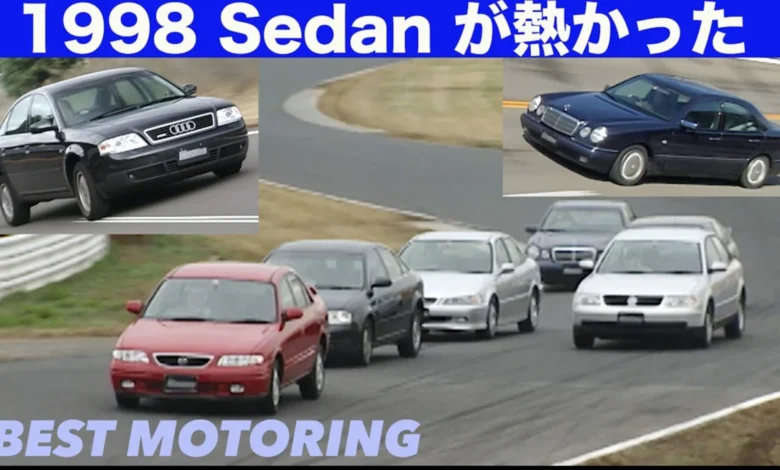
The enduring legacy of the Japanese automotive media landscape finds one of its most compelling expressions in the archival footage of Best Motoring, a seminal video series that operated between 1987 and 2011. For nearly a quarter-century, the program established a global reputation for its unorthodox approach to vehicle testing: taking consumer-grade road cars and subjecting them to high-intensity, multi-lap racing conditions at professional circuits. Recently, the official Best Motoring YouTube channel uploaded a restored feature showcasing a 1998 track battle involving six midsize family sedans. This retrospective serves as both a historical record of late-1990s automotive engineering and a case study in how manufacturers once balanced daily utility with track-day performance.
The Context of the 1998 Comparison Test
During the late 1990s, the automotive market was in a state of transition. Manufacturers were increasingly attempting to bridge the gap between reliable, comfortable family transportation and the rising demand for "sporty" driving dynamics. The selection of vehicles for this particular Best Motoring episode—the Honda Accord SiR, Nissan Primera Camino Te-V, Mazda Capella Zi-R, Volkswagen Passat 1.8T, Audi A6 2.8 Quattro, and Mercedes-Benz E320—highlights a deliberate effort to compare domestic Japanese offerings against European benchmarks.
At the time, the Japanese domestic market (JDM) was producing specialized versions of sedans that often remained exclusive to the region. Meanwhile, European manufacturers like Volkswagen, Audi, and Mercedes-Benz were cementing their reputations for build quality and performance, even in their entry-level and mid-range executive offerings. The Best Motoring team utilized these vehicles not to determine the "best" family car in a traditional sense, but to test the absolute limits of their suspension geometry, power delivery, and braking systems under sustained stress.
Chronology and Technical Specifications
The test followed the established Best Motoring format: a "battle" style race consisting of several laps, where professional drivers pushed the machinery to the point of mechanical strain. To understand the disparity in the field, one must examine the technical specifications of the participants at the time of their 1998 production.
The JDM Honda Accord SiR was powered by a 2.0-liter, four-cylinder DOHC VTEC engine producing 177 horsepower. It utilized a five-speed automatic transmission, a configuration that prioritized smooth power delivery over the raw, tactile engagement of a manual gearbox. The Nissan Primera Camino Te-V, a vehicle marketed as the Infiniti G20 in North American markets, was equipped with a 2.0-liter naturally aspirated engine generating roughly 140 horsepower. Its reliance on a Continuously Variable Transmission (CVT)—a technology that was still in its relative infancy in terms of performance applications—marked it as an experimental contender in this group.
The Mazda Capella Zi-R, known globally as the 626, featured a 168-horsepower 2.0-liter engine paired with a four-speed automatic transmission. While these vehicles were designed for the commuter market, the Best Motoring crew pushed them to their limits, highlighting how front-wheel-drive platforms managed weight transfer during cornering.
Contrasting these were the European imports. The Volkswagen Passat 1.8T offered a turbocharged alternative that provided a different torque profile compared to the naturally aspirated Japanese engines. The Audi A6 2.8 Quattro and the Mercedes-Benz E320 represented a higher tier of luxury and engineering. With their more sophisticated chassis and, in the case of the Audi, all-wheel-drive capability, they occupied a different segment of the market, effectively acting as the "gold standard" benchmarks against which the Japanese sedans were measured.
Analysis of Performance Dynamics
The core interest of this specific video lies in the data derived from the interaction between these disparate vehicle classes. When driving a sedan designed for comfort, the suspension usually favors compliance over rigidity. Under the conditions of a professional circuit, the cameras capture the noticeable body roll and understeer inherent in these designs.
The inclusion of the Mercedes-Benz E320 is particularly noteworthy. As a rear-wheel-drive executive sedan, its handling characteristics contrasted sharply with the front-wheel-drive layout of the Japanese sedans. The Best Motoring drivers focused on how these vehicles communicated feedback through the steering wheel and how the electronic driver aids—which were becoming more prevalent in 1998—intervened when the cars were pushed past their intended operational envelopes.
From a mechanical standpoint, the test demonstrates the resilience of 1990s-era drivetrains. Pushing a 1998 automatic transmission to its redline for five consecutive laps requires a level of cooling and internal component integrity that many consumers never test in their daily lives. The fact that these vehicles remained functional throughout the filming serves as a testament to the manufacturing standards of the era.
Broader Industry Impact and Historical Significance
The historical significance of Best Motoring cannot be overstated. By bringing these tests to the public, the series influenced a generation of automotive enthusiasts and potentially shifted how manufacturers approached the marketing of their sedans. In the years following this test, the "sport sedan" segment grew significantly, with many manufacturers incorporating the lessons learned regarding chassis stiffening and transmission responsiveness into their future production cycles.
Furthermore, the video archives provided by Best Motoring serve as a vital resource for automotive historians. With over 830 episodes, the channel provides a chronological look at the evolution of performance technology. While modern digital simulation and computer-aided design have made current vehicles significantly faster and more capable, these archival videos capture the "analog" era of performance, where the human element—driver skill and mechanical sympathy—played a much larger role in the outcome of a race.
Official Perspective and Legacy
While formal statements from the manufacturers regarding these specific 1998 tests are unavailable, the industry-wide reaction to such programs in the late 90s was generally one of guarded appreciation. Manufacturers recognized that while their family sedans were not intended for track use, a strong showing in a Best Motoring battle provided significant prestige. It served as a proof-of-concept for the reliability and handling capabilities of their engineering teams.
Today, the digital preservation of this content allows for a reassessment of these vehicles. Many of the cars featured in this test, such as the Nissan Primera and the Honda Accord SiR, have transitioned from common commuters to modern classics. The Best Motoring footage provides a unique opportunity to see these vehicles in their prime, operating in a way that most owners never experienced.
Conclusion
The latest release from the Best Motoring archives is more than just a nostalgic look at 1998 family transportation. It is a detailed documentation of an era where manufacturers experimented with performance in everyday vehicles. Through the lens of the professional test driver, the viewers gain insight into the nuanced differences between Japanese domestic engineering and European luxury standards.
As the automotive industry shifts toward electrification and autonomous driving, the visceral, high-stakes nature of these "track battles" becomes increasingly rare. The Best Motoring series remains a benchmark for automotive media, proving that even the most mundane machinery, when subjected to the rigors of a race circuit, can provide a fascinating narrative of performance, engineering, and historical evolution. For enthusiasts and researchers alike, these videos continue to offer a wealth of data regarding the capabilities and limitations of the vehicles that defined the late 20th century.