Hera spacecraft arrives to inspect the aftermath of NASA’s historic asteroid deflection mission

Four years after NASA executed a high-stakes kinetic impact experiment to test the limits of planetary defense, the European Space Agency’s (ESA) Hera spacecraft has reached the Didymos-Dimorphos binary system. The mission marks a pivotal second phase in humanity’s quest to understand how to deflect potentially hazardous near-Earth objects. While the initial 2022 Double Asteroid Redirection Test (DART) provided a proof-of-concept, Hera serves as the investigative follow-up, designed to scrutinize the physical damage and orbital changes that forever altered the 500-foot-wide moonlet, Dimorphos.
A Chronology of the Kinetic Impact Experiment
The story began in November 2021, when NASA launched the DART mission from Vandenberg Space Force Base in California. The objective was singular: to prove that a spacecraft could navigate to a specific asteroid and strike it with enough force to alter its trajectory. The target, Dimorphos, orbits a larger primary asteroid, Didymos. While neither body posed a threat to Earth, they provided an ideal laboratory for a controlled collision.
On September 26, 2022, the DART spacecraft, traveling at approximately 13,700 mph, impacted the surface of Dimorphos. The resulting kinetic energy—estimated at 10 billion joules—was designed to shift the asteroid’s orbit around Didymos. Astronomers observing from Earth confirmed the success of the mission within days: the orbital period of Dimorphos was shortened by 33 minutes, a result that significantly exceeded the most conservative estimates provided by mission planners.
However, the destructive nature of the impact meant that the DART spacecraft was vaporized upon contact. Beyond the final images transmitted by the probe and a brief observation from the LICIACube satellite that deployed shortly before impact, the immediate physical consequences of the collision—the cratering, the structural deformation, and the ejected debris—remained a mystery. The arrival of the ESA’s Hera probe at the system this month provides the first high-resolution diagnostic of that historic event.
Unveiling the Aftermath: A Landscape Transformed
As Hera approached the binary system, located approximately 120 million miles from Earth, it began transmitting data that challenged initial scientific assumptions. The spacecraft’s instruments revealed that the impact did not merely leave a dent; it radically reshaped the asteroid.
Principal Investigator Patrick Michel of the Côte d’Azur Observatory noted that the team had originally modeled two distinct possibilities: either the creation of a localized crater or a global reshaping of the moonlet. "In fact, we did both because the crater is so large that the shape has changed," Michel stated. The imagery suggests the impact carved out a crater of stadium-like proportions relative to the size of the 151-meter asteroid.
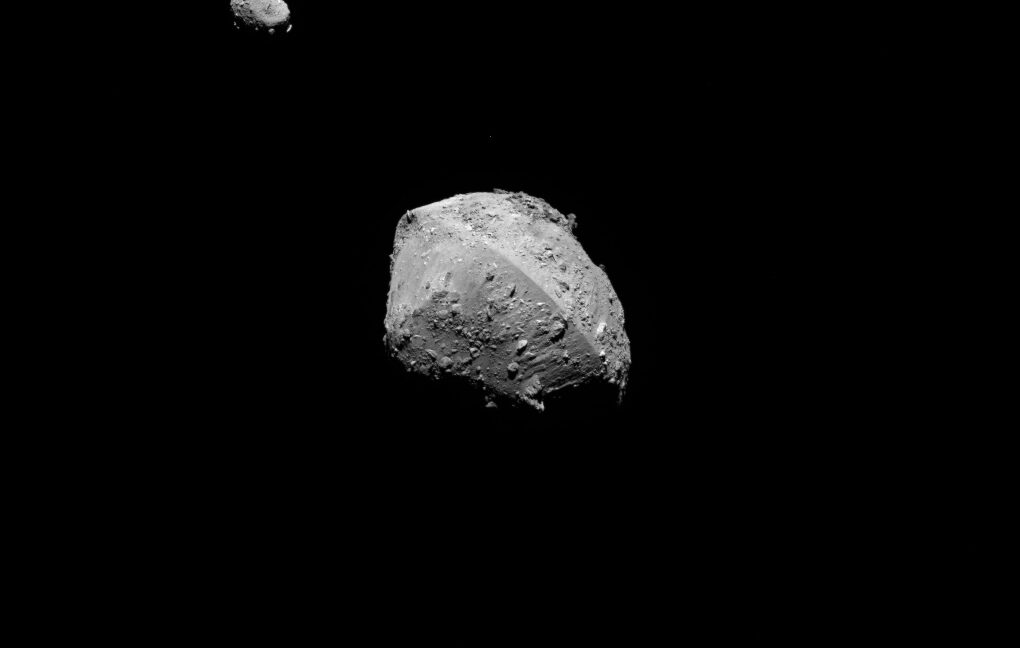
Perhaps more startling is the state of Dimorphos itself. DART observed the asteroid in a relatively stable orbit in 2022, but Hera’s recent reconnaissance indicates that the impact has left the body tumbling erratically. This chaotic rotation is a key variable that scientists must now quantify to understand the long-term structural integrity of the asteroid.
The Debris Field and the Mystery of the Companions
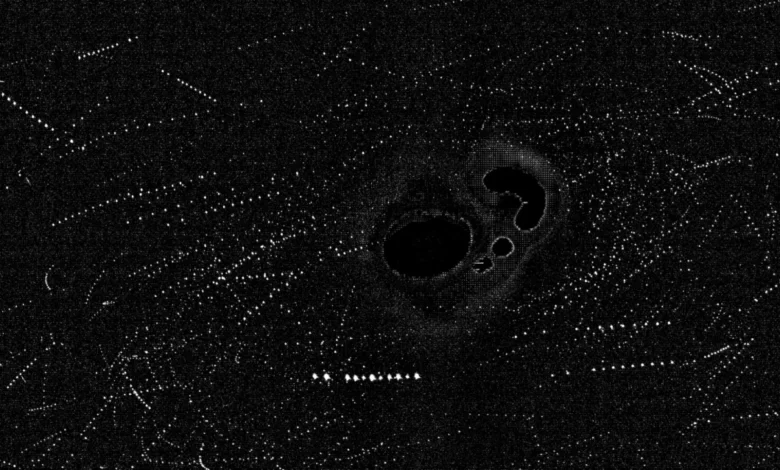
One of the most significant findings from Hera’s arrival is the discovery of a vast field of debris surrounding the Didymos-Dimorphos system. While the Hubble Space Telescope had previously detected a cloud of dust and rubble trailing the asteroids shortly after the DART impact, the density of the debris discovered by Hera is far greater than anticipated.
Using the Hyperscout-H instrument, ESA scientists captured long-exposure images that revealed hundreds of boulders—ranging from the size of a football to the size of a household appliance—orbiting the system. "Hera came to visit two asteroids, and we found hundreds of companions," noted planetary scientist Naomi Murdoch.
These findings introduce a new layer of complexity to planetary defense models. Scientists must now determine whether these boulders are entirely the result of the DART impact, essentially "shrapnel" blasted from the surface of Dimorphos, or if some of these fragments are primordial relics from the formation of the binary system. Disentangling the debris of the 2022 impact from the natural state of the asteroids is essential for calibrating future models.
Scientific Objectives and the Future of Planetary Defense
The primary goal of the Hera mission over the next six months is to move beyond speculation and into precise empirical measurement. The spacecraft will conduct a series of close-range flybys, gathering data on the mass, internal structure, and mineralogical composition of both Didymos and Dimorphos.
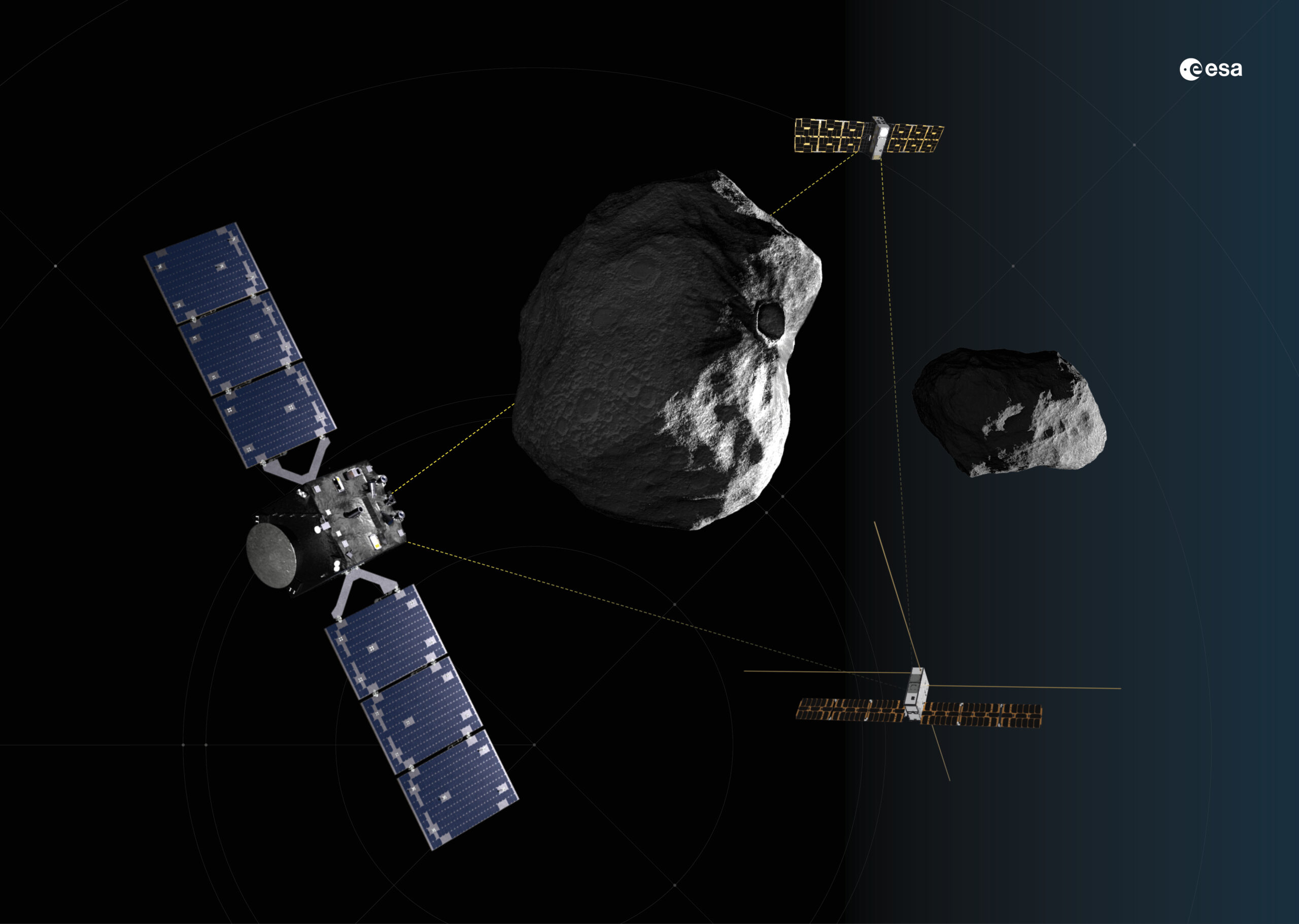
To facilitate this, Hera will release two sub-satellites, Juventas and Milani. These CubeSats are designed to perform even more daring maneuvers, including potential surface-proximity operations to map the asteroid’s internal gravity field and subsurface composition. By understanding the porosity and "rubble pile" nature of Dimorphos, mission planners hope to create a universal template for asteroid deflection.
"Once we understand, we have a breakthrough, which really solves planetary defense," Patrick Michel emphasized. The logic is straightforward: every asteroid is unique, varying in density, composition, and structural cohesion. A deflection strategy that works on a solid metallic asteroid might fail on a porous "rubble pile." By using Dimorphos as a benchmark, scientists are building a predictive library that will allow Earth to respond to a genuine threat with the appropriate level of force.
Broader Implications for Global Security
The DART-Hera sequence of missions represents the first time humanity has transitioned from monitoring space threats to actively engineering their outcomes. The implications for planetary defense are profound.
Historically, the threat of an asteroid impact was viewed as a matter of fate, with mitigation strategies limited to "last resort" scenarios. The successful deflection of Dimorphos, followed by the rigorous analysis provided by Hera, shifts the paradigm toward proactive management. This mission has demonstrated that with sufficient warning time—ideally years or decades—the kinetic impact method is a viable tool for redirecting a threat away from a collision trajectory with Earth.
Moreover, the international collaboration between NASA and the ESA underscores the global nature of this challenge. The data collected by Hera will be shared with the global astronomical community, ensuring that the lessons learned from the "mess" created by DART are integrated into the planetary defense plans of nations worldwide.
Assessing the Data: A Technical Perspective
As Hera continues its mission, the focus will shift to reconciling the observed physical changes with the computer models used to predict the DART impact. Discrepancies between the predicted crater size and the observed deformation suggest that our understanding of asteroid "regolith"—the layer of loose, heterogeneous superficial deposits covering solid rock—is incomplete.
The presence of the boulder swarm, in particular, suggests that the asteroid’s surface was more fragile than anticipated. If the surface is composed of loosely bound material, it acts as a shock absorber, potentially reducing the efficiency of a kinetic impactor. Conversely, if the asteroid is a solid monolithic rock, the impact mechanics are entirely different. Hera’s mission is the key to closing this gap in our physical knowledge.
Conclusion
The arrival of the Hera spacecraft at the Didymos-Dimorphos system is not merely the end of a mission, but the beginning of a new era in space exploration. By returning to the site of the first successful human-led alteration of a celestial body, we are validating our capacity to protect the planet from the catastrophic risks posed by near-Earth objects.
As the mission progresses, the data relayed back to Earth will serve as the foundation for the next century of planetary defense strategies. While the "mess" left behind by DART may be chaotic, it is a productive chaos—a wealth of information that, when fully understood, will ensure that the next time a threat appears on our radar, we will have the knowledge to move it out of harm’s way. The legacy of the DART-Hera partnership is one of scientific rigor, international cooperation, and, ultimately, a safer future for all of humanity.
Related posts: