China’s First AI-Generated Feature Film Flops at the Box Office Signaling a Chasm Between Short-Form Trends and Cinematic Expectations

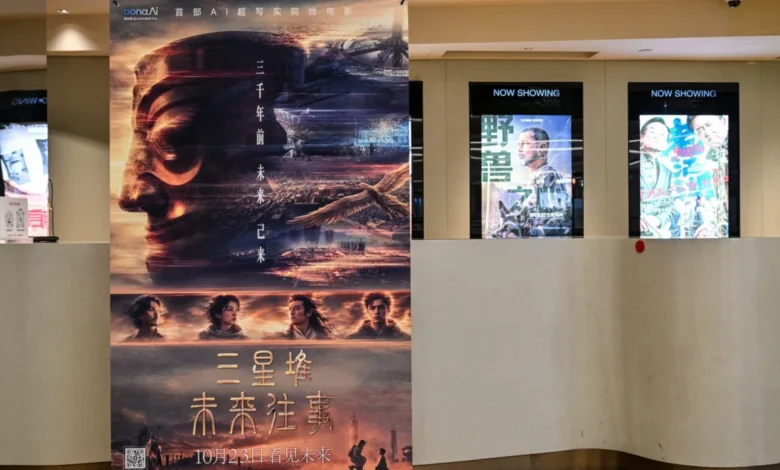
The release of the science fiction thriller Sanxingdui: Future Past has served as a sobering milestone for the global film industry, marking the first time a fully AI-generated feature film has reached Chinese cinema screens. Produced by the Bona Film Group, the project was positioned as a pioneering technological experiment. However, the film’s lackluster performance at the box office suggests that while artificial intelligence has successfully disrupted the production of short-form digital content, it has yet to prove itself a viable replacement for the traditional feature-length cinematic experience.
According to data from the ticketing platform Maoyan, the film generated an estimated $180,000 in revenue by Monday, a figure that pales in comparison to its $1.5 million production budget. This financial shortfall highlights a growing tension in the entertainment sector: the rapid, cost-effective automation of media creation is meeting significant resistance when applied to the narratives and emotional depth required for long-form storytelling.
A Chronology of the AI Film Experiment
The emergence of Sanxingdui: Future Past is the culmination of a broader trend toward AI-integrated media that has gained momentum in China over the last two years. The trajectory of this development can be traced through several key phases:
Early 2024 marked the beginning of the "microdrama" explosion. Platforms like TikTok, Douyin, and Kuaishou began seeing an influx of AI-generated short-form narratives, which offered low barriers to entry for independent creators. By the first quarter of 2026, the shift was total; statistics from Caixin reveal that over 95% of the 120,000 microdramas released during that period were AI-generated. This represents a staggering shift from near-zero adoption just twelve months prior.
As the production costs for these short-form projects plummeted—sometimes to as little as $3,000—producers began eyeing the lucrative theatrical market. In late 2026, Bona Film Group greenlit Sanxingdui: Future Past, a project designed to test the limits of generative AI in a narrative format. The film, which depicts an archaeologist battling a future world enslaved by artificial intelligence, was framed by state media as a landmark effort. Following its theatrical release permit, the film served as the first true "stress test" for AI in a professional, high-stakes cinematic environment.
Dissecting the Financial and Critical Failure
The financial failure of Sanxingdui: Future Past is not merely a matter of poor ticket sales; it is a signal of shifting audience expectations. While audiences have embraced the rapid, iterative nature of AI-generated micro-content, they have demonstrated a high bar for theatrical offerings.
Jiang Defu, the Chief Operating Officer of Bona Film Group, acknowledged the lukewarm reception in an interview with the Chinese film outlet Yuli. Defu defended the project by framing it as a necessary technological R&D investment rather than a standard commercial product. "We are the first to try it, the first to get a theatrical release permit, and the first to be tested by the audience," Defu noted, emphasizing that the logistical and regulatory hurdles of being a first-mover in this space were substantial.
Social media sentiment, however, remains fractured. On Xiaohongshu, users expressed a range of reactions, from genuine discomfort to technical appreciation. One user famously remarked that the experience was "totally traumatizing," suggesting that the uncanny valley—a phenomenon where AI-generated human representations feel unsettlingly close to, but not quite, human—remains a significant hurdle for feature-length narrative immersion. Conversely, other viewers highlighted the creative potential of the technology, noting that AI allows for unprecedented freedom in storytelling without the traditional overhead costs of location scouting or physical set construction.
The Global Context of AI in Filmmaking
The debate over the use of artificial intelligence in cinema is not confined to China. In the United States, the industry has been embroiled in a contentious dialogue regarding the integration of machine learning tools. The 2023 labor strikes involving the Writers Guild of America (WGA) and SAG-AFTRA were fueled in large part by fears of AI-driven displacement and the erosion of intellectual property rights.
Hollywood is already integrating AI, though the strategy often differs from the "fully generated" approach seen in the Chinese experiment. Major studios are leveraging AI for post-production, visual effects, and sound engineering. Ben Affleck, in his recent role as director for the Netflix crime thriller Animals, openly discussed his use of AI to enhance the film. During a Bloomberg-hosted event in October 2026, Affleck stated, "I used AI for lots of things in that movie," while simultaneously expressing hesitation about disclosing specifics. His reasoning—that films must "foster the illusion of reality"—underscores the industry’s desire to maintain the sanctity of the human-centered narrative even as it utilizes algorithmic tools.
This approach contrasts sharply with the "AI-first" model attempted by Bona Film Group, which sought to lean into the technology as the primary engine of the film’s creation rather than a supplementary tool.
Implications for the Future of Cinema
The failure of Sanxingdui: Future Past will likely serve as a cautionary tale for film studios globally. Stanley Rosen, a professor at the University of Southern California and an expert in Chinese film and society, suggests that the market for AI films is currently binary.
"The public is highly skeptical about AI use in major feature films, despite their general acceptance of short-form films," Rosen explains. He notes that for an AI-generated film to succeed in a theater, it would need to achieve a standard of visual and emotional quality comparable to major blockbusters like Avatar or the popular Chinese animated hit Nezha 2. Until generative AI can bridge the gap between "technically impressive" and "emotionally resonant," audiences are likely to remain wary.
The implications for the industry are three-fold:
- Strategic Shift toward Streaming: Studios may pivot away from theatrical releases for AI-heavy content. As Rosen suggests, streaming platforms like Netflix and Amazon Prime Video offer a more forgiving environment for experimental, lower-budget AI projects where the financial risk is mitigated by a subscription-based revenue model.
- The "Human-First" Premium: There is an emerging potential for a "human-made" marketing label. Just as "organic" or "hand-crafted" labels have disrupted the food and artisanal markets, the film industry may see a surge in advertising that explicitly highlights the human labor involved in a production as a premium feature.
- Regulatory and Ethical Slowdown: The lackluster box office returns may grant traditional studios more time to negotiate with unions and creators regarding the ethical use of AI. If the "AI-only" model is not yet a commercial juggernaut, there is less immediate pressure for studios to rush into fully automated production schedules.
Conclusion
The experiment of Sanxingdui: Future Past has confirmed that while AI is an incredibly powerful tool for the democratization of content creation in the social media era, it has not yet mastered the art of the long-form cinematic narrative. For now, the "future of the past" remains firmly in human hands.
The financial loss incurred by Bona Film Group acts as a regulatory checkpoint, forcing the industry to reconsider the pace at which it replaces traditional filmmaking methods. As the technology continues to evolve, the distinction between a "tool" and a "creator" will remain the central focus of the debate. Until AI can replicate the nuance, intent, and emotional intelligence of a human director and cast, theatrical audiences will likely continue to vote with their wallets in favor of stories that, at their core, reflect the human condition.
Related posts: