When Britpop Staged Its Ultimate Showdown: The Day Damon Albarn and Liam Gallagher Took the Chart War to the Football Pitch

The cultural landscape of mid-1990s Great Britain was defined by a singular, all-encompassing musical phenomenon: Britpop. At its apex, the movement was not merely a genre of music, but a comprehensive cultural renaissance that dominated tabloids, fashion, and political discourse. Within this ecosystem, two bands emerged as undisputed royalty, capturing the national consciousness and polarizing the public in a rivalry for the ages. While the hostilities between Blur and Oasis played out primarily across record store counters and music magazine covers, the simmering tension reached its physical zenith on May 12, 1996, during a charity football match that brought the bitter class and musical war out of the recording studio and onto the grass.
The Rise of Britpop and the Anatomy of a Rivalry
Britpop crystallized in the early 1990s as a triumphant counter-narrative to the moody, American-imported grunge movement spearheaded by Nirvana. It was inherently patriotic, heavily influenced by 1960s British guitar pop, and deeply tied to national identity. Blur, formed in London in 1988, established an early foothold in the movement. Led by charismatic frontman Damon Albarn and bassist Alex James, the band released its debut album, Leisure, on August 26, 1991, laying the groundwork for what would become a stylistic pivot toward quintessentially English storytelling.
Three years later, Manchester’s Oasis crashed onto the scene with the release of Definitely Maybe on August 29, 1994. Helmed by primary songwriter Noel Gallagher and fronted by his volatile younger brother, Liam Gallagher, Oasis presented a swaggering, unapologetic iteration of working-class rock and roll. The commercial viability of both groups was immense; Noel Gallagher had famously stockpiled a vast catalog of material prior to the debut album, allowing the band to maintain a relentless release schedule and an extraordinary level of quality control across their formative years.
Initially, relations between the two camps were relatively cordial. Members of both bands occasionally crossed paths at industry events and awards ceremonies, sharing a mutual understanding of the whirlwind success they were experiencing. However, the music press, sensing an opportunity to manufacture a compelling narrative, began pitting the London art-school sensibilities of Blur against the northern, blue-collar bravado of Oasis. Rather than defusing the tension, both bands and their respective management teams actively leaned into the antagonism, recognizing the immense promotional value of a high-stakes culture war.
The Battle of the Charts: August 1995
The rivalry escalated from friendly competition to outright hostility in August 1995, a watershed moment in Britpop history. In a calculated commercial maneuver, Blur shifted the release date of their single “Country House” to coincide directly with the release of Oasis’s single “Roll With It.” The resulting media storm was dubbed the "Battle of Britpop," turning a standard chart race into a national referendum on class, style, and musical superiority.
The mainstream media and the British tabloids covered the chart battle with the fervor typically reserved for general elections or international football tournaments. When the official chart figures were tallied, Blur emerged victorious on units sold, moving 274,000 copies of “Country House” compared to Oasis’s 216,000 copies of “Roll With It.”
The defeat deeply stung the Gallagher brothers, who viewed the loss as an affront to their cultural dominance. The animosity spilled over into the public sphere when Noel Gallagher gave an infamous interview to The Observer, stating that he hoped Damon Albarn and Blur guitarist Graham Coxon would “catch AIDS and die.” Though Gallagher subsequently issued a public apology for the vicious remark, the line had been irrevocably crossed. The rivalry was no longer a playful marketing ploy; it was a genuine personal feud.
Despite losing the initial single sales battle, Oasis ultimately won the broader commercial war of that autumn. Their sophomore studio album, (What’s The Story) Morning Glory?, released in October 1995, became a global juggernaut, eventually selling over 22 million copies worldwide and cementing the band as international superstars. Meanwhile, Blur’s The Great Escape, released in September 1995, achieved critical acclaim and debuted at No. 1 on the UK charts, but failed to achieve the same enduring global resonance as their rivals’ masterwork.
The 1996 Soccer Six Tournament: Tensions on the Turf
By the spring of 1996, the Britpop phenomenon had reached a fever pitch. With both bands dominating the cultural landscape, the public appetite for any interaction between them was insatiable. There existed, in the minds of many fans and commentators, only one culturally authentic British method to settle a dispute of this magnitude: a football match.
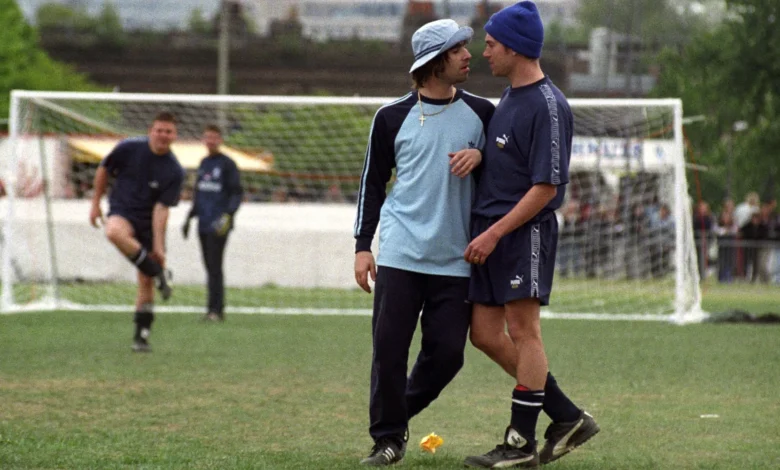
On May 12, 1996, the opportunity arose at the annual "Soccer Six" charity tournament, hosted to benefit music therapy initiatives. While the event featured a diverse lineup of high-profile musicians, actors, and public figures, all eyes were fixed on the fixture pitting Blur against Oasis.
The match provided a fascinating physical manifestation of the bands’ contrasting personas. Liam Gallagher, playing with characteristic intensity and aggression, targeted Blur frontman Damon Albarn from the opening whistle. Throughout the game, Gallagher actively bumped, pushed, and provoked Albarn, treating the charity match with the grim determination of a World Cup final.
The boiling point arrived when Gallagher and Albarn confronted one another face-to-face on the pitch, exchanging words as the crowd and press photographers went wild. The standoff encapsulated the deep-seated friction of the era. The confrontation only dissolved when a visibly exhausted Gallagher, having expended his reserves of energy, abruptly decided to lie down on the turf mid-match to catch his breath.
Aftermath and Antics
When the final whistle blew, it was Blur who walked away with sporting vindication, defeating Oasis 2-0 and finishing the tournament with a 2-1 record. True to form, the conclusion of the match was marked by trademark Gallagher theatrics. Liam Gallagher, undeterred by the defeat, calmly smoked a cigarette during the halftime interval. Following the match’s conclusion, his combative behavior continued off the pitch when he threw a can of beer at a reporter, snatched the foam windscreen off a journalist’s microphone, and stormed away from the venue.
Despite the chaotic scenes, the tournament proved to be a rare moment where the two rival factions shared physical space in an unfiltered environment, offering a glimpse into the human dynamics underpinning the multi-million-pound music industry rivalry.
Reconciliation and Legacy
As the 1990s drew to a close, the cultural momentum of Britpop began to wane, supplanted by the rise of post-rock, electronica, and the burgeoning American pop-punk wave. The intense pressure that had fueled the Blur and Oasis rivalry gradually dissipated as both bands evolved musically and faced internal turbulence, culminating in Oasis’s eventual acrimonious split in 2009 and Blur’s transition into a more experimental, mature collective.
The definitive burial of the hatchet arrived nearly two decades after the height of their hostilities. In March 2013, Damon Albarn and Noel Gallagher appeared together on stage during a charity concert for Teenage Cancer Trust at London’s historic Royal Albert Hall. Joined by Paul Weller and members of the Jam and Blur, the former arch-nemesis embraced, symbolizing the closing of a defining chapter in British music history.
Reflecting on the complex trajectory of the rivalry, Blur bassist Alex James offered a succinct retrospective: “Blur won the battle, Oasis won the war, then Blur went on to win the whole campaign.”
Today, the legacy of the Blur-Oasis rivalry is viewed not with bitterness, but as a golden era of British pop culture—a time when guitar bands mattered intensely, charts were fiercely contested, and a simple charity football match could temporarily stop a nation to watch two musical titans clash on the turf.