President Trump Unveils GENEROUS Model to Address Escalating Medicaid Pharmaceutical Costs Amid Scrutiny of Implementation Challenges

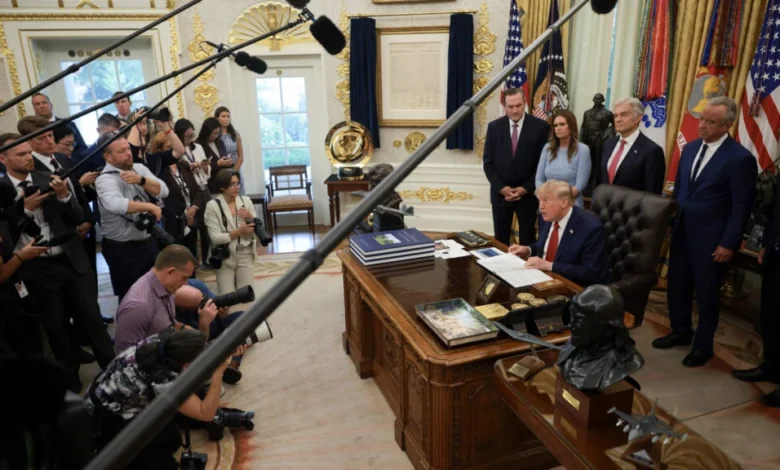
WASHINGTON — President Trump announced on Friday the formal launch of the GENEROUS model, a sweeping federal initiative designed to curtail the rising costs of prescription drugs within state Medicaid programs. The announcement, delivered from the White House, framed the program as a centerpiece of the administration’s broader strategy to align domestic drug pricing with international benchmarks. Under the new model, all 50 states, the District of Columbia, and Puerto Rico are slated to participate, marking a significant shift in how Medicaid—the primary health safety net for low-income Americans—negotiates pharmaceutical expenditures.
The core mechanism of the GENEROUS model involves voluntary agreements between the federal government and more than two dozen pharmaceutical manufacturers. These companies have committed to providing state Medicaid programs with pricing tiers that mirror those found in comparable peer nations. While the administration positioned the move as a landmark victory for taxpayer-funded healthcare, the announcement has prompted immediate questions from policy analysts, state administrators, and healthcare advocates regarding the practical logistics, legal feasibility, and long-term efficacy of the model.
The Chronology of the Administration’s Drug Pricing Agenda
The rollout of GENEROUS follows a multi-year effort by the Trump administration to address the "international pricing disparity" that has long been a flashpoint in U.S. health policy. Since taking office, the administration has consistently argued that American consumers and government programs subsidize drug development for the rest of the world by paying significantly higher prices for the same medications.
In early 2018, the administration released its "American Patients First" blueprint, which laid the groundwork for future regulatory and legislative attempts to lower costs. Throughout 2019 and 2020, the White House shifted its focus toward executive action, culminating in several high-profile initiatives aimed at Medicare Part B and Part D. The GENEROUS model represents the latest iteration of this approach, specifically targeting the Medicaid program, which accounts for a substantial portion of state budgets and is often constrained by federal and state spending caps.
The negotiation phase for the GENEROUS model began in late 2023, involving quiet discussions between the Department of Health and Human Services (HHS) and key pharmaceutical stakeholders. By securing commitments from over two dozen companies, the administration sought to demonstrate that private-sector participation could be achieved without the need for controversial government-mandated price controls, which have historically faced stiff resistance from the pharmaceutical lobby.
Supporting Data and Market Dynamics
To understand the scope of the GENEROUS model, one must look at the financial strain Medicaid currently faces. According to data from the Centers for Medicare & Medicaid Services (CMS), federal and state spending on Medicaid prescription drugs has risen consistently over the past decade. In 2022 alone, net spending on Medicaid pharmaceuticals reached an estimated $40 billion, a figure that does not include the significant rebate structures already in place.
The price disparity that GENEROUS intends to close is well-documented by the Kaiser Family Foundation and other non-partisan research bodies. In many instances, the same specialty drug—used to treat chronic conditions such as hepatitis C, oncology patients, or rare diseases—can cost two to three times more in the United States than in Canada, the United Kingdom, or Germany. By forcing a convergence toward international reference pricing, the administration hopes to recapture billions in potential savings for state treasuries.
However, the efficacy of this model depends heavily on the definition of "peer countries" and the transparency of the pricing data. Critics point out that pharmaceutical companies often employ complex rebate structures that vary by country, making a direct, "apples-to-apples" price comparison difficult to enforce. Without a robust oversight mechanism, there is concern that manufacturers might simply raise prices in peer countries to maintain higher global profit margins, thereby rendering the GENEROUS model less effective over time.
Official Responses and Industry Skepticism
The announcement received a mixed reception from industry groups and policy stakeholders. Pharmaceutical Research and Manufacturers of America (PhRMA) issued a measured statement following the press conference, emphasizing the importance of "innovation and access" while noting that the companies participating in GENEROUS did so under the understanding that the model would remain voluntary.

"The pharmaceutical industry remains committed to ensuring that patients have access to the medications they need," the PhRMA statement read. "We have engaged with the administration to explore market-based solutions that reflect the unique value of our products. However, we remain concerned about any policy that could inadvertently stifle the research and development pipeline that produces life-saving cures."
Conversely, state Medicaid directors have expressed cautious optimism. For many states, the fiscal burden of providing high-cost specialty drugs has been a primary driver of budget shortfalls. "Any mechanism that provides relief to our Medicaid pharmacy budget is a step in the right direction," said a spokesperson for a coalition of state health officials. "The challenge, as always, will be in the implementation—ensuring that these agreements actually materialize into tangible savings for the taxpayer without disrupting the existing supply chain for our beneficiaries."
Implications for the Healthcare Landscape
The implications of the GENEROUS model extend beyond immediate cost savings. If successful, the model could shift the balance of power in pharmaceutical negotiations, moving the U.S. toward a more centralized, government-influenced pricing environment. This marks a departure from the historical reliance on private market negotiations, which have traditionally been the hallmark of American healthcare procurement.
A primary area of concern for health economists is the "spillover effect." If manufacturers lower prices for Medicaid, will they simultaneously raise prices for private insurers to offset the loss in revenue? This phenomenon, known as cost-shifting, has been a significant hurdle for previous drug pricing interventions. If the administration cannot effectively insulate the private market from these adjustments, the GENEROUS model might only succeed in reallocating costs rather than reducing them at the systemic level.
Furthermore, the legal landscape surrounding GENEROUS remains murky. Previous attempts by the executive branch to alter drug pricing through administrative rule-making have faced immediate legal challenges in federal court. Industry groups have often argued that the executive branch lacks the statutory authority to impose such pricing models without congressional approval. Whether GENEROUS survives the inevitable wave of litigation will likely depend on how the administration has structured the agreements—specifically whether they are framed as purely voluntary contracts or as regulatory mandates disguised as agreements.
Long-term Outlook and Unanswered Questions
As the administration moves toward full implementation, several critical questions remain unaddressed. First, the administration has yet to release the specific list of drugs covered under the GENEROUS model. It is unclear whether the model will apply to high-volume generic drugs, which are already subject to intense price competition, or if it will focus primarily on high-cost brand-name biologics.
Second, the mechanism for monitoring compliance is largely undefined. If a pharmaceutical company fails to meet its pricing commitments, what are the federal government’s enforcement options? Without clear penalties—such as the loss of eligibility for other government contracts—the model may rely too heavily on the goodwill of the manufacturers.
Finally, the timeline for when states will see actual savings is still speculative. Federal administrative processes, including the integration of new pricing data into existing Medicaid Management Information Systems (MMIS), are notoriously slow. It is highly probable that any financial impact will not be felt until the next budget cycle, at the earliest.
In conclusion, the GENEROUS model represents a bold attempt by the Trump administration to tackle a persistent issue in American healthcare. By leveraging the combined purchasing power of all 50 states, the White House is attempting to force a change in the pharmaceutical industry’s pricing behavior. However, the path to implementation is fraught with technical, legal, and economic hurdles. Whether this initiative succeeds in creating a sustainable, long-term solution for drug affordability or proves to be a symbolic measure with limited practical reach remains a central question that will define the healthcare legacy of the current administration. As the rollout proceeds, the healthcare industry, state legislators, and patients alike will be watching closely to see if the promise of lower prices translates into reality.
Related posts: