Life, Larry and the Pursuit of Unhappiness: Larry David’s Ambitious Historical Sketch Comedy Series Lands on HBO Max

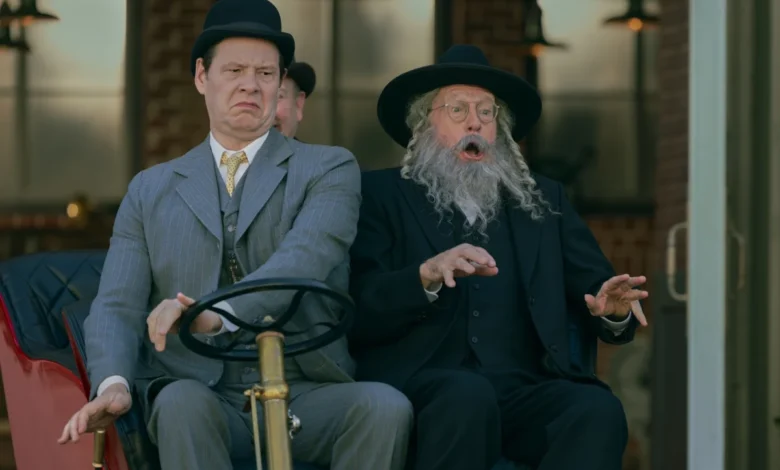
Larry David, the acclaimed creator and star behind the long-running improvisational comedy Curb Your Enthusiasm, has embarked on a new comedic venture, Life, Larry and the Pursuit of Unhappiness, now available on HBO Max. This ambitious sketch comedy series delves into American history, reimagining pivotal moments and figures through David’s signature observational humor. The show, executive produced by former President Barack Obama and Michelle Obama’s Higher Ground Productions, features an extensive ensemble of celebrity guests portraying a diverse array of historical characters, marking a significant departure from David’s previous work and offering a unique lens on the nation’s past. The series premiered following the conclusion of Curb Your Enthusiasm, a show that itself redefined observational comedy over its twelve seasons.
A Star-Studded Journey Through American History
Life, Larry and the Pursuit of Unhappiness distinguishes itself not only through its thematic focus on American history but also through its remarkably star-studded cast. Each episode boasts over a dozen celebrity guests, transforming them into figures from various eras. The roster includes familiar faces from David’s Curb Your Enthusiasm ensemble, alongside acclaimed actors, musicians, and comedians. Notably, the series marks the final screen performance of the late Rob Reiner, a beloved director and actor who also had a recurring role in Curb Your Enthusiasm.
Major Hollywood figures such as Samuel L. Jackson, who also serves as the series’ narrator, and Lin-Manuel Miranda, known for his groundbreaking work on the musical Hamilton, don elaborate costumes and wigs to inhabit historical personas. They are joined by television stalwarts like Jerry Seinfeld, David’s co-creator on the iconic sitcom Seinfeld, and Jon Hamm, further underscoring the show’s broad appeal and the caliber of talent it attracts. The Hollywood Reporter is closely tracking the series to ensure all participating stars receive appropriate recognition for their contributions to this unique project.
Premiere Episode: "Livingston" – Setting the Stage
The inaugural episode, titled "Livingston," immediately establishes the series’ tone and scope. It kicks off with a surprising appearance by executive producer Barack Obama, who offers a warm, yet characteristically witty, introduction to the nation as it approaches its semiquincentennial. Obama’s presence as himself, the former leader of the nation being celebrated, provides a meta-commentary on the series’ premise and David’s often curmudgeonly persona. His brief remarks serve as a bridge to the narrative voice of Samuel L. Jackson, whose authoritative and familiar narration has become a staple in contemporary filmmaking and television.
The first sketch transports viewers to the formative years of the United States, with Henry Winkler as John Hancock, Chris Parnell as Benjamin Franklin, and Alan Tudyk as Thomas Jefferson. These esteemed figures are depicted debating additions to the Declaration of Independence, with Larry David portraying Robert Livingston, a delegate to the Continental Congress. The humor arises from the clash between historical gravitas and David’s character’s likely anachronistic or overly specific concerns.
Following this foundational moment, David takes on the role of Alexander Graham Bell, showcasing the debut of the telephone. His scene partner is Richard Kind, reprising a role akin to his Curb Your Enthusiasm character, Thomas Watson. The sketch humorously highlights the public’s immediate desire for advanced features like texting and color options, even at the invention’s inception, with the crowd of early adopters portrayed by sitcom veterans Alison Becker, Mary Sohn, and Rodney J. Hobbs.
The episode then shifts to the grim realities of World War I trench warfare. David embodies a cowardly soldier under the command of a stern sergeant, played by Michael Chiklis. His fellow soldiers are depicted by Mike Castle and Jake Reiner, son of the late Rob Reiner, further weaving together the show’s cast and personal connections. The premiere concludes with a poignant, yet characteristically awkward, sketch featuring David as an irritating bus passenger seated next to Jurnee Smollett’s portrayal of civil rights icon Rosa Parks, offering a stark contrast in character and a glimpse into the series’ willingness to tackle more sensitive historical moments with its unique comedic touch.
Episode Two: "Farewell" – Unlikely Explorers and Political Fumbles
"Farewell" opens with a highly anticipated reunion, bringing together Larry David and Jerry Seinfeld, the creative forces behind the legendary sitcom Seinfeld. In this sketch, they portray explorers Lewis and Clark, embarking on their ambitious mission to map the Louisiana Territory. The comedy stems from the notion that these two iconic figures, known for their observational humor and often mundane concerns, are the chosen leaders of such a monumental expedition. Rita Wilson appears as Mavis Lewis, Meriwether Lewis’s long-suffering wife, offering a grounded perspective on her husband’s prolonged absence.
David then turns his attention to the contentious 1876 presidential election, portraying Samuel Tilden, who won the popular vote but narrowly lost the Electoral College. The sketch satirizes the political machinations of the era, with Matthew Jones and Rich Fulcher appearing as Tilden’s exasperated aides.
The Great Depression provides the backdrop for another segment, where David is joined by comedian Larry Wilmore and Colton Dunn. The highlight of this sketch is Kaley Cuoco’s performance as a grieving widow, whom David’s character attempts to cut in line for bread. This scenario, ripe for David’s brand of social awkwardness and petty grievances, likely provides ample comedic fodder.
The episode culminates with the much-discussed final screen appearance of Rob Reiner. He portrays George Washington, discussing presidential term limits. This scene serves as a setup for David’s character to deliver veiled critiques of political figures, implicitly referencing contemporary political discourse, specifically without naming Donald Trump. Jimmy Kimmel also makes a cameo, adding a layer of meta-commentary on his own public feuds, further blurring the lines between historical satire and modern cultural commentary.
Episode Three: "McCarthy" – Revolutionary Zeal and the Red Scare
The third episode, "McCarthy," delves into different facets of American history, beginning with David’s character "crashing" the Boston Tea Party. Lin-Manuel Miranda makes a fitting appearance as one of the key organizers of this revolutionary act, a nod to his Hamilton origins. Comedian Lou DiMaggio also features, highlighting David’s character’s exclusion from the rebellion.
The narrative then shifts to the Underground Railroad, where J.B. Smoove’s character, Jonesey, interacts with David’s host, introducing a dynamic of cultural clash and unexpected demands. The episode then pivots to the early days of aviation, with David playing a less heroic Wright sibling, engaged in domestic squabbles with his wife (played by Isla Fisher) over his butter-churning skills. This mundane conflict contrasts sharply with the historical significance of the actual Wright brothers, portrayed by Jon Hamm as Orville Wright and Sean Hayes as Wilbur Wright, as they prepare for their pioneering flight.
The episode’s most anticipated segment focuses on the McCarthy era and the communist witch hunts of the mid-20th century. Larry David takes on the role of Senator Joseph McCarthy, while Michael McKean, known for his roles in Saturday Night Live and Better Call Saul, portrays attorney Joseph Welch, delivering the iconic "Have you no decency, sir?" line. Rob Huebel also appears as a senator involved in moderating these infamous hearings. This segment promises to be a potent exploration of political paranoia and the power of rhetoric, filtered through David’s unique comedic sensibility.
Episode Four: "Deepthroat" – Watergate, Industry, and Vaccine Paranoia
"Deepthroat" tackles the Watergate scandal, with Larry David portraying the titular anonymous informant who leaked crucial details to Washington Post reporters. In this sketch, David’s "Deep Throat" offers trivial, nonsensical information to Beck Bennett’s Bob Woodward, subverting the dramatic stakes of the historical event for comedic effect.
The episode then features Ike Barinholtz as Henry Ford, a figure known for his controversial views, interacting with David’s rabbi character. The humor likely arises from the clash between Ford’s antisemitism and David’s character’s religious identity.
David also steps into the shoes of President James Buchanan, depicted as a lecherous figure at a party, making unwelcome advances towards women, including Jordana Brewster and Katie Aselton. Diallo Riddle plays Buchanan’s assistant, John Appleton.
The episode’s most talked-about sketch revisits an old stand-up bit by David, portraying Dora Salk, the overly proud mother of polio vaccine discoverer Jonas Salk. This sketch humorously skewers parental bragging and extends into a parody of contemporary vaccine debates, referencing HHS Secretary Robert F. Kennedy Jr. and a young character who voices skepticism about vaccines, mirroring the stark political realities surrounding public health discourse.
Episode Five: "Lincoln" – The Wild West and the Theatre of Tragedy
The fifth installment, "Lincoln," focuses on two significant historical moments. The first sketch is set at the O.K. Corral, featuring Timothy Olyphant as Wyatt Earp and Don Johnson as Doc Holliday. The scene injects David’s characteristic style of an exasperated, logistics-obsessed conversation into the planning of the legendary shootout. Marc Menchaca, Johnno Wilson, and Maximo Salas round out the cowboy cast, adding to the chaotic yet familiar comedic dynamic.
The second half of the episode delves into the strained relationship between Abraham Lincoln and his wife, Mary Todd Lincoln, a dynamic recently explored in the Broadway production Oh, Mary!. Bill Hader portrays a beleaguered Abraham Lincoln, who, along with his chief of staff, Lawrence Butterfield (played by a yet-to-be-named actor in the provided text, but inferred from context), connives to get rid of Mary at Ford’s Theatre. The sketch culminates in a comedic rendition of the events surrounding the assassination during a performance of Our American Cousin, with a subsequent argument over a stolen sweater between Butterfield and Mary, a scenario that feels directly lifted from the observational humor of Curb Your Enthusiasm. Seth Morris appears as Andrew Johnson, Lincoln’s successor.
Life, Larry and the Pursuit of Unhappiness represents a significant artistic evolution for Larry David, blending his established comedic genius with a rich tapestry of American history. The series’ extensive guest cast, coupled with its willingness to tackle both monumental and intimate historical moments, positions it as a unique and potentially groundbreaking addition to the sketch comedy genre. The show’s ongoing release on HBO Max, with new episodes arriving Friday nights at 9 p.m. on HBO and streaming on HBO Max, ensures continued audience engagement with David’s particular brand of historical absurdity. The series’ success will likely be measured not only by its comedic impact but also by its ability to spark conversation and offer fresh perspectives on the nation’s past.