This 1997 Ford Ranger Splash EV Conversion Represents a Unique Chapter in the History of Electrified Light-Duty Trucks

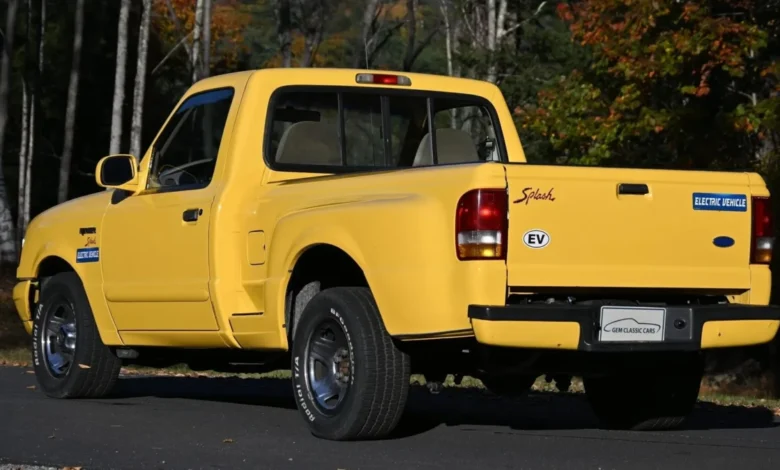
The automotive landscape of the late 1990s was defined by experimental propulsion technology, largely driven by mandates like the California Air Resources Board (CARB) Zero Emission Vehicle program. While manufacturers like General Motors were experimenting with the purpose-built EV1, a secondary market of enthusiasts and aftermarket firms began exploring the viability of converting internal combustion engine (ICE) vehicles into electric platforms. A prime example of this era has surfaced on the auction platform Bring a Trailer: a 1997 Ford Ranger Splash, converted to electric power by Electric Vehicles of America (EVA).
Historical Context and the Rise of DIY Electric Conversions
During the mid-to-late 1990s, the concept of an electric pickup truck was considered an engineering curiosity rather than a commercial imperative. While the Ford Ranger was a staple of the American workforce, the "Splash" trim level—introduced in 1993—marketed the vehicle toward a lifestyle-oriented consumer base, featuring distinctive flareside beds and monochromatic paint schemes.
The conversion of this specific 1997 model serves as a time capsule for early electric vehicle technology. Before the lithium-ion revolution spearheaded by Tesla and modern battery manufacturers, builders relied on lead-acid battery technology. These conversions were rarely about achieving the performance metrics of modern EVs; instead, they were exercises in proving that electric propulsion could replicate the functionality of a utility vehicle. The use of the original five-speed manual transmission in this Ranger is a hallmark of this period, as it allowed converters to utilize existing driveline components without the need for sophisticated, expensive electronic power management systems.
Technical Specifications and Performance Metrics
The conversion, performed by Electric Vehicles of America, replaced the truck’s factory 3.0-liter Vulcan V6 engine with an Advanced D.C. Motors FB1-4001A electric motor. This motor, controlled by a Curtis controller, produces an estimated output of 18 to 30 horsepower. While this figure represents a significant reduction from the original V6’s 140 horsepower, the conversion relies on the high, instant-on torque characteristics typical of DC electric motors to maintain driveability.
Energy storage is managed through a bank of 20 Trojan six-volt lead-acid batteries wired in series to create a 120-volt system. The distribution of these batteries is a testament to the logistical challenges of early conversion work: the cells are spread between a custom box located between the vehicle’s frame rails, a housing within the pickup bed, and a compartment beneath the hood.
According to documentation provided by the seller, the vehicle does not utilize a clutch system despite the retention of the manual transmission. Operators are advised to start the vehicle in a lower gear and transition through the gears as speed increases, effectively using the transmission as a range-extender for the motor’s efficiency band. Charging is handled by an onboard charger located under the hood, requiring a standard household 120-volt outlet. The estimated range—highly dependent on the age and health of the lead-acid cells—is projected between 38 and 81 miles, with an average real-world expectation of approximately 53 miles.
Chronology of the Build and Maintenance Profile
The vehicle’s current state reflects a period of automotive experimentation that predates the modern EV infrastructure. The interior retains the original factory aesthetic, complete with analog instrumentation. In lieu of a fuel gauge, the driver monitors battery health via three auxiliary gauges: battery voltage, amperage, and a state-of-charge indicator. Because the removal of the ICE eliminated the engine coolant system, a 1,500-watt electric heater has been installed to provide cabin warmth, a common necessity for early electric conversions in temperate climates.
The truck shows expected wear consistent with its age, including minor body imperfections and a damaged headliner. However, the simplicity of the electrical architecture makes it a candidate for continued maintenance and potential upgrades. Unlike modern EVs, which often require proprietary diagnostic software and dealership-level access to service, this Ranger’s architecture is entirely mechanical and analog. The presence of original instruction manuals and conversion documentation further suggests that the vehicle was designed for an owner with basic mechanical aptitude.
Implications for the Modern EV Enthusiast Market
The presence of this vehicle at auction highlights a growing divide in the automotive hobbyist community. On one side are the modern, high-performance, integrated electric vehicles like the Rivian R1T or the Tesla Cybertruck. On the other are "legacy" conversions that offer a tactile, albeit primitive, experience.
Industry analysts often point to the limitations of lead-acid battery technology as the primary barrier to the long-term viability of 1990s-era conversions. Lead-acid batteries suffer from significant weight-to-energy density disadvantages compared to modern lithium-ion chemistries, and they are prone to degradation if not maintained with specific discharge cycles. Furthermore, the lack of regenerative braking and fast-charging capabilities means that this Ranger is effectively tethered to a "neighborhood electric vehicle" profile.
However, the cultural significance of the "Ford Ranger" brand name, coupled with the rising interest in retro-modding, creates a unique market niche. While the current high bid of $300 at the time of initial assessment underscores the experimental nature of the vehicle, the eventual sale price will reflect the value collectors place on the preservation of early automotive history.
Comparative Analysis: Legacy vs. Modern Utility
When compared to the aforementioned "Slate" trucks or other contemporary boutique electric utility concepts, the 1997 Ranger represents a "from-the-ground-up" approach to customization that is becoming increasingly rare. Most modern electric utility vehicles are designed with integrated chassis and software-defined architectures. The Ranger, by contrast, is a study in modularity.
The implications for buyers are clear: this vehicle is not a daily driver for the average commuter. It is an artifact of the pre-internet, pre-lithium era of electric mobility. Its value is derived from its educational utility and its status as an eccentric piece of American automotive heritage. For the collector, the vehicle offers a manageable entry point into the mechanics of electric propulsion, provided they are prepared to manage the inherent constraints of mid-90s battery technology.
Industry Outlook
As the automotive industry continues to pivot toward full electrification, the existence of such vehicles serves as a reminder that the transition to electric mobility has been a decades-long pursuit. The efforts of converters like Electric Vehicles of America provided the initial groundwork for the technology that is now being mass-produced by global manufacturers.
The sale of this Ranger provides a window into the evolution of the electric truck. While it lacks the power, range, and convenience of modern alternatives, it possesses a structural and mechanical simplicity that is highly prized by those who value the "do-it-yourself" spirit. Whether this truck is destined to be a restoration project for a vintage enthusiast or a test bed for a new battery chemistries, it remains a testament to the ingenuity of the era. The auction serves not only as a transaction but as a broader acknowledgment of the diverse paths taken to achieve the electrification of the American pickup truck.
In summary, the 1997 Ford Ranger Splash EV conversion is an outlier in the current automotive market. It is a vehicle that requires a nuanced understanding of its limitations, yet it offers a unique experience that cannot be replicated by any modern factory-produced electric vehicle. As the auction concludes, the ultimate fate of this truck will likely be decided by a buyer who values its history, its simplicity, and its role as a precursor to the modern EV movement.
Related posts: