Networks Scramble To Report On Reasons Behind “Extraordinary” Nationwide Ground Stop Of All U.S. Flights

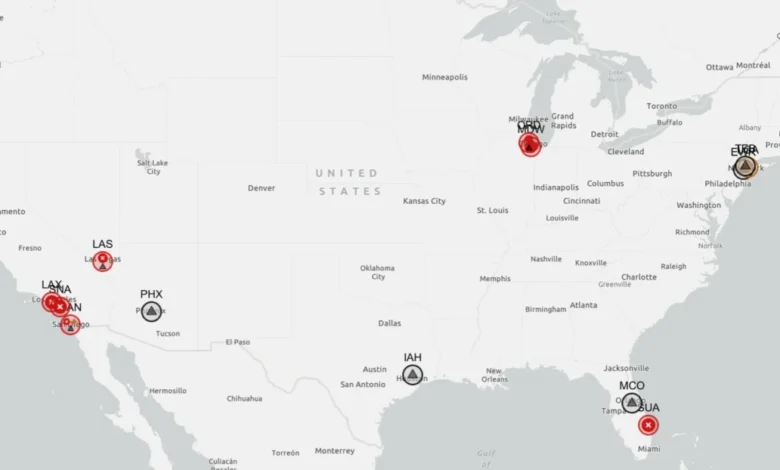
The Federal Aviation Administration (FAA) issued a sudden and unprecedented nationwide ground stop that halted all departing flights across the United States, sending shockwaves through the national transportation network and forcing major newsrooms to immediately pivot their broadcasting schedules. The directive, characterized by federal officials as an emergency measure prompted by "extraordinary circumstances" and vital "reasons of safety," paralyzed airports from coast to coast and triggered immediate concern among passengers, airlines, and federal oversight committees.
As terminals filled with bewildered travelers and monitors flashed delayed and canceled status updates, transportation authorities worked frantically to diagnose the root cause of the system failure. The sweeping nature of the restriction highlighted the fragile interdependence of modern civil aviation infrastructure, where a localized technical glitch can rapidly snowball into a nationwide crisis affecting millions of people.
The Immediate Response and Communications Blackout
Shortly after the FAA’s emergency directive went into effect, Transportation Secretary Sean Duffy addressed the unfolding situation during an impromptu briefing, confirming that the ground stop was necessitated by a critical communication failure. According to Duffy, the technical anomaly directly impacted all Air Route Traffic Control Centers (ARTCCs) across the country, effectively blinding air traffic controllers to critical radar and flight data handoffs necessary for safe en-route navigation.
"FAA technicians are actively investigating the issue to restore full operational capability," Duffy stated, emphasizing that safety remains the absolute priority of the department.
The scope of the order was absolute for departures: all flights scheduled to leave U.S. airfields were grounded "until further notice." Meanwhile, inbound international flights already airborne were handled on a rigorous, highly restricted case-by-case basis, with controllers redirecting long-haul aircraft to alternative oceanic corridors or holding patterns outside of U.S. airspace until secure communication channels could be verified.
Media Scramble and Breaking News Coverage
Major television networks and digital news organizations immediately scrambled to report on the developing crisis, breaking away from scheduled daytime programming to air special reports. Newsrooms across the country mobilized aviation analysts, former transportation officials, and congressional reporters to make sense of the sparse initial updates coming from federal regulators.

Fox News was among the first major networks to report on the escalating ground stop, quickly followed by CNN, MS NOW, and the major broadcast networks. On-air anchors struggled to provide definitive answers as reporters sought statements from the Department of Transportation, airline representatives, and homeland security officials.
Appearing live on CNN, aviation correspondent and analyst Richard Quest did not mince words regarding the operational fallout of the grounding. "This is going to be chaos for hours to come," Quest warned viewers, pointing out that even if the underlying technical issue were resolved quickly, the cascading ripple effects on crew scheduling, aircraft positioning, and airport gate availability would plague the aviation system well into the following days.
Chronology of an Unfolding Crisis
While the precise timeline of the technical failure remains under rigorous federal review, the sequence of events on Friday morning unfolded with alarming rapidity:
- Early Morning: Air Route Traffic Control Centers begin experiencing intermittent data drops and communication anomalies, though operations initially continue under manual and degraded modes.
- Mid-Morning: As the communication failure spreads and impacts multiple regional centers simultaneously, safety protocols dictate that continued operations pose an unacceptable risk.
- The FAA Directive: The Federal Aviation Administration formally orders an immediate nationwide ground stop for all departing domestic flights, classifying the move under "extraordinary circumstances."
- International Adjustments: Inbound international flights are subjected to immediate case-by-case management, with regional controllers coordinating closely with foreign flag carriers to secure safe holding patterns or diversions.
- Cabinet-Level Briefings: Transportation Secretary Sean Duffy steps forward to publicly confirm the communication failure across ARTCCs and announces that technical teams are deployed to resolve the glitch.
- Media Interruption: Cable news networks and broadcast stations break into regular programming to deliver live updates, while major airlines begin issuing broad travel waivers for stranded passengers.
Supporting Data and the Vulnerability of U.S. Airspace
To understand the immense gravity of a nationwide ground stop, one must look at the sheer volume of daily air traffic managed by the Federal Aviation Administration. On an average day, the U.S. National Airspace System (NAS) handles roughly 45,000 flights and 2.9 million airline passengers across more than 5,000 public-use airports.
Air Route Traffic Control Centers—the 20 facility hubs responsible for guiding planes at high altitudes between airport terminal areas—form the backbone of this massive operation. When a communication failure compromises these centers, the invisible digital highways that separate aircraft vertically and horizontally begin to break down. Without continuous, reliable data feeds linking radar systems, flight plans, and controller consoles, the risk of mid-air conflicts rises exponentially, forcing regulatory bodies to choose between total gridlock and catastrophic risk.
Industry analysts note that while ground stops affecting specific hubs or regional sectors are relatively common due to severe weather or localized technical outages, a total nationwide halt of all departures is an extremely rare occurrence. Past incidents of this magnitude are usually limited to major historical security events or isolated, severe software corruptions within core FAA notification systems.
Official Reactions and Political Ramifications
The sudden disruption immediately drew sharp scrutiny from lawmakers on Capitol Hill, many of whom have spent years warning about the aging technological infrastructure underpinning the American aviation network. Committees in both the House and Senate announced plans to summon transportation officials for formal briefings and hearings to determine how a nationwide communication failure could occur.

"The American traveling public deserves a resilient, modern aviation system that does not grind to a halt because of systemic communication failures," said a congressional aide close to the House Transportation Committee. Lawmakers are expected to press the FAA on the redundancy of its backup systems, the aging nature of its software architecture, and the timeline for ongoing modernization projects funded by recent federal infrastructure packages.
Meanwhile, major U.S. carriers—including Delta Air Lines, United Airlines, American Airlines, and Southwest—scrambled to manage customer service centers that were instantly flooded with millions of calls and app inquiries. Airlines issued immediate travel waivers, allowing passengers to rebook flights without penalty once the ground order is lifted, though industry groups warned that the backlog of stranded travelers would strain airline resources for days.
Broader Economic and Logistical Implications
The implications of a nationwide aviation shutdown extend far beyond frustrated vacationers and delayed business travelers. Modern supply chains rely heavily on the commercial belly cargo space of passenger airlines and dedicated air freight carriers to move high-priority medical supplies, e-commerce packages, and perishable goods across the country in a matter of hours.
Economists note that even a few hours of total airspace closure can result in hundreds of millions of dollars in economic losses, factoring in lost productivity, airline revenue deficits, hotel and meal accommodations for stranded passengers, and disrupted supply chain logistics. Furthermore, the psychological impact on public confidence in air travel safety cannot be understated.
As FAA technicians and engineers work around the clock to isolate the communication glitch, the ultimate challenge will not only be getting planes back into the air safely, but also restoring public trust in the technological safeguards that manage the world’s busiest airspace. Federal regulators have pledged a transparent investigation into the root cause of the failure once normal operations are fully restored.