Solar-Powered Desalination Breakthrough Eliminates Toxic Brine While Harvesting Critical Battery Minerals

Around the globe, billions of people still lack reliable access to safe drinking water, a mounting humanitarian and environmental crisis driven by climate change, population growth, and industrial expansion. According to United Nations estimates, approximately 2.2 billion people currently live without safely managed drinking water. In response, arid and semi-arid regions stretching from the agricultural valleys of California to the hyper-arid expanses of the Middle East increasingly rely on coastal and inland desalination plants to convert saline ocean water or brackish groundwater into fresh, potable water.
While conventional desalination provides a critical and sometimes life-saving water supply for millions of municipal and industrial users, today’s most dominant technological methods come with severe and well-documented environmental drawbacks. Reverse osmosis, the current industry standard, forces pressurized seawater through specialized polymeric membranes to filter out dissolved salts. Meanwhile, thermal distillation systems use large amounts of thermal energy to evaporate and re-condense fresh water from seawater. Both conventional approaches consume vast quantities of electricity, frequently require intensive chemical pre-treatment and post-treatment protocols, and generate a high-volume, highly concentrated salty waste product commonly referred to as liquid brine.
When this toxic brine is discharged back into coastal marine environments, it typically sinks to the seafloor due to its high density, rapidly increasing local salinity and severely depleting dissolved oxygen levels. This localized chemical shock creates hypoxic or anoxic conditions that can devastate benthic ecosystems, destroying seagrass meadows, coral reefs, and local fish populations. Furthermore, the massive energy footprint of traditional desalination facilities means the sector remains heavily dependent on fossil fuels, directly exacerbating the very climate anomalies that drive chronic water shortages.
The Global Water Scarcity Crisis and the Limits of Conventional Desalination
To understand the urgency of alternative desalination technologies, one must examine the staggering scale of global water stress. The World Resources Institute reports that roughly one-quarter of the global population currently faces extremely high water stress annually, consuming up to 80% of their available renewable water supply. As traditional surface water reservoirs shrink and deep aquifers are overdrawn, municipalities have turned to the oceans as an inexhaustible reservoir.
However, scaling traditional reverse osmosis comes with staggering financial and ecological costs. Capital costs for mega-desalination plants run into the billions of dollars, and the continuous energy required to run high-pressure pumps accounts for up to half of an operating plant’s total budget. In regions reliant on fossil-powered grids, this creates an unsustainable loop. Additionally, the pre-treatment chemicals used to prevent biological fouling on reverse osmosis membranes—such as chlorine and coagulants—frequently find their way back into the marine biosphere, compounding the environmental degradation caused by brine discharge.
Amidst these compounding ecological and economic pressures, researchers worldwide have intensified the search for decentralized, zero-liquid-discharge (ZLD) technologies. The goal has been to harness renewable energy sources—primarily solar power—to drive phase-change evaporation without the heavy infrastructural requirements of industrial mega-plants. Yet, previous solar thermal systems have consistently foundered when confronted with the complex chemical composition of natural seawater.
A Novel Solar Thermal Approach Developed at the University of Rochester
Addressing these systemic limitations, a team of researchers at the University of Rochester has developed a radically different solar thermal desalination system capable of producing high-purity fresh water efficiently, operating completely free of liquid brine, and bypassing the need for chemical water pre-treatment. The breakthrough method and its underlying physics are detailed in a research paper published in the academic journal Light: Science & Applications.
The research initiative was spearheaded by Chunlei Guo, a prominent professor of optics and physics and a senior scientist at URochester’s Laboratory for Laser Energetics (LLE). Guo and his team set out to engineer a system that could overcome the two historic hurdles of solar desalination: low evaporation efficiency and the inevitable, catastrophic clogging caused by salt and mineral crystallization on evaporating surfaces.
The Technological Core: Ultrafast Femtosecond Laser-Treated Black Metal
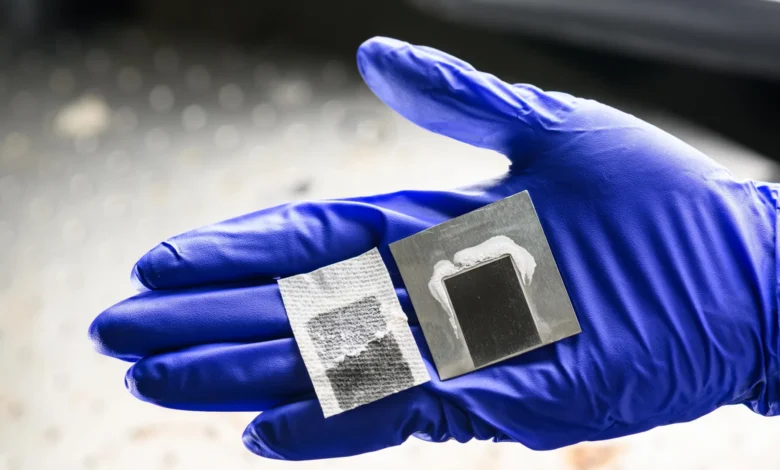
At the technological heart of the URochester system are specialized solar panels fashioned from ordinary metal sheets treated with femtosecond lasers. A femtosecond is an extraordinarily brief unit of time, equal to one quadrillionth of a second ($10^-15$ seconds). When focused ultrafast laser pulses are unleashed upon a metallic substrate, they induce precise, nanoscale topographical alterations that fundamentally transform how the material interacts with both light and liquid water.
The laser-texturing process creates a dense array of microscopic structures across the metal surface, turning the material pitch black. This nanostructured black metal exhibits near-perfect solar absorbance, capturing virtually all incoming solar radiation across the visible and infrared spectrums without reflective loss. Simultaneously, the laser treatment imparts extreme superwicking properties to the metal surface. Rather than forming discrete beads—as water naturally does on untreated metallic surfaces—liquid water spreads instantaneously and uniformly across the micro-grooves, forming an infinitesimally thin film that maximizes the surface-area-to-volume ratio for rapid thermal evaporation.
The Mechanics of Self-Cleaning and the Coffee Ring Effect
Operating the device involves a deliberate architectural design that prevents mineral accumulation on the primary active evaporation zones. Each solar panel features a designated laser-treated active region that continuously draws a microscopic layer of raw seawater across its face via capillary action. As the pitch-black metal absorbs solar energy, it rapidly heats the thin water layer, driving vapor phase change while leaving dissolved salts and minerals behind.
In conventional solar evaporators, these left-behind minerals rapidly nucleate and grow directly over the heated zone, forming a dense, encrusting crust that chokes off liquid supply and brings the system to a halt. To circumvent this, Guo’s team engineered a clever fluid-transport mechanism leveraging the well-documented "coffee ring effect."
The coffee ring effect is a familiar physical phenomenon observed whenever a spilled droplet of coffee dries: as liquid evaporates faster from the droplet’s outer perimeter, outward capillary flow drags suspended solute particles toward the edge, leaving a dark, concentrated ring behind. By meticulously designing the microscopic surface grooves on the black metal panels, the researchers harnessed this exact hydrodynamic principle. Instead of allowing salts to precipitate over the active solar-heating zone, the micro-fluidic channels systematically direct dissolved minerals outward toward untreated, cooler peripheral areas known as passive regions.
In rigorous laboratory testing utilizing authentic seawater samples collected directly from the Pacific, Atlantic, and Indian Oceans, the panels successfully executed continuous self-cleaning cycles. The active evaporation zone remained entirely free of scale, while migrating salts were safely sequestered in the passive peripheral zones for dry collection. Crucially, this continuous salt migration occurred without causing any measurable degradation in the panel’s overall evaporation and freshwater generation efficiency.
Confronting the Complex Mineralogy of Real Seawater
A primary reason why prior solar thermal concepts failed outside the laboratory lies in the vast disparity between artificial and natural saltwater solutions. In earlier academic experiments, researchers frequently relied on simplified, binary saline solutions composed of pure water and sodium chloride ($textNaCl$).
When simple sodium chloride crystallizes out of an evaporating aqueous solution, it typically forms a loose, highly porous crystalline matrix. Water can continue to percolate through the microscopic interstitial spaces of porous sodium chloride structures, partially re-dissolving accumulated salt crystals and rendering the surface relatively simple to clean.
Natural seawater, however, is a chemically complex multi-component brine. Beyond sodium chloride, it contains high concentrations of dissolved magnesium, calcium, sulfates, carbonates, and trace metals. When heated, these secondary ions do not form porous matrices; rather, they precipitate into hard, dense, highly adhesive mineral scales. This complex scaling behavior is chemically analogous to the stubborn limescale buildup that gradually chokes residential showerheads or water heaters. However, in a marine desalination context, the challenge is magnified exponentially because seawater contains hundreds of times more dissolved mineral content than municipal tap water.
By utilizing the coffee ring effect and precision-machined surface topographies, Guo’s team successfully prevented these dense, stubborn mineral scales from establishing a foothold on the active solar-evaporation zone, overcoming a technical barrier that has stymied membrane-free thermal desalination research for decades.
Transforming Desalination Waste Into Strategic Mineral Resources
One of the most profound paradigm shifts introduced by the URochester technology lies in its complete elimination of liquid brine waste. Traditional plants discharge concentrated brine back into the sea; the URochester system extracts nearly 100 percent of dissolved salts in a solid, dry crystalline form.
This solid residue fundamentally alters the economics and environmental footprint of desalination, transforming what was previously a hazardous waste stream into a valuable mineral repository. While a portion of the harvested solid residue can be refined into commercial-grade salt, the remaining mineral fraction contains highly valuable trace elements that are increasingly critical to modern clean-energy supply chains.
Chief among these targeted elements is lithium, an irreplaceable component in the lithium-ion batteries that power electric vehicles, utility-scale renewable energy storage arrays, portable electronics, and critical defense infrastructure. Traditional lithium mining—whether extracted from brine flats in South America via massive evaporation ponds or quarried from hard-rock pegmatite deposits in Australia—is notoriously water-intensive, chemically toxic, and carbon-heavy.
In a companion study published in the Journal of Materials Chemistry A, Guo and his research collaborators demonstrated that the superwicking solar desalination panels can be chemically augmented to selectively isolate and extract lithium directly from raw saltwater mixtures.
By embedding specialized hydrogen titanate nanoparticles directly into the microscopic grooves of the laser-treated black metal, the researchers engineered a surface capable of selectively trapping lithium ions while allowing other sodium and magnesium salts to pass through or deposit separately. Testing this functionalized surface on brine samples sourced from the Great Salt Lake, the research team successfully recovered approximately 50 percent of the total lithium content trapped within the mineral residue.
Implications, Scalability, and Future Outlook
The broader implications of this dual-purpose technology are profound. If successfully scaled from current proof-of-concept prototypes to industrial-sized arrays, the system offers a synchronized solution to two of the twenty-first century’s most intractable challenges: acute freshwater scarcity and the tightening supply bottlenecks of critical battery minerals.
"Mining lithium from the earth has proven to be very taxing from an energy and environmental standpoint, so pulling lithium directly from saltwater could be a very important future route," noted Professor Chunlei Guo. By extracting critical materials at the point of freshwater production, coastal nations could simultaneously secure municipal water supplies and domestic mineral supply chains without opening new, ecologically destructive mines.
While the technology remains in an early developmental stage—having been demonstrated primarily through benchtop prototypes—the underlying physical mechanics are inherently modular and scalable. Future development phases will likely focus on engineering larger array assemblies, optimizing long-term durability under harsh marine weathering conditions, and partnering with industrial stakeholders to pilot commercial installations in water-stressed coastal communities.
The research was made possible through financial and logistical support from key scientific and philanthropic bodies, including the National Science Foundation, the Bill & Melinda Gates Foundation, and the Worldwide Universities Network. Alongside Professor Guo, the interdisciplinary research team from URochester’s Institute of Optics included Senior Scientist Subash Singh, recent PhD alumnus Ran Wei (’24), doctoral candidates Luheng Tang and Tainshu Xu, and researcher Mingjiang Ma.
As climate pressures continue to strain global hydrological cycles and demand for green technology minerals surges, innovations like laser-textured, self-cleaning solar evaporators point the way toward a more sustainable, closed-loop industrial future—one where the oceans can quench human thirst while simultaneously fueling the clean energy transition.