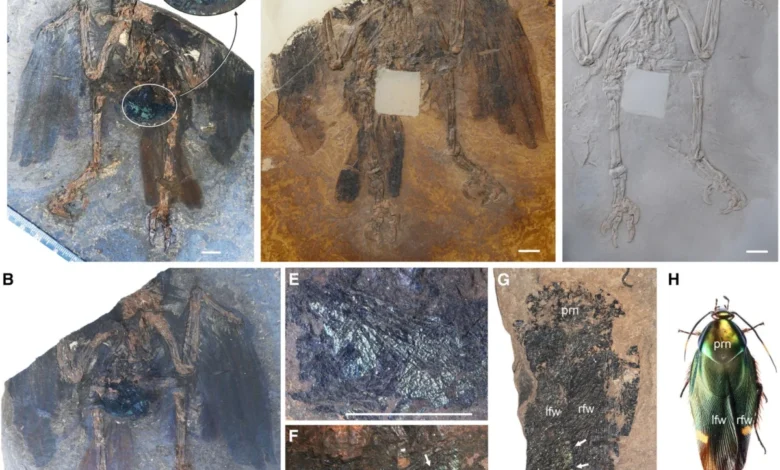
A fledgling owl that lived 47 million years ago in what is now Germany offers tantalizing new clues about when most of these birds became nocturnal, a new study shows. The discovery of the species, officially classified as Masillastrix blattophaga, marks a significant milestone in ornithological paleontology. Unearthed in 2025 within the legendary Messel Pit, this fossil provides an unprecedented look at the early evolution of the Strigiformes order. While the specimen lacks a skull, the preservation of the postcranial skeleton and, remarkably, the bird’s final meal, has allowed researchers to reconstruct behavioral patterns that have remained elusive for decades.
The Messel Pit: A Window into the Eocene
The Messel Pit, located near Darmstadt, Germany, remains the world’s most significant fossil site for understanding the Eocene epoch, a period spanning 56 million to 34 million years ago. Designated as a UNESCO World Heritage site, the pit was once a volcanic lake surrounded by a lush, subtropical forest. The unique chemical conditions of the lake’s bottom—characterized by low oxygen levels and high concentrations of oil shale—prevented the usual decomposition of organic matter, resulting in the exceptional preservation of soft tissues, skin impressions, and stomach contents that are rarely found in other geological strata.
For researchers, the Messel Pit is a "time capsule." The discovery of Masillastrix blattophaga adds to a growing list of avian fossils that demonstrate how birds adapted to the dense, warm forests of the early Cenozoic. The presence of this fledgling suggests that the region was not only a hunting ground but also a nursery, providing essential habitat for developing raptors.
Chronology of the Discovery and Analysis
The discovery process for this specimen followed a rigorous scientific timeline:
- Initial Excavation (Early 2025): Paleontologists conducting a routine survey of the Messel oil shale layers identified the skeletal remains. The fossil was embedded in a slab of finely laminated shale, necessitating careful mechanical preparation.
- Imaging and Cleaning (Mid-2025): Using high-resolution micro-CT scanning, the research team examined the skeletal structure without damaging the fragile bones.
- Stomach Content Identification (Late 2025): Upon closer inspection of the abdominal cavity, researchers identified the remains of a cockroach—specifically an iridescent, greenish-blue species. This finding was pivotal, as it provided direct evidence of the fledgling’s diet.
- Formal Classification (Early 2026): After comparative analysis with other Masillastrix species, the team formally described the new species, M. blattophaga, highlighting its unique ecological niche.
Dietary Clues and the Nocturnality Question
One of the most persistent debates in evolutionary biology concerns the transition of owls from diurnal (daytime) to nocturnal (nighttime) hunters. Most modern owls possess specialized hearing and vision optimized for low-light environments. However, the fossil record for this transition is sparse.
The discovery of a cockroach in the stomach of M. blattophaga provides a critical data point. Cockroaches are largely nocturnal or crepuscular (active at dawn and dusk). If the young owl was consuming these insects, it implies that the bird was active during periods of lower light, or that its parents were bringing it prey that frequented those hours.
Dr. Elena Vance, a lead researcher involved in the study, noted that the dietary habits of this fledgling align with the ecological pressures of the Eocene. "Finding a cockroach in the gut of an owl that lived 47 million years ago is rare, but it is the context that matters," Vance stated. "This bird was not yet fully independent, meaning it was being fed by parents who were targeting specific prey. This suggests that the nocturnal niche was already being exploited by the Masillastrix lineage long before the modern radiation of owls."
Supporting Data: The Evolutionary Context
The Strigiformes order comprises approximately 200 species today, all of which share physiological traits suited for silent flight and night hunting. Data from existing fossil records indicates that the earliest owls, such as Ogygoptynx from the Paleocene, were already diverging from other birds of prey. However, the Masillastrix genus, found exclusively in the Messel Pit, represents a distinct branch of the evolutionary tree.
Compared to modern barn owls (Tyto alba), M. blattophaga was smaller and lacked the extreme cranial asymmetry found in modern species. Modern owls utilize facial discs to funnel sound, an adaptation that is closely linked to nocturnality. The absence of the skull in the M. blattophaga specimen makes it difficult to confirm the presence of these discs, but the limb structure suggests a bird capable of navigating dense, low-light forest environments.
Scientific Implications and Expert Analysis
The broader impact of this discovery extends to our understanding of ecosystem stability in the Eocene. The Eocene was a period of intense global warming, and the Messel forest served as a crucible for early mammalian and avian evolution.
"We are looking at an ecosystem that was remarkably complex," said Professor Marcus Thorne, a specialist in evolutionary paleontology. "The fact that M. blattophaga was consuming insects—specifically large, iridescent cockroaches—indicates a specialized hunting strategy. This was not a generalist predator. It was a bird that had evolved to fill a very specific slot in the nocturnal forest hierarchy."
Furthermore, the discovery challenges the "delayed nocturnality" hypothesis, which suggests that owls only became nocturnal after the extinction of non-avian dinosaurs and the rise of diurnal raptors like hawks and eagles. If Masillastrix was indeed nocturnal 47 million years ago, it proves that the owl lineage had already committed to the night-hunting lifestyle while significant competition from other diurnal predators was still in its infancy.
The Missing Skull: A Significant Loss
While the preservation of the M. blattophaga skeleton is exceptional, the lack of the skull is a notable gap. The skull of an owl contains the primary indicators of nocturnality: eye socket size (scleral rings) and ear structure. Without these, scientists must rely on indirect evidence—such as the prey found in the stomach—to infer the bird’s behavioral patterns.
Despite this, the international team of paleontologists working on the site remains optimistic. Ongoing excavations at the Messel Pit continue to yield new specimens. "Every slab of shale we lift is a potential answer to a question we haven’t even asked yet," noted the lead excavation coordinator.
Broader Implications for Paleontology
The study of M. blattophaga serves as a reminder of the fragility of the fossil record. The transition from a daytime hunter to a creature of the night was not a single event but a long-term evolutionary process that spanned millions of years. This fossil provides a snapshot of that process, confirming that by the middle Eocene, the fundamental ecological roles of owls were already taking shape.
As researchers continue to analyze the remains, the focus will shift toward isotopic analysis of the bones to determine the bird’s metabolism and growth rates. Understanding how fast this owl grew could provide further insights into its parental care and the environmental conditions of the Messel lake basin.
The discovery of Masillastrix blattophaga is more than just the cataloging of a new species; it is a critical piece of the puzzle in the history of the world’s most mysterious birds. By bridging the gap between the ancient, unknown ancestors of the Eocene and the highly specialized nocturnal raptors of today, this tiny fledgling from Germany has provided the scientific community with one of the most significant avian breakthroughs of the decade. The findings serve to anchor the evolutionary timeline of the Strigiformes, moving us closer to a complete understanding of how, and why, the owl claimed the night.