Mathematical Breakthrough Sheds New Light on the Century-Old Four-Color Theorem and Graph Theory


Some mathematical problems continue to haunt researchers long after they have been officially declared closed. A proof emerges, garners celebration, and yet a quiet dissatisfaction lingers within the academic community. Perhaps the argument is too convoluted—leaving mathematicians on a perpetual hunt for an elusive, elegant one-page paper—or perhaps it simply fails to provide deeper theoretical insights into why a fundamental truth holds. Whatever the underlying reason, mathematicians return again and again to problems that have otherwise been sealed in textbooks. One of the most famous and persistent cases of this intellectual obsession is the four-color theorem, a foundational concept that fundamentally transformed how modern mathematicians conceptualize spatial relations, maps, and networks.
The core premise of the theorem is disarmingly simple, easily understood by children and scholars alike: given any contiguous map divided into regions, is it possible to color each distinct region using no more than four colors such that no two neighboring regions share the same color? When this question was first posed in the mid-19th century, it was of little practical interest to professional cartographers, who routinely utilized a wide array of contrasting pigments and saw no commercial or logical reason to restrict their color palettes. However, to both amateur puzzle enthusiasts and professional mathematicians, the spatial brain teaser quickly evolved into a consuming obsession.
A Historical Chronology of False Starts and Controversy
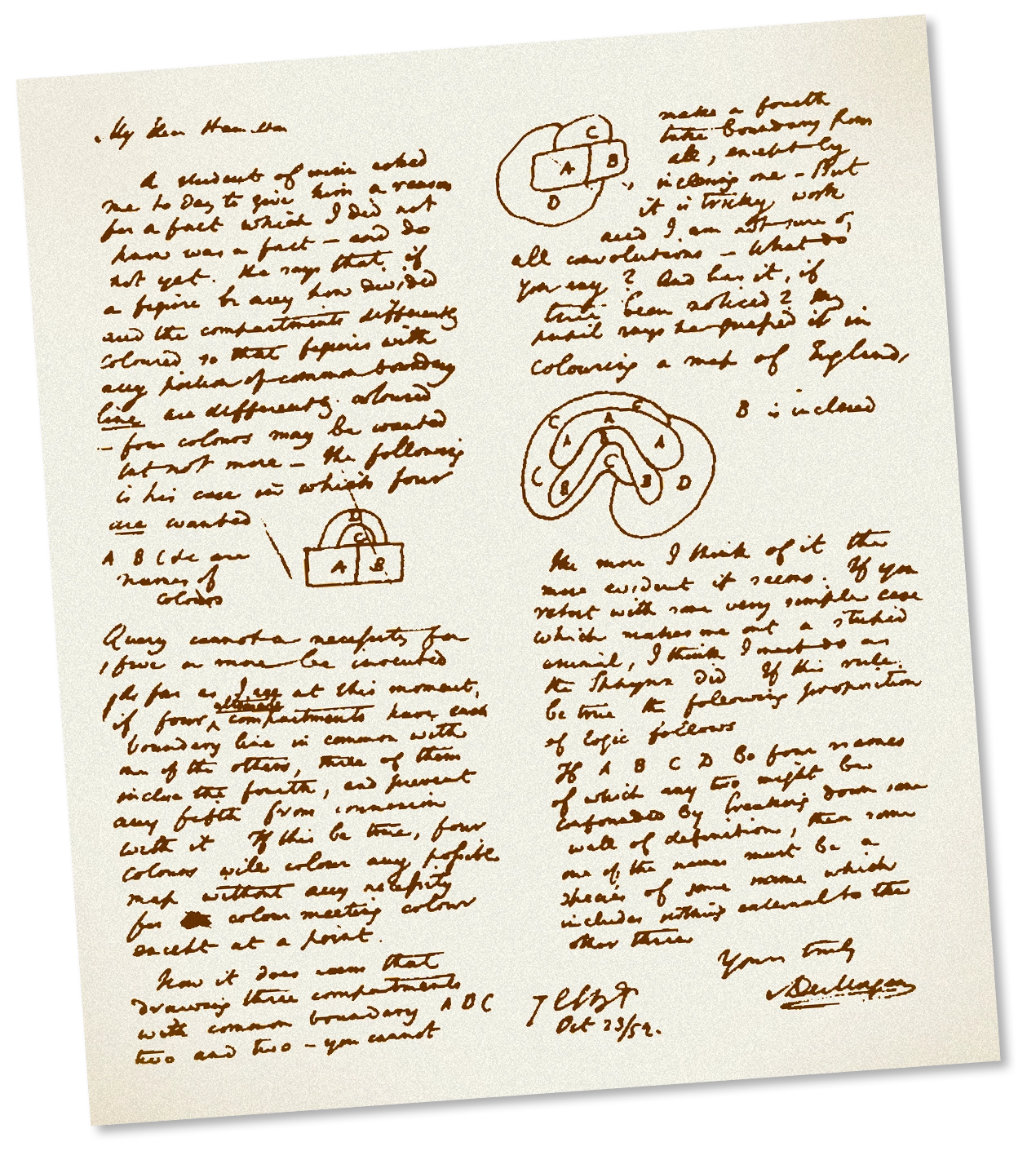
The journey toward resolving the four-color problem is paved with historic missteps, false proofs, and philosophical debates about the nature of mathematical certainty. The narrative began in October 1852, when mapmaker and mathematics student Francis Guthrie was coloring a map of the counties of England and noticed that only four distinct colors were necessary to prevent any adjacent counties from sharing a hue. Puzzled as to whether this rule applied universally to all conceivable maps, he inquired with his brother Frederick, who subsequently brought the query to his professor, the renowned British mathematician Augustus De Morgan.

De Morgan actively publicized the problem across the British mathematical community, turning it into a widespread academic curiosity. For decades, many attempted to solve it without success. Then, in 1879, a major milestone was announced: mathematician Alfred Bray Kempe published a proof that was celebrated in the pages of Nature as a definitive triumph.
Kempe’s approach was brilliantly strategic. He employed a proof by contradiction, assuming the existence of a hypothetical "minimal" map that stubbornly required five colors. By stripping away extraneous geographical details and converting the map into a planar graph—where countries become vertices and shared borders become connecting edges—he sought to demonstrate that such a map was a logical impossibility. Leveraging a property discovered in the 18th century by Swiss mathematician Leonhard Euler, which guarantees that every planar graph contains at least one vertex with five or fewer neighbors, Kempe attempted to define an "unavoidable set" of configurations. He argued that any one of these configurations could be removed and successfully recolored through a systematic color-swapping procedure, today known as a "Kempe chain."
For eleven years, Kempe’s proof stood as gospel. Then, in 1890, mathematician Percy John Heawood discovered a subtle yet fatal flaw in the color-swapping procedure for vertices with five neighbors. Under specific, complex conditions, Kempe’s method could cause identical colors to collide, rendering the reduction invalid. Although the proof collapsed, Kempe’s conceptual framework—specifically the Kempe chain—remained foundational to all subsequent attempts.
The Computer-Assisted Revolution of 1976
As decades passed, numerous professionals, including doctors, lawyers, and distinguished graph theorists, tried and failed to salvage the theorem by hand. It eventually became apparent that proving the theorem required evaluating an immense number of distinct configurations—far beyond the computational limits of human manual calculation. A correct proof would ultimately demand identifying and verifying a massive set of 8,900 separate reducible configurations.

The deadlock was finally broken in 1976 by mathematicians Kenneth Appel and Wolfgang Haken. Utilizing state-of-the-art supercomputers at the University of Illinois, they cleverly reduced the necessary configurations first to 1,936, and finally to 1,482 distinct cases. For thousands of hours, the university’s computers—relying on core memory technology woven from magnetic wires—checked every single configuration to confirm its reducibility.
The announcement that the four-color theorem had been settled sparked intense controversy across the global mathematical community. The reliance on heavy computation shocked traditionalists who viewed mathematics as a domain of pure human reason and rigorous logical deduction. Skeptics openly questioned the reliability of the computer-assisted proof, raising concerns about potential hardware glitches, electrical surges, or untraceable software errors that could silently invalidate the entire mathematical structure.
Despite initial resistance, the academic community gradually accepted the validity of the result. In 1997, a separate team of researchers further streamlined the computer-assisted approach, reducing the number of configurations down to 633 and cementing the consensus that four colors are indeed universally sufficient for planar maps. Yet, despite this closure, a deep-seated philosophical hunger remained for a more efficient, theoretically transparent, and human-comprehensible understanding of the phenomenon.
A New Breakthrough on a Danish Beach
The next major chapter in this enduring mathematical saga began in 2015 on the picturesque white sands of Nyborg, Denmark. Ken-ichi Kawarabayashi, a graph theorist at Japan’s National Institute of Informatics, was attending a conference alongside his long-time collaborator, Mikkel Thorup, a computer scientist at the University of Copenhagen. Having recently completed a major collaborative project, the pair sought their next grand challenge.

Reflecting on their academic roots, both researchers acknowledged how deeply the four-color theorem had influenced their career trajectories. However, they remained deeply dissatisfied with an algorithmic shortcoming of the 1997 computer proof: while it provided a definitive recipe for coloring any planar graph with four colors, that recipe was remarkably inefficient. For a graph consisting of $n$ vertices, the traditional coloring procedure required an exorbitant $n^2$ steps. This inefficiency stemmed from the sequential nature of the algorithm—researchers had to search a graph for one specific configuration, remove it, search for the next, remove it, and repeat the process iteratively until the entire structure was reduced.
To overcome this bottleneck, Kawarabayashi and Thorup—soon joined by prominent graph theorists Carsten Thomassen of the Technical University of Denmark and Bojan Mohar of Simon Fraser University—embarked on a quest to identify an unavoidable set of configurations that could be reduced simultaneously, or in parallel, rather than one by one. Achieving this required absolute mathematical guarantees that reducing one configuration would not inadvertently interfere with the colorings of neighboring configurations undergoing reduction at the same time.
Unchartered Territory in Flat Graph Regions
To locate these non-interfering configurations, the research team shifted their analytical focus away from traditional areas of interest. While historical proofs concentrated heavily on regions featuring clusters of vertices with sparse connections, Kawarabayashi, Mohar, Thomassen, and Thorup directed their attention toward the "flat areas" of the graph—regions where every vertex connects to six others in a dense, triangular web.
These flat areas had long been treated as graphical no-man’s-land. Because they lacked the structural anomalies typically leveraged to prove configuration reducibility, they were systematically ignored by previous generations of mathematicians. Yet, the team recognized that flat regions are exponentially more common across planar graphs. To execute parallel reductions successfully, they needed a vast reservoir of options, making these overlooked territories essential.
With the assistance of Kawarabayashi’s graduate students, Yuta Inoue and Atsuyuki Miyashita, the team launched an intensive, months-long computational campaign. The sheer scale of the undertaking pushed their computational resources to the limit. Ultimately, their perseverance paid off: they successfully mapped and verified a massive, unprecedented unavoidable set comprising 8,202 distinct configurations.
Implications and Broader Impact on Graph Theory
The new proof, formally posted to scientific archives and slated for presentation at the Foundations of Computer Science conference, represents far more than an alternative verification of a 150-year-old theorem. While the proof itself is exceptionally complex—prompting computer scientist Georges Gonthier of Inria in Paris to remark that the authors "used electricity liberally" to carry out the work—its structural byproduct is revolutionary.
By pioneering a novel approach to parallel reducibility and unlocking the hidden properties of flat graph regions, the researchers have delivered a dramatically more efficient coloring algorithm. For any arbitrary graph containing $n$ vertices, the new method executes the coloring process in just $n(log n)$ steps, representing a massive exponential performance leap over previous $n^2$ methods.
Beyond mere algorithmic speed, the broader implications of this research extend deep into theoretical computer science and advanced mathematics. Graph theorists study complex networks existing across various topological surfaces, such as doughnut-shaped tori. The structural machinery developed during this latest re-examination of the four-color theorem provides researchers with fresh analytical tools to tackle stubborn, unresolved coloring problems across these higher-order surfaces.

Yet, despite these profound theoretical leaps, the psychological allure of the problem persists. Carsten Thomassen, reflecting on the enduring legacy of the field, admits that the ultimate mathematical white whale remains uncaptured. While contemporary methods continue to refine algorithms and expand our structural comprehension of planar networks, the ultimate desire shared by generations of mathematicians remains unchanged: the pursuit of a purely human, elegant, one-page proof that explains once and for all why four colors are universally sufficient, without requiring the hum of a single supercomputer. Until that mythical proof is found, the four-color theorem will continue to inspire, challenge, and captivate the mathematical imagination.