The Battle Over AI Infrastructure: Communities Nationwide Push Back Against Data Center Expansion Amid Environmental and Energy Concerns

The rapid, unyielding ascent of artificial intelligence has sparked a quiet yet fierce conflict across the United States, transforming peaceful neighborhoods into the frontline of a high-stakes infrastructure war. While technology companies and utility providers pitch massive AI data centers as engines of local job creation, municipal tax revenue, and economic revitalization, a growing coalition of citizens is pushing back. Recent data from Gallup reveals that a majority of Americans actively oppose the construction of data centers in their local areas, driven by mounting anxieties over resource depletion, noise pollution, severe strain on electrical grids, and long-term environmental degradation.
This friction is no longer confined to boardrooms or state legislative chambers; it is unfolding on the streets. In cities from coast to coast, residents are mobilizing to demand moratoria, stringent zoning laws, and legislative pauses on a digital land grab that threatens to fundamentally alter their communities.
The Long Shadow of Industrialization in Grays Ferry
For community organizers like Shawmar Pitts, the debate over technological expansion is deeply personal and rooted in a grim history. As a lifelong resident of the Grays Ferry neighborhood in Southwest Philadelphia, Pitts grew up intimately familiar with the collateral damage of American heavy industry. His backyard was dominated by the Philadelphia Energy Solutions (PES) oil refinery, once the largest petroleum processing facility on the East Coast, which routinely handled up to 335,000 barrels of crude oil daily.
For decades, residents of Grays Ferry lived under a cloud of industrial emissions, quietly bearing the burden of chronic health conditions. However, the systemic nature of these illnesses did not click for Pitts until 2018, when he encountered representatives from Philly Thrive, a local environmental justice organization, tabling in his neighborhood to oppose a proposed refinery expansion.

"I read the information they had on the table about how living near the refinery affects you, and I’m looking at all the sicknesses on this paper, and I’m like, ‘My mother has this, my sister has that, my next-door neighbor suffers from this’ — every house, someone has something on that list," Pitts recalled. "From that point, I was all the way in."
The stakes of this environmental burden were violently underscored in June 2019, when a catastrophic series of explosions ripped through the PES refinery, sending towering fireballs into the sky and raining metallic debris across the surrounding area. While the disaster mercifully resulted in no fatalities, it triggered the permanent closure of the facility, offering a bittersweet reprieve to a traumatized community.
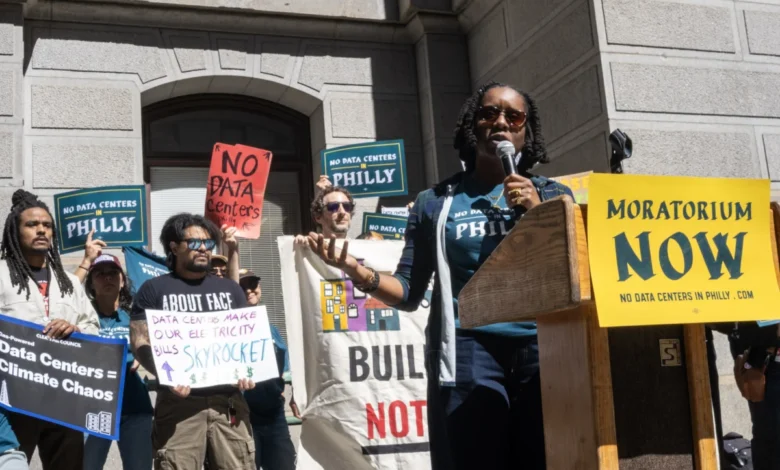
Tragedy, however, had already left its indelible mark. Sonya Sanders, the board president of Philly Thrive and a fellow Grays Ferry native, lost her husband to a rare bone cancer in 2020. A lifelong non-smoker and non-drinker, Sanders remains convinced that decades of toxic exposure from the neighboring refinery stole his life. At a high-profile municipal rally outside Philadelphia’s City Hall, Sanders delivered a scathing indictment of corporate indifference. "In my eyes, they killed him," she told the assembled crowd. "The pollution killed him. I believe he would be here today if he wasn’t silently murdered, because it was the pursuit of profit that killed him."
From Crude Oil to Server Racks: Philadelphia’s New Threat
Today, Pitts serves as the managing co-director of Philly Thrive, channeling his foundational grassroots experience into a new campaign: stopping the encroachment of AI data centers. Although Philadelphia has not yet received formal construction proposals, city planning documents have identified two potential locations for massive server farms—one in Northeast Philadelphia and another directly inside Pitts’ neighborhood of Grays Ferry.
This prospect has galvanized local opposition. On a brisk Monday morning, more than 100 residents and environmental advocates gathered at City Hall for the launch of the "No Data Centers in Philly" campaign. Chanting slogans and waving placards, demonstrators aimed their message directly at City Council offices, demanding a preemptive moratorium on digital infrastructure development.

"We don’t want data centers," Sanders declared to the crowd. "We don’t want the pollution, we don’t want the noise, and we know they’re not going to bring us more jobs."
Local residents like Donna Greenberg share these apprehensions, expressing deep-seated fears regarding the invisible footprint of the digital economy. "I’m worried about pollution," Greenberg noted. "I’m worried about surveillance and the fact that they’re going to have access to information they have no business knowing, and I’m concerned that they’re going to be using water and electricity that takes away from the people and the neighborhoods who need it."
The National Landscape: A Wave of Municipal and State Pushback
Philadelphia is far from an isolated case. Across the United States, communities burdened by historical industrial pollution or strained municipal resources are pushing back with unprecedented speed. The national resistance is fueled by the staggering resource demands of generative AI models, which require continuous, intensive computing power, resulting in massive heat generation and insatiable electricity consumption.
According to a stark projection published by BloombergNEF, U.S. data centers are on track to consume more natural gas by 2035 than the combined totals of Germany and Japan. This estimate nearly doubles the research firm’s projections from just nine months prior, illustrating how rapidly the artificial intelligence boom is outpacing energy forecasts.
While natural gas burns cleaner than petroleum products, it remains a potent driver of climate change and localized air pollution. Combustion of a single cubic foot of natural gas releases approximately 60 grams of carbon dioxide equivalent. Industry analysts estimate that surging data center demand will generate an additional one million metric tons of greenhouse gas emissions daily—representing roughly 12% of total contemporary U.S. greenhouse gas output. These emissions carry severe public health costs; a landmark 2021 study by researchers at Harvard University found that fossil fuel-related air pollution is responsible for one in every five deaths globally, a grim statistic poised to worsen as data centers proliferate.

Furthermore, the immediate operational reality of these facilities poses direct local hazards. Annie Fox, an attorney with the Clean Air Council, highlighted the hidden dangers during the Philadelphia rally. "A typical data center planned in Pennsylvania has hundreds of diesel engines that spew air pollution, and even if they’re supposedly reserved for emergencies, the government has already said that the data center should use those rather than drawing from an overstressed electrical grid during some heat waves," Fox warned. "We can expect that to get more frequent… Fossil fuel-hungry data centers will worsen climate change, making those heatwaves more frequent and severe."
Legislative Moratoria Gain Traction Nationwide
The relentless advocacy of grassroots organizations and concerned citizens is beginning to alter the political calculus for elected officials. Recognizing the potential strain on local resources, several states and municipalities have enacted sweeping legislative pauses.
In July 2026, New York Governor Kathy Hochul signed a high-profile executive order temporarily halting the state’s approval of new permits for large-scale data center projects. "Progress shouldn’t arrive with a higher utility bill, deleted water supply, or noise pollution," Governor Hochul stated during a press conference announcing the move. "These data centers can only be built, should only be built in places that want them."
Similar protective measures have cascaded through local governments nationwide. Municipalities including Denver, Indianapolis, Asheville, Charlotte, and Reno have successfully approved formal data center moratoriums or zoning freezes. In most cases, these policy interventions are designed to buy city planners time to conduct comprehensive studies on power grid capacity, water usage, acoustic impacts, and zoning compatibility before welcoming tech conglomerates into their jurisdictions.
Implications and the Path Forward

The escalating conflict between the technology sector and local communities underscores a fundamental tension in the modern economy: the physical infrastructure required to power the digital future often imposes immediate, tangible costs on vulnerable populations who reap few, if any, of the financial rewards.
Tech companies and corporate developers frequently pitch data centers as economic boosters, promising high-tech employment and robust tax bases. However, skepticism remains deeply entrenched among residents who point out that modern server facilities, once constructed, require remarkably few permanent on-site workers while continuously drawing heavily on local water reserves and municipal power grids.
For organizers like Shawmar Pitts and Sonya Sanders, the fight against data centers is an extension of decades-long battles for bodily autonomy, clean air, and environmental justice. By demanding transparency, rigorous environmental reviews, and legislative moratoria, these communities are signaling that the rapid expansion of artificial intelligence cannot come at the expense of human health and environmental sustainability.
"I just think that our community standing up and fighting back is tremendous," Pitts reflected, surveying the crowd outside City Hall. "It takes a lot of effort and a lot of people." As the race for AI dominance accelerates, the outcome of these local skirmishes will likely define the regulatory boundaries of the technology industry for decades to come, forcing a national reckoning over who bears the true cost of digital innovation.