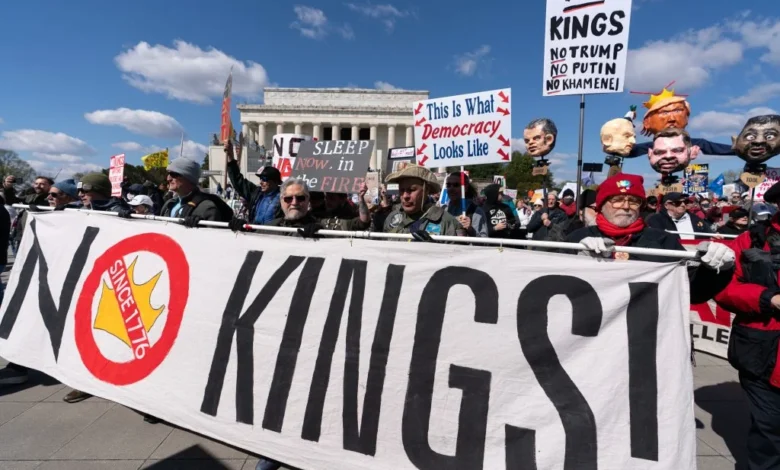
A recent commentary by Washington Examiner columnist Joe Concha has ignited a debate surrounding the authenticity and financial backing of the nationwide "No Kings" protests, suggesting that the demonstrations, which saw celebrity participation, were far from spontaneous. Concha’s observations, delivered during an appearance on Fox News’s Fox & Friends First, highlighted a pervasive sense of contrivance, aligning with a Fox News Digital investigation that revealed a vast network of organizations with significant financial resources reportedly orchestrating the events. Simultaneously, the discussion pivoted to the nascent stages of the 2028 Republican presidential primary, where an early straw poll from the Conservative Political Action Conference (CPAC) indicated a strong preference for candidates aligned with the "MAGA" movement, potentially narrowing the field for future aspirants.
The "No Kings" Protests: Unpacking Claims of Astroturfing and External Funding
The "No Kings" protests, a series of demonstrations that reportedly unfolded nationwide on a recent Saturday, have become a focal point of discussion regarding the nature of modern activism. While ostensibly grassroots movements are characterized by spontaneous public participation driven by shared conviction, the "No Kings" events have faced intense scrutiny, particularly concerning their origins and financial underpinnings.
The Fox News Digital Investigation and the $3 Billion Network
Central to the controversy is a Fox News Digital investigation, which reported that approximately 500 groups, collectively boasting an estimated annual revenue of $3 billion, were allegedly behind the coordinated "No Kings" protests. This revelation has fueled arguments that the demonstrations were not "organic" but rather meticulously organized and heavily funded. The sheer scale of the alleged financial backing and the extensive network of organizations involved raise fundamental questions about the definition of grassroots activism in contemporary political discourse.
Such large-scale coordination and funding are not unprecedented in the realm of political activism. Historically, various advocacy groups, non-profits, and political action committees (PACs) have funded and organized demonstrations to advance specific agendas. Examples range from labor union rallies in the early 20th century to environmental protests and civil rights marches, many of which benefited from significant organizational and financial support. However, the term "astroturfing" is often applied when externally funded and coordinated campaigns are presented as spontaneous, bottom-up movements, creating a misleading impression of widespread public support. The implication of the Fox News report is that the "No Kings" protests might fall into this category, generating an artificial appearance of popular uprising.
Expert Commentary: Joe Concha’s "Contrived" Narrative
Joe Concha, a columnist for the Washington Examiner, articulated his skepticism regarding the protests’ authenticity, describing them as "contrived." His analysis stemmed from observations of celebrity participants, notably actress and activist Jane Fonda and actor Robert De Niro, at various protest locations. Concha specifically cited Fonda’s appearance at a protest in St. Paul, Minnesota, where he noted she appeared to be "reading a script." Similar observations were made about De Niro, who reportedly stumbled over his remarks, reinforcing Concha’s belief that the speeches were pre-written and not spontaneous expressions "from the heart."
Concha emphasized the striking contrast between the perceived lack of spontaneity from these high-profile figures and the expectation of genuine, unscripted passion in grassroots movements. "I thought this was organic, just speak from the heart," Concha remarked, drawing attention to the discrepancy. He further underscored the magnitude of the alleged financial backing, reiterating the "Todd, Carley" reference to the $3 billion figure. "That doesn’t exactly seem grassroots or organic," he concluded, linking the substantial funding directly to the perceived artificiality of the events.
Allegations of Paid Participants and Manufactured Messaging
Further evidence cited by Concha to support the "contrived" narrative included videos purportedly showing individuals at the protests admitting they were paid to march. These individuals were reportedly seen carrying signs that were "made for them," suggesting a top-down organization rather than a spontaneous assembly of concerned citizens creating their own messages. This practice, if confirmed, points to a sophisticated operation designed to maximize visual impact and amplify a predetermined message, potentially for social media dissemination.
The implication is that the "No Kings" protests were meticulously engineered as a "made-for-social-media event." In an age dominated by digital communication, the visual spectacle of protests, including large crowds and unified messaging, can significantly influence public perception and media narratives. If participants are compensated and signage is pre-fabricated, it raises ethical questions about the transparency of such demonstrations and their true reflection of public sentiment. The effectiveness of such tactics in shaping public opinion and political discourse is a subject of ongoing academic and journalistic scrutiny.
Historical Context of Funded Activism and Its Implications
The practice of funding political movements and protests has a long and complex history. From philanthropic foundations supporting social reforms to corporate interests backing lobbying efforts, external funding is a ubiquitous element of political action. However, the critical distinction often lies in transparency and the perceived "organic" nature of the movement. When funding is covert or when a movement is presented as a spontaneous public outcry despite significant external orchestration, it can erode public trust in activism and democratic processes.
The allegations surrounding the "No Kings" protests highlight a broader challenge in modern political communication: distinguishing genuine grassroots movements from those strategically manufactured for political effect. This blurring of lines can lead to increased cynicism among the public, making it harder to discern authentic expressions of dissent or support from well-resourced campaigns. The implications extend to media reporting, which must navigate these complexities to accurately represent the nature and motivations behind public demonstrations.
Democratic Party Dynamics and the "No Kings" Irony
Concha’s critique of the "No Kings" protests extended beyond their alleged artificiality, delving into what he perceived as an inherent irony regarding the Democratic Party. The slogan "No Kings," implying a rejection of authoritarian rule or unelected power, struck Concha as incongruous with recent Democratic Party actions and historical precedents.
Concha’s Critique: DNC’s Role in Nominations
Concha specifically questioned how individuals could chant "No Kings" while, in his view, the Democratic Party had effectively "installed" former Vice President Kamala Harris as its presidential nominee in July 2024. While the article’s timeline is slightly ahead of current events (as of late 2023/early 2024, the 2024 Democratic nomination process is still unfolding, with President Biden as the incumbent), Concha’s statement reflects a perception of a pre-determined outcome within the party’s nomination process. This sentiment often arises when a dominant figure or party establishment appears to clear the field for a preferred candidate, limiting genuine primary contests.
This critique draws parallels to the 2016 Democratic primary, where Concha recalled the WikiLeaks revelations. These leaks, according to Concha, showed that the Democratic National Committee (DNC) did "everything" to install former Secretary of State Hillary Clinton over Senator Bernie Sanders (I-VT). The 2016 DNC email leak indeed revealed instances where DNC officials appeared to favor Clinton over Sanders, leading to significant controversy and accusations of bias within the party’s primary process. These revelations fueled a narrative among Sanders’s supporters and critics of the party establishment that the DNC was not an impartial arbiter but an active participant in shaping the nomination outcome.
Broader Debate on Party Influence vs. Voter Choice
The "No Kings" slogan, in this context, becomes a potent symbol for those who feel that political parties, particularly their leadership, exert undue influence over candidate selection, effectively bypassing the democratic will of primary voters. The debate between party establishment influence and grassroots voter choice is a perennial one in American politics. Proponents of strong party structures argue that parties need to coalesce around viable candidates to win general elections and govern effectively. Critics, however, contend that such centralization stifles internal democracy, disenfranchises voters, and leads to a less representative political landscape.
Concha’s commentary taps into a broader current of anti-establishment sentiment that exists across the political spectrum. Whether it’s the "No Kings" protests or critiques of party nomination processes, the underlying theme is a rejection of perceived hierarchical control and a call for greater transparency and genuine popular representation. The irony he highlights serves to challenge the credibility of movements that claim to be anti-establishment while allegedly being aligned with or benefiting from the very systems they purport to oppose.
Navigating the 2028 Republican Presidential Landscape: The "MAGA Approval" Imperative
Shifting focus to the future of the Republican Party, Concha also weighed in on the early dynamics of the 2028 presidential primary race, drawing insights from the Conservative Political Action Conference’s (CPAC) annual straw poll. These early indicators, while not definitive, offer a glimpse into the preferences of a significant segment of the conservative base.
CPAC Straw Poll Results: Vance and Rubio Lead
The CPAC annual straw poll, a tradition at the influential conservative gathering, found Vice President JD Vance as the top choice for the GOP’s next presidential nominee in 2028, garnering 53% of respondents’ support. Following Vance was Secretary of State Marco Rubio, who secured 35% of the vote. These results suggest a strong preference for candidates perceived to be aligned with or acceptable to the populist, America First wing of the Republican Party, often associated with former President Donald Trump.
Understanding CPAC and its Straw Polls
CPAC is one of the largest and most influential annual gatherings of conservatives in the United States. Its straw poll, conducted among attendees, serves as an early barometer of conservative sentiment. While these polls are not predictive of future primary outcomes – given the long lead time and the self-selected nature of CPAC attendees – they do reflect the mood and preferences of a highly engaged and ideologically committed segment of the Republican base. Historically, CPAC straw polls have sometimes identified rising stars, while at other times they have favored figures who ultimately did not secure the nomination. For instance, Ron Paul famously won multiple CPAC straw polls but never became the nominee. However, the poll’s significance lies in its ability to signal which candidates resonate with the party’s activist core.
The "MAGA Approval" Imperative: Concha’s Analysis
Concha interpreted the CPAC poll results as a stark message for any Republican not named Vance or Rubio: "Don’t bother running for president next time around." He posited that any candidate who attempts to run without the explicit or implicit "approval by MAGA" or without having served in the Trump administration "will lose." This analysis underscores the enduring and perhaps intensifying influence of Donald Trump and the "Make America Great Again" (MAGA) movement within the Republican Party.
The "MAGA approval" imperative suggests a litmus test for future GOP presidential candidates. It implies that to be a viable contender, a candidate must demonstrate loyalty to Trump’s agenda, policies, and base. This could manifest in various ways: echoing Trump’s rhetoric, adopting his populist nationalist platform, or receiving his direct endorsement. This dynamic presents a significant challenge for Republicans who might seek to chart a different course or appeal to a broader, more traditional conservative base. The internal struggle within the GOP between its traditional conservative wing and its populist MAGA wing continues to define its political landscape.
Potential Contenders: Ted Cruz and Rand Paul
The article also touched upon other potential 2028 contenders, notably Senator Ted Cruz (R-TX) and Senator Rand Paul (R-KY). Both senators previously ran for the Republican nomination in 2016, ultimately losing to Donald Trump.
Senator Ted Cruz has consistently sidestepped questions about a potential 2028 presidential bid. When asked, he emphasized his current focus on "continuing to deliver major victories" in the Senate. This mirrors his response to a November report on a potential 2028 run, where he similarly deflected. Cruz’s cautious approach might be strategic, allowing him to maintain relevance and build his political capital without committing too early to a race that is still years away and heavily influenced by the 2024 election cycle. His past presidential run, while unsuccessful, established him as a prominent figure within the conservative movement.
Senator Rand Paul, on the other hand, indicated a more open stance, stating he is "50-50" about running for president again. This comment came in response to a Washington Examiner headline that suggested he sounded like he was running for president. Paul, known for his libertarian-leaning conservative views, has a distinct base of support. His hesitation reflects the significant commitment and resources required for a presidential campaign, as well as the need to assess the political climate closer to the actual primary season. Both Cruz and Paul, as established senators, possess national profiles and fundraising capabilities, but they would still face the challenge of securing the "MAGA approval" that Concha deems crucial.
Implications for the Future of the Republican Party
The early CPAC poll results and Concha’s analysis carry significant implications for the Republican Party’s future. The continued dominance of "MAGA-approved" candidates suggests that the party’s direction will remain firmly rooted in the populist nationalist ideology championed by Donald Trump. This could lead to a more homogenous field of candidates in 2028, potentially marginalizing those who do not align with this faction.
For candidates like Cruz and Paul, who have their own established brands and policy platforms, the challenge will be to either adapt to the MAGA imperative or find a way to carve out a distinct path that can still garner sufficient support within the primary electorate. The overarching question for the GOP is whether this intense focus on "MAGA approval" will ultimately broaden its appeal to a wider electorate or limit its capacity to attract independent and moderate voters in general elections. The 2028 race, even in its nascent stages, promises to be a crucial indicator of the Republican Party’s long-term trajectory and its ability to reconcile internal ideological divisions.
Intersecting Narratives of Political Power and Influence
The discussions surrounding the "No Kings" protests and the 2028 Republican primary, while distinct, converge on a central theme: the dynamics of political power and influence in contemporary American politics. The "No Kings" controversy highlights concerns about the authenticity of public movements and the role of money in shaping political narratives, potentially creating an illusion of widespread popular support. This raises important questions about transparency, the integrity of grassroots activism, and the public’s ability to discern genuine expressions of popular will from strategically engineered campaigns.
Concurrently, the analysis of the GOP’s future presidential nominations underscores the evolving power structures within political parties. The "MAGA approval" imperative reflects a shift in internal party dynamics, where a powerful faction or figure can significantly influence candidate selection, potentially limiting democratic choice within the primary process. This mirrors Concha’s critique of the Democratic Party’s past nomination processes, suggesting a broader concern about the balance between party establishment control and voter sovereignty.
Together, these narratives paint a complex picture of a political landscape grappling with questions of authenticity, funding, and the true representation of public sentiment. As the nation moves closer to future election cycles, the scrutiny over the origins of political movements and the internal workings of political parties will undoubtedly intensify, shaping both public discourse and electoral outcomes.