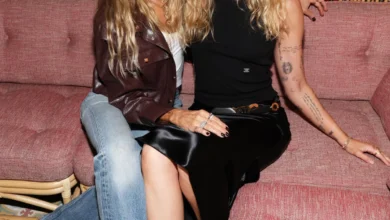
Scout Willis Celebrates Birthday with Empowering Topless Photoshoot, Family Offers Heartfelt Tributes


Scout Willis, the eldest daughter of Hollywood icons Bruce Willis and Demi Moore, marked her 35th birthday with a striking display of self-expression, sharing a series of artistic topless photographs on her Instagram account. The images, captured outdoors, depict Willis perched on a stone ledge, her gaze directed thoughtfully into the distance. Adorned with a delicate pink flower held to her lips, and accessorized with rings and hoop earrings, she presented a portrait of natural beauty and quiet contemplation. Her long, brunette hair, styled in loose waves, cascaded down her back, emphasizing the serene and confident atmosphere of the photoshoot. A minimalist approach to makeup, featuring mascara and meticulously shaped brows, further highlighted her tanned skin and natural radiance.
The birthday post, shared on Monday, July 20th, was accompanied by a simple yet profound caption: "It’s my Birthday and I Love you." The heartfelt sentiment resonated deeply with her followers, who flooded the comments section with an outpouring of admiration and celebratory messages. Terms like "Goddess" and "literal goddess" were frequently used, with one commenter expressing awe, "WOW hello my jaw dropped." Another follower described the imagery as "the most divine photo ever taken," underscoring the artistic and impactful nature of Willis’s birthday tribute.

This personal celebration was echoed by her mother, Demi Moore, who also took to social media to honor her daughter’s special day. Moore shared a touching video montage, featuring a moment where she serenades Scout with a rendition of "Happy Birthday." The clip captures an intimate exchange between mother and daughter, culminating in a warm embrace and a kiss on Scout’s head, showcasing their strong familial bond.
A Legacy of Artistry and Resilience
The public acknowledgment of Scout Willis’s birthday, both by herself and her prominent mother, brings renewed attention to the blended family cultivated by Bruce Willis and Demi Moore. The couple, who were married from 1987 to 2000, have maintained an exceptionally close and supportive relationship despite their divorce, a testament to their dedication to co-parenting their three daughters: Rumer, 37; Scout, 35; and Tallulah, 32. This enduring friendship and shared commitment to their children have often been cited as a model for amicable post-divorce relationships within Hollywood.
Scout Willis, born on July 20, 1988, has carved her own path, exploring her artistic inclinations through music and fashion. Her decision to share such personal and empowering imagery on her birthday can be viewed through the lens of contemporary discussions around body positivity and self-acceptance. In an era where social media platforms serve as potent vehicles for personal expression, Willis’s topless photos can be interpreted as a declaration of agency and a celebration of her own physicality and evolving identity. This act of vulnerability and confidence aligns with a broader cultural movement encouraging individuals to embrace their bodies and express themselves freely, unburdened by societal expectations.

Mother’s Affectionate Tribute
Demi Moore’s accompanying birthday message for Scout was particularly poignant. "Honey, I… Honey, I am so grateful for you," Moore captioned her Instagram reel, her words radiating maternal love. "Getting to love you and watch you grow into the spectacular woman you are is one of life’s greatest gifts. You make everything brighter, lighter, and so much more beautiful just by existing. Happy Birthday, my sweet Scout LaRue. I love you endlessly." This heartfelt declaration underscores the profound connection between Moore and her second-born daughter, highlighting the pride and joy she derives from witnessing Scout’s personal and professional development. The use of the nickname "Scout LaRue" further emphasizes the intimacy of their relationship.
Moore, herself a celebrated actress and style icon, has consistently shown support for her daughters’ endeavors. Her own recent public appearances, such as a stunning display in a white bikini alongside her baby granddaughter Louetta, have also garnered significant attention, showcasing a shared appreciation for embracing life at every stage and celebrating familial milestones with grace and style.
Family Ties and Enduring Support
The blended family of Bruce Willis and Demi Moore has often been in the public eye, navigating the complexities of fame while prioritizing familial harmony. Rumer Willis, the eldest of the three sisters, has also established a career in acting and has been vocal about her experiences growing up in a prominent household. Tallulah Willis, the youngest, has openly discussed her journey with mental health and addiction, finding strength and support within her family.

The enduring respect and affection between Bruce Willis and Demi Moore, despite their divorce, has been a consistent theme. They have successfully navigated the challenges of coparenting, ensuring their daughters felt loved and supported through every phase of their lives. This strong foundation has undoubtedly contributed to the independent spirits and artistic pursuits of Rumer, Scout, and Tallulah.
The significance of Scout’s birthday celebration extends beyond a personal milestone. It reflects a broader narrative of self-empowerment and the celebration of individuality. In sharing her topless images, Scout Willis is not merely posing for photographs; she is making a statement about her autonomy and her comfort in her own skin. This resonates with a generation increasingly focused on authenticity and challenging traditional norms surrounding beauty and self-presentation.
A Look Back at the Willis-Moore Union
Bruce Willis and Demi Moore first met in 1987 and married later that year, becoming one of Hollywood’s most prominent power couples. Their union produced three daughters, and their shared life in the spotlight was closely followed by the public. While they separated in 1998, their divorce was not finalized until 2000. Despite the dissolution of their marriage, they demonstrated a remarkable ability to remain friends and dedicated coparents, a feat often lauded in celebrity circles. This commitment to their children’s well-being undoubtedly played a crucial role in shaping the confident and well-adjusted individuals their daughters have become. The ongoing support and love demonstrated by both parents, and indeed the entire extended family, continues to be a source of inspiration and admiration for many. Scout’s birthday celebration, with its blend of personal empowerment and familial warmth, serves as a powerful reminder of these enduring bonds.