An international consortium of astronomers, co-led by a researcher at the Institute for Advanced Study (IAS), has uncovered what appears to be a universal physical law regulating one of the most violent and energetic phenomena in the universe: the launching of powerful relativistic jets by black holes. The landmark study demonstrates that diverse black holes—ranging from stellar-mass objects roughly ten times the mass of our sun to supermassive behemoths millions or billions of times heavier—initiate these massive outflows at the exact same critical stage of their feeding cycle.
Published in the journal Nature Astronomy, the research bridges a long-standing divide in astrophysics between the behavior of small, localized stellar-mass black holes and their distant, supermassive counterparts. The collaboration was spearheaded by Andrew Mummery, a Martin A. and Helen Chooljian Member in the School of Natural Sciences at the IAS, alongside Adelle Goodwin, a Forrest Research Foundation Fellow at Curtin University’s International Centre of Radio Astronomy Research (ICRAR) in Western Australia. By synthesizing extensive multi-wavelength observational data from an array of ground- and space-based telescopes spanning the Americas, Australia, India, and South Africa, the research team has provided unprecedented clarity into how cosmic bodies consume and expel matter.
The Mechanics of Cosmic Destruction: Tidal Disruption Events
To understand how black holes manage their gargantuan diets, astronomers often observe tidal disruption events (TDEs). These cataclysmic episodes occur when an unwary star wanders too close to the event horizon of a supermassive black hole. The intense, non-uniform gravitational gradient—known as tidal forces—stretches, deforms, and ultimately rips the star apart in a matter of hours.
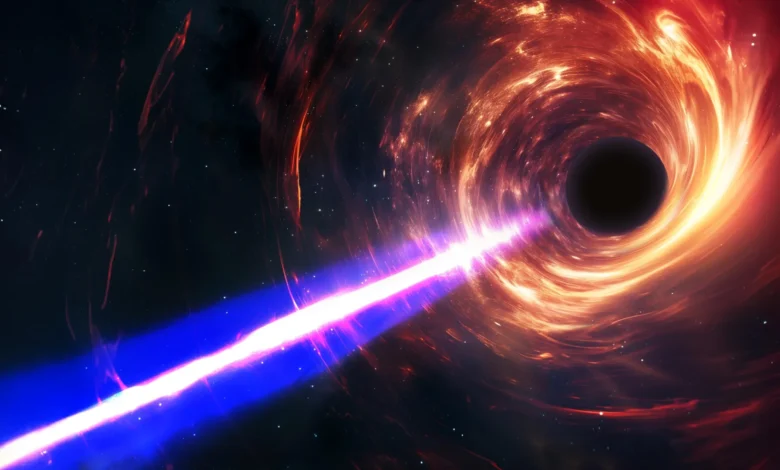
While popular culture frequently depicts black holes as cosmic vacuum cleaners that quietly and efficiently suck in everything within their reach, the reality is far more chaotic and messy. When a star is shredded, the black hole cannot swallow the entire mass instantaneously. Instead, the stellar debris forms a swirling, highly luminous accretion disk around the black hole. A fraction of this stellar material spirals inward to be consumed, while a significant portion is violently blasted back out into interstellar and intergalactic space via high-speed winds and collimated radio jets.
These massive cosmic outflows act as feedback loops, carrying energy and matter across vast distances. They play a critical role in shaping the evolution of host galaxies, regulating star formation, and distributing heavy elements throughout the cosmos. However, predicting when these jets will fire has historically puzzled scientists. While some supermassive black holes erupt into radio brightness almost immediately after consuming a star, others remain stubbornly dormant, only to unexpectedly ignite their jets months or even years later.
Accelerating Cosmic Evolution: Watching the Universe in Fast-Forward
One of the greatest challenges in observational astrophysics has been confirming whether stellar-mass and supermassive black holes adhere to the same fundamental physical laws. Because supermassive black holes operate on immensely grand scales, evolutionary processes around them typically unfold over thousands or millions of years—far too slow for human astronomers to track in real time.
Tidal disruption events provide a clever workaround to this temporal barrier. By inducing a sudden, massive feeding episode around a previously quiescent supermassive black hole, a TDE compresses an evolutionary timeline that would normally take millennia into a window of just a few years. This gives scientists a high-speed viewfinder into complex physical processes that would otherwise remain opaque.
The conceptual breakthrough for the new study materialized in an unconventional setting. During an astrophysics conference in Madrid, Spain, Mummery and Goodwin engaged in a late-night discussion at a local establishment. They began comparing notes on the accretion physics of small black holes within our own Milky Way galaxy against the behavior of distant supermassive giants. They realized that a specific mathematical threshold known to govern jet production in smaller systems might also universally apply to the largest black holes in the universe.
Methodology and Observational Analysis
To rigorously test their hypothesis, the research team assembled a comprehensive dataset of twenty tidal disruption events. They analyzed observations captured across the electromagnetic spectrum, incorporating optical light, ultraviolet emissions, high-energy X-rays, and low-frequency radio waves.
After rigorous data filtering and quality control, the researchers narrowed their sample down to ten pristine, high-fidelity events. For this refined cohort, the team was able to calculate with high precision both the instantaneous mass accretion rate of the black hole—the speed at which it was swallowing matter—and the precise chronological timing of its radio jet outflows.
The resulting analysis laid bare a distinct, dual-phase timeline for black hole jet formation.
The first phase occurs almost immediately following the stellar destruction, characterized by a chaotic, highly luminous period where the black hole consumes material at a frantic, supercritical rate. The second phase, however, occurs much later—often hundreds or thousands of days after the initial tidal disruption.
During this delayed second phase, the feeding rate of the black hole drops significantly until it reaches approximately two percent of its Eddington limit. The Eddington limit represents the theoretical threshold where the outward radiation pressure from the intensely hot accretion disk balances the inward gravitational pull of the black hole.
Significantly, this two-percent threshold was already known by astrophysicists to trigger jet production in stellar-mass black holes residing within our local galactic neighborhood. Discovering that supermassive black holes obey the exact same numerical threshold provides robust empirical evidence that black hole jet physics is scale-invariant, operating identically across masses that differ by factors of millions.
Implications for Observational Astronomy and Future Megaprojects
Beyond advancing theoretical astrophysics, this discovery carries substantial practical benefits for observational astronomers worldwide. Allocating telescope time on premier global facilities is fiercely competitive, and scheduling observations to catch transient radio phenomena is notoriously difficult.
By establishing a reliable predictive framework for when delayed jets will erupt, astronomers can optimize their observation schedules. Instead of continuously monitoring dormant black holes on the off-chance they might become active, researchers can target their resources precisely when a black hole approaches the critical two-percent Eddington threshold. This reduces wasted observation time and maximizes the scientific return on heavily utilized instruments.
This predictive capability will become increasingly vital with the advent of next-generation astronomical facilities. Chief among these is the Square Kilometre Array (SKA) radio telescope project, an international mega-science endeavor spanning Australia and South Africa that is scheduled to begin full scientific operations around 2028. The SKA will map the radio sky with unprecedented sensitivity and speed, generating massive firehoses of data that will require precise target-selection algorithms to fully exploit.
"We hope that our work will pave the way for even more profound discoveries about our universe," Mummery remarked, emphasizing the foundational nature of the findings.
As astronomers prepare for a new era of high-sensitivity sky surveys, the realization that black holes across the universe follow a universal script offers a powerful new tool for decoding the life cycle of galaxies and the extreme physics operating at their centers.